


 News
News Contest
 Forums
 Collectors
 Videos
 E-books
The Titanic, a gimmick?
A legendary ocean liner and symbol of the greatest maritime tragedy of the 20th century, the Titanic is mentioned several times in The Adventures of Tintin. So why – and how – did Hergé seize upon the myth? Find out at tintin.com...
The Titanic is one of the most famous ships in history.
Described as ‘unsinkable’, this luxury liner left Southampton on 10th April 1912 on its maiden voyage to New York. Four days later, during the night of 14th to 15th April, it struck an iceberg in the North Atlantic and sank within a few hours, killing more than 1,500 passengers.
At the time, the tragedy was widely reported, but over time it has become a true legend. So much so that its story still fascinates people today. Even now, scientists, researchers, artists and enthusiasts from all over the world continue to perpetuate the myth in their own way.
And what about Hergé? Well, he also contributed to the cause by slipping three clever references into the adventures of his young hero. It was an original and humorous way to pay tribute to this giant of the seas, lost forever.
Let us now analyse these famous references…
“That's no doubt the figurehead of the Titanic!”
In Red Rackham's Treasure, after several days at sea, Captain Haddock's enthusiasm has clearly waned. It must also be said that the search so far has not yielded the expected results.
And to top it all off, the persistent deafness of his friend Calculus complicates matters. As a result, exasperated by their futile dialogue, Haddock cannot help but play along and make ironic remarks about the figurehead of The Unicorn, which had been found earlier.
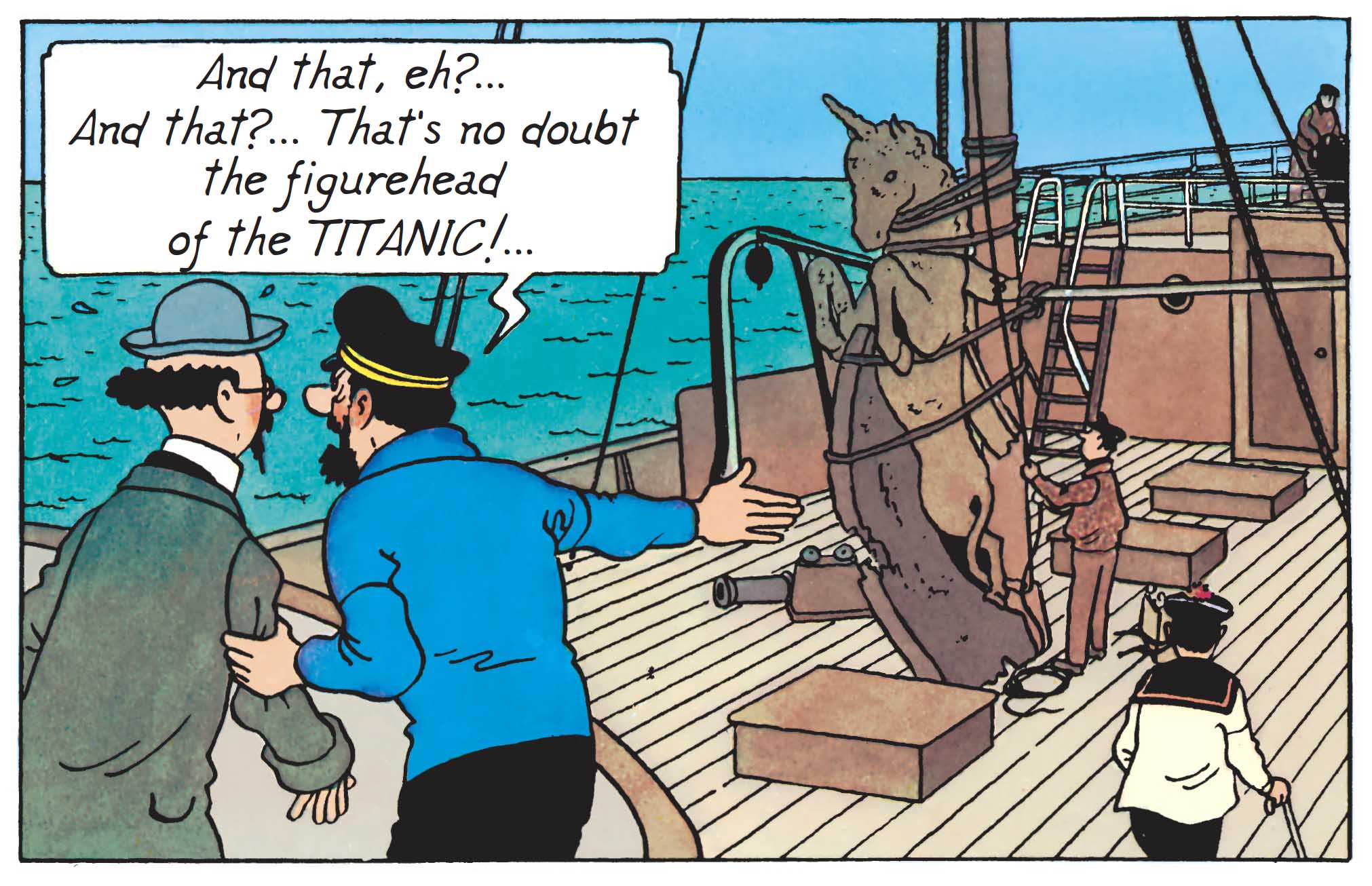
The scene is all the more comical given that the imposing sculpture, securely fastened to the deck of the Sirius, obviously has no connection with the Titanic. This is all the more so given that the liner had no such effigy or exterior decoration. Its evocation here is therefore merely a pretext to further emphasise the ridiculousness of the situation.
“And now we must be careful not to attract attention”
Speaking of ridiculousness, here come two of its most famous artisans – and supporters, too: the famous Thompson and Thomson, of course.
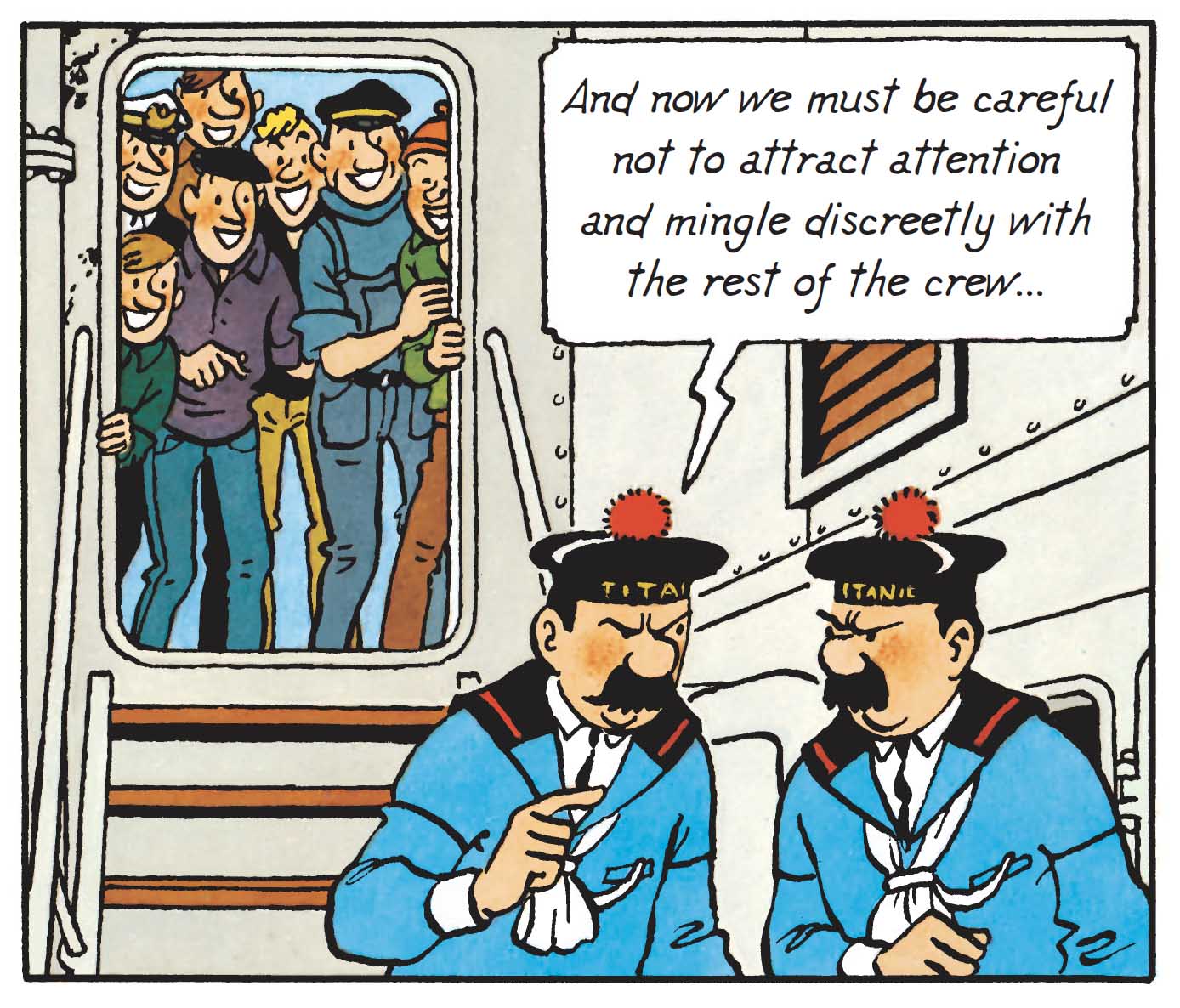
In Tintin in the Land of Black Gold, they board the Speedol Star wearing sailor’s uniforms (see article A Summer Icon) in order to blend in quickly. At least, that's what they think...
Because the dress code on board is actually more like that of the merchant navy (overalls and turtleneck jumpers) than traditional sailor's attire. And for them, it's the icing on the cake – in other words, the last straw – since Hergé dresses them in sailor’s caps emblazoned with the name ‘Titanic’. A discreet visual nod, but one that is highly effective.
Proof that if the devil is in the details... Hergé's humour is there too!
“Iceberg dead ahead!”
In Tintin and the Picaros, Hergé finally evokes the myth in the most unlikely way possible. That is to say: by extracting and completely distorting the warning phrase – heralding the drama – from its original context.
The effect works wonderfully, as Tintin and General Alcazar are stunned to hear it echoing in the middle of the equatorial jungle.

Obviously, in such a setting, the expression becomes meaningless Thus, it only serves to emphasise, in a burlesque manner, the captain's momentary confusion – the victim of a simian blow to the head.
And it is precisely the incongruity of this discrepancy that constitutes the comic essence of this third and final “titanic” allusion.
In conclusion
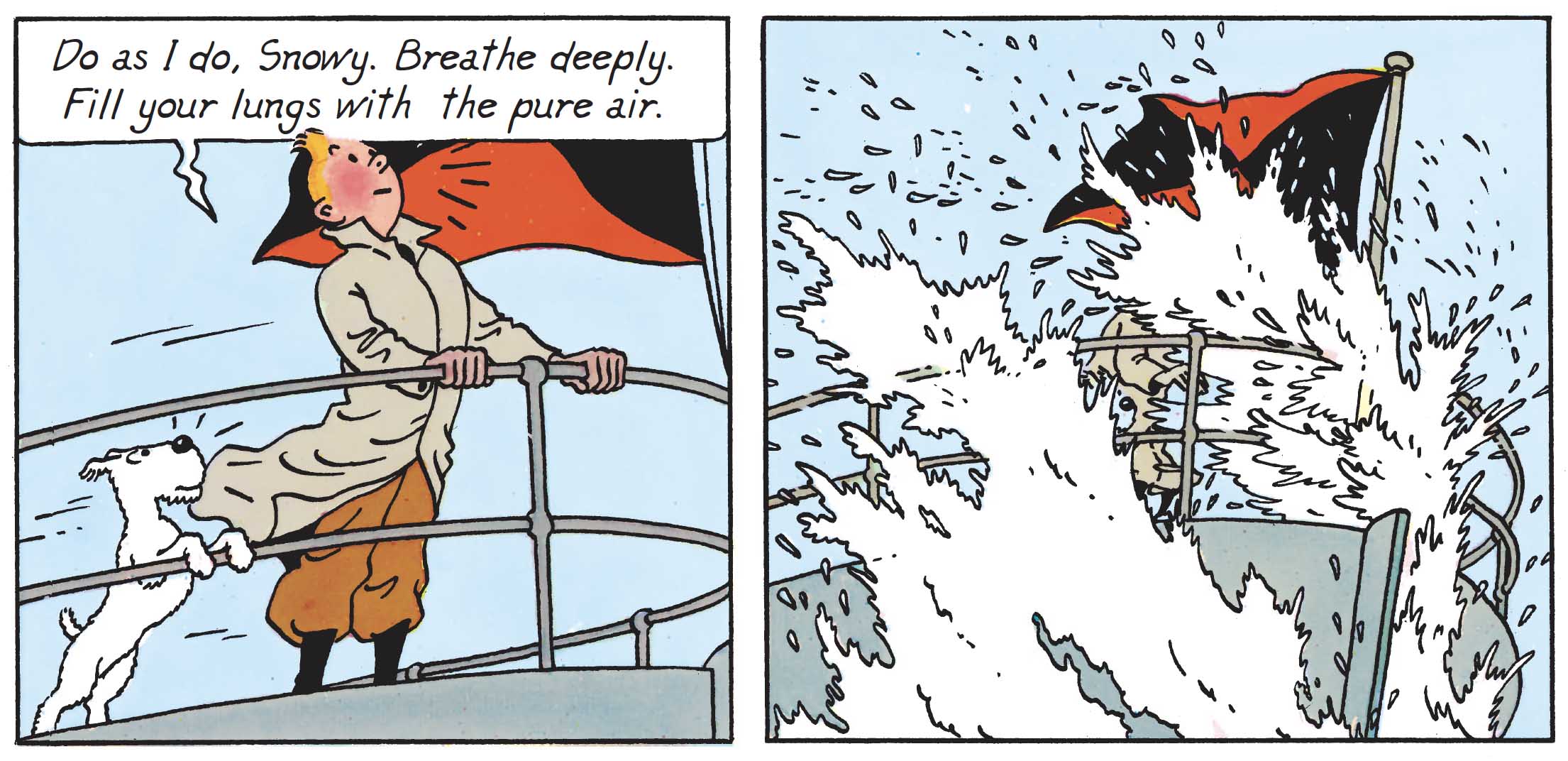
And to end this article on a high note, what could be better than this sequence from The Shooting Star, where we see Tintin and Snowy standing proudly at the bow of the Aurore?
Although it has no direct connection with the famous liner, it nevertheless foreshadows – well ahead of its time – the cult scene from James Cameron's Titanic (1997), in which Jack and Rose – the two protagonists – savour the illusion of flying together above the waves.
In Hergé's work, however, the romantic magic quickly turns comical: no sooner has Tintin invited Snowy to breathe in the ‘pure air’ than a wave engulfs them, sweeping away the lyrical momentum of the moment in favour of a memorable gag.
Another salty shower that will surely remain in the annals of maritime history!
Texts and pictures © Hergé / Tintinimaginatio - 2025


