News
News Contest
 Forums
 Collectors
 Videos
 E-books
Nights in China
A recurring theme in Hergé's work, night-time scenes occupy a special place in the Chinese adventures of his young reporter. This month's dossier sheds light on the fascinating shadows that punctuate The Blue Lotus.
Hergé's nights in China are far from cuddly - contrary to a popular song that came out 14 years earlier ("Nuit de Chine" written by Louis Lynel). The adventure's night-time sequences - which always make a highly interesting narrative and visual contribution - are, in fact, key moments when the action unfolds with much greater uncertainty, suspense and, therefore, intensity.
And we're going to see how, in this dossier...
Lights out in ‘dark-light’ mode
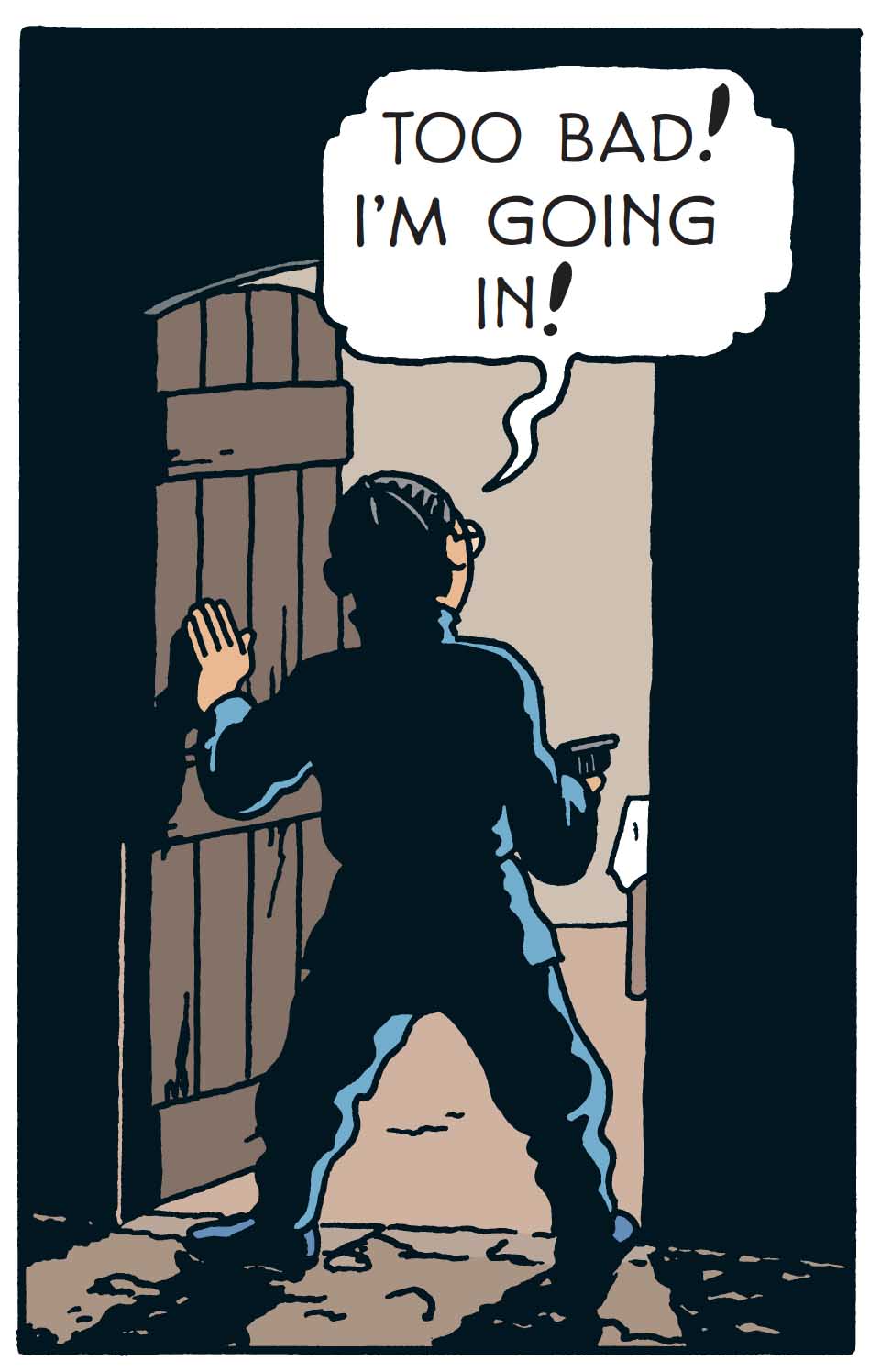
To translate graphically speaking the experience of the night is not an easy task, because it involves capturing and reproducing an atmosphere, while ensuring that the scene drawn remains legible.
The great tenebrist masters such as Caravaggio, Georges de la Tour and Rembrandt opted for a radical solution: the famous chiaroscuro. By darkening the backgrounds of their paintings, they were able to magnify - and dramatise, too - their subjects through a highly contrasting effect of light.
As an apostle of clarity, Hergé developed a completely different alternative: uniformly subdued lighting. He used this technique from the very first adventure in the saga. At the time, he was working exclusively in black and white (except for the illustrations outside the text), so he came up with the simple but brilliant idea of having his actors act in front of a backdrop treated as a printing screen (generally covering the entire vignette).
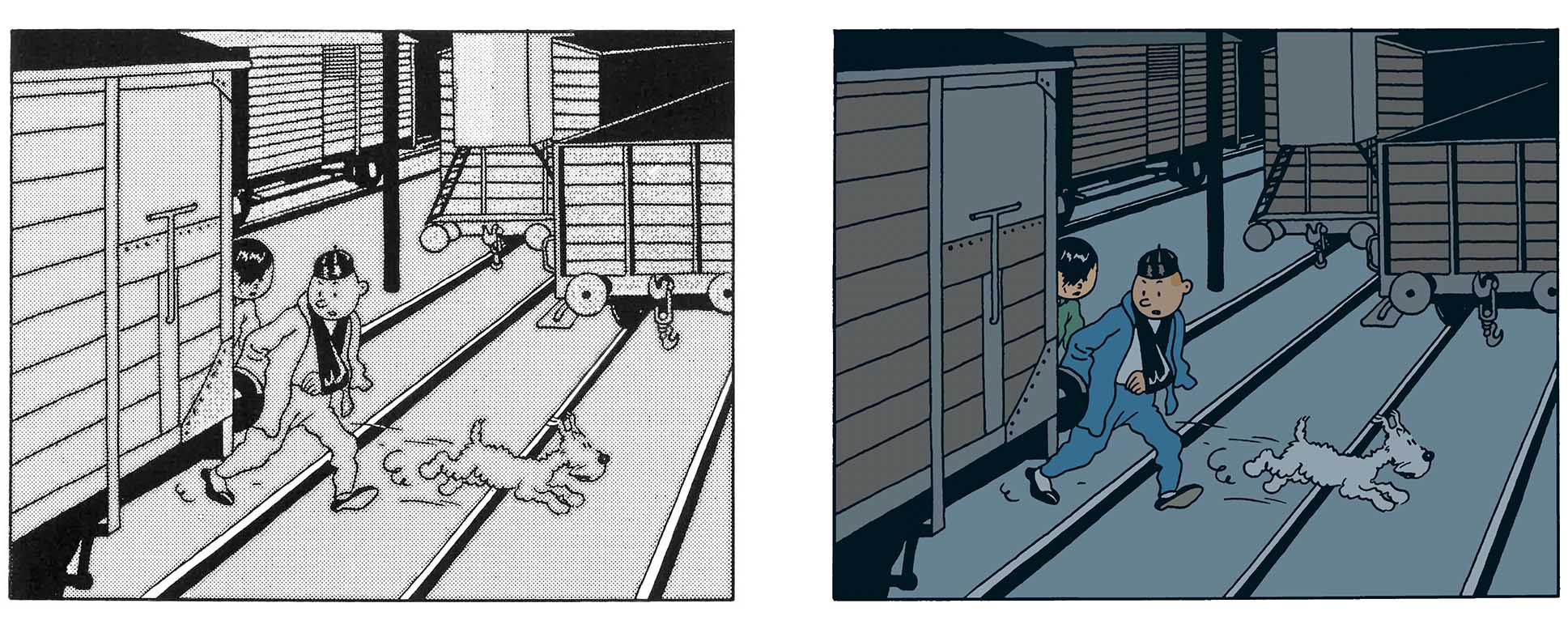
This means that the characters, like the scenery, remain perfectly identifiable. They retain their appearance and their particularities. So its black passages... weren't really black. Obviously, in the 2025 colourised version, these greys have been replaced by flat blue tones. And the result is nothing short of the ‘American Nights’ usually seen on the big screen.
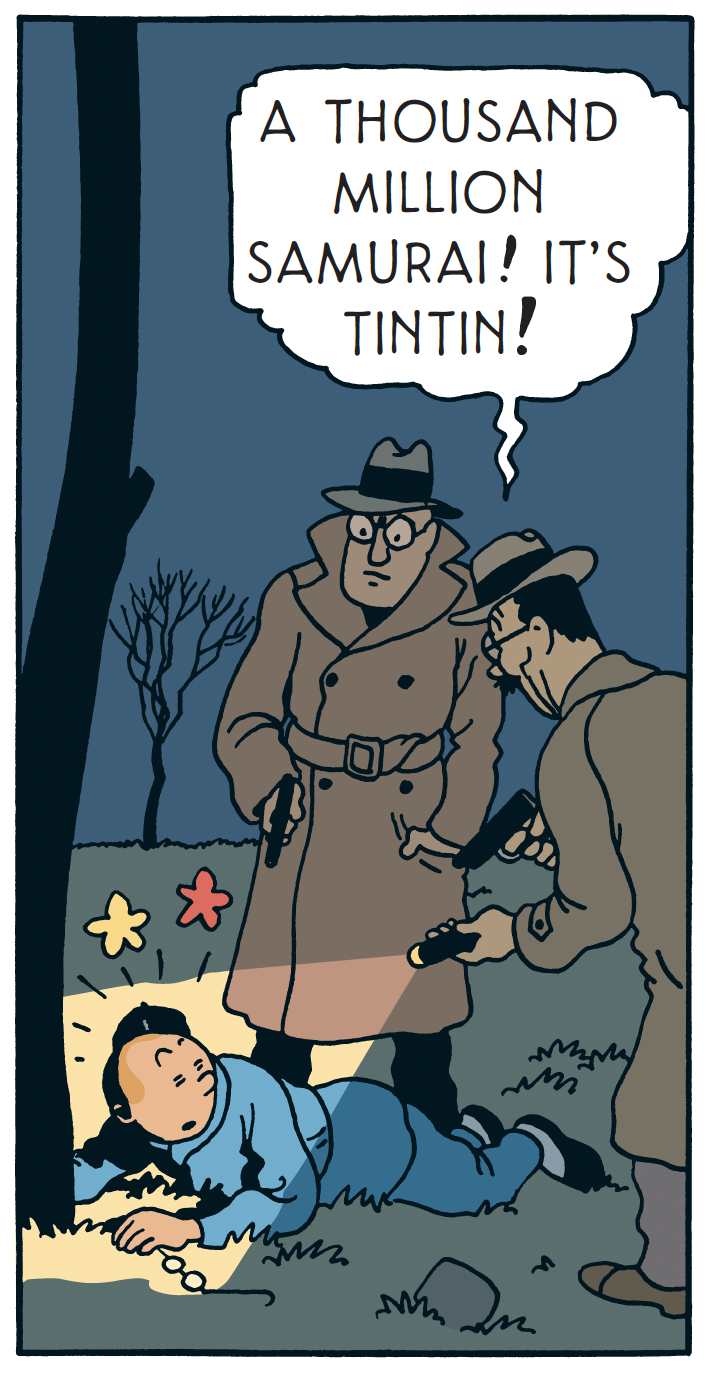
Light, when present (as it is not systematically used), partially illuminates the scene. It is usually introduced by a single external source (street lamp, car headlight, torchlight, etc.) whose beam immediately generates strong contrasts. Visual effect guaranteed! As well as adding to the suspense, this spotlight enabled Hergé to focus his reader’s attention on a precise point in the composition. The cast shadows generated in this way immediately draw the eye to an important or particularly significant detail, such as the expression on a face, for example.
At night, all cats are grey
In the late hours of the night, while some cats sleep soundly, others take the opportunity to commit all sorts of crimes. It has to be said that the ambient darkness and the significant drop in human activity (so there are potentially fewer troublesome witnesses) make this time of year an ideal setting for the most suspicious acts. So it's at night that The Blue Lotus drug traffickers carry out the bulk of their logistical operations.
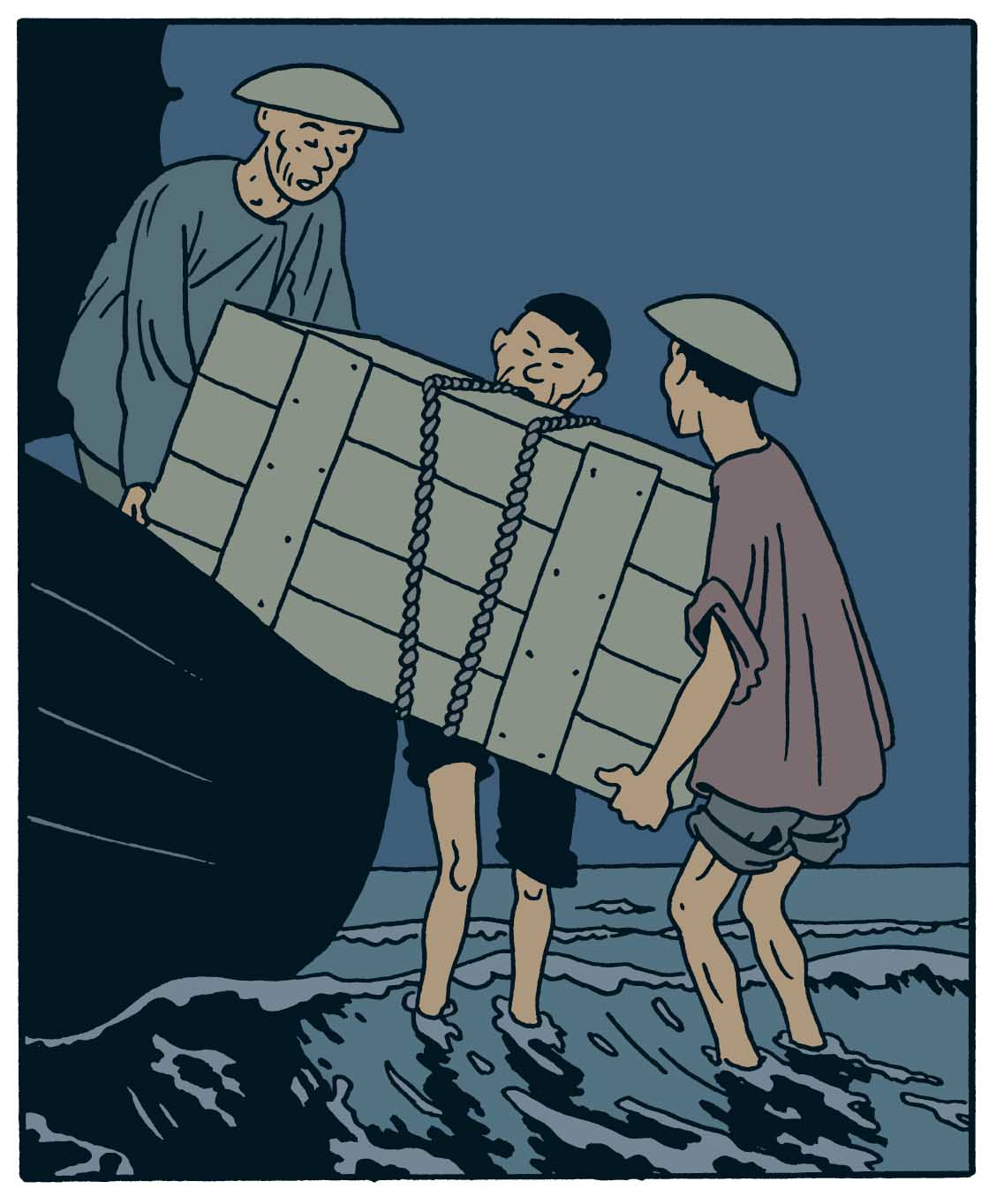
Another strategic advantage - not to be underestimated - is that it offers them complete anonymity and discretion. The low light levels allow them to hide and/or go unnoticed. In fact, Hergé didn't hesitate to black out the paintings... er, vignettes in which they were working. He also took the opportunity to pay a graphic tribute to one of the oldest Sino-artistic forms: shadow theatre.
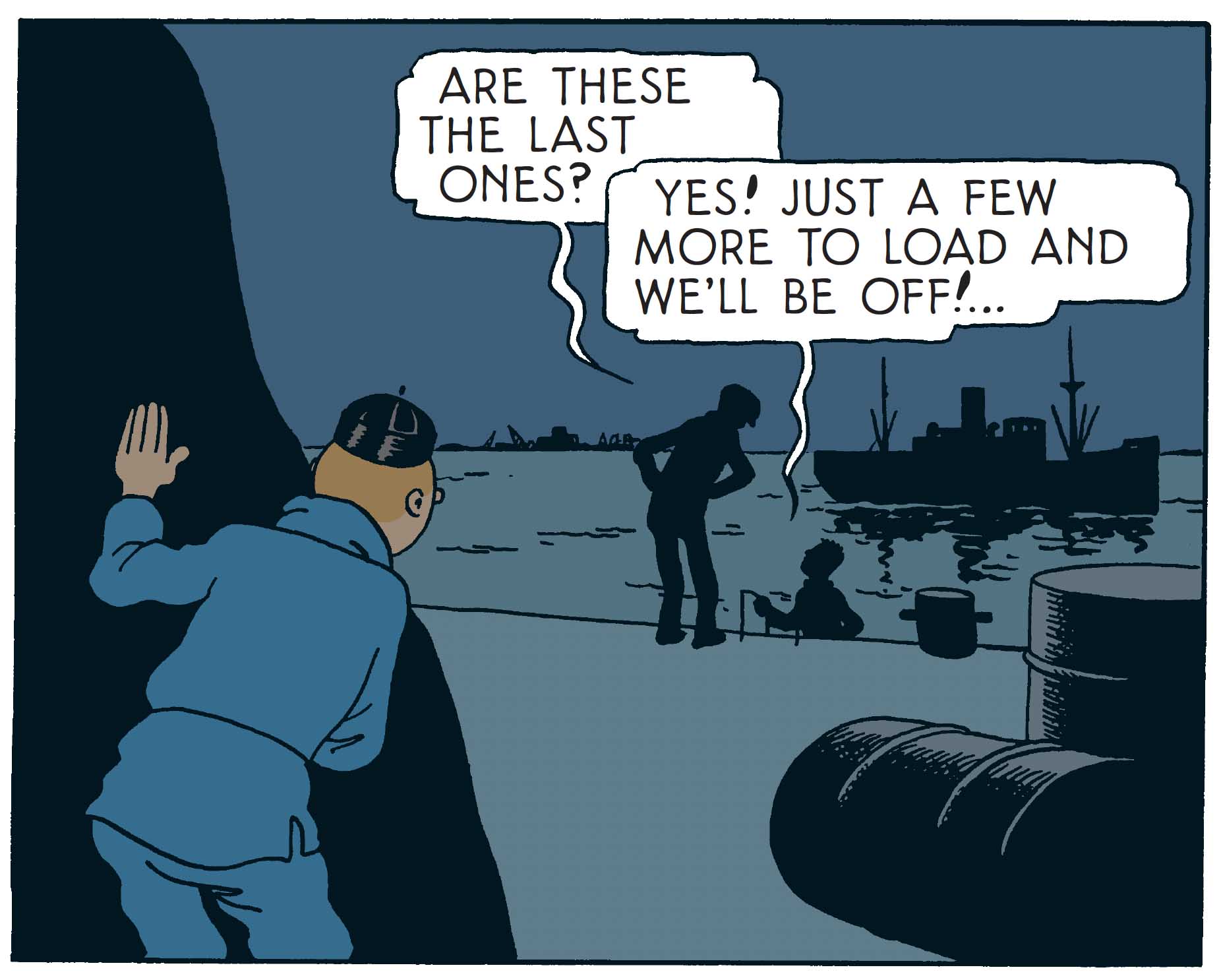
These nocturnal vignettes feature an intriguing ballet of cut-out silhouettes, in which the visual rendering plays a key role. All the aesthetic and refined codes of this ancestral art can be found here. With this deliberate minimalism, Hergé invites his readers to concentrate on the essential. That is to say: the form, the movement and the intention behind the action.
Shadows become the main medium, allowing him to tell the story forcefully, in the form of a direct impression, of what's going on. Naturally, these shadowy areas add a little more to the atmosphere, which becomes increasingly disturbing...
‘Black is black’, but there's always hope!
In The Blue Lotus, darkness is also a structuring element. It is in fact a formidable narrative tool which, by being more or less pronounced, enables Hergé to guide his readers in their understanding of the story. As a result, as soon as an action reaches its climax, he drastically - and suddenly, too - reduces the lighting conditions. So much so that in the space of a single frame, these heroes go from darkness to pitch black, before a dazzling light bursts forth - usually a sign of new-found freedom, as when Tintin escapes from prison with the help of Mr Wang, for example.
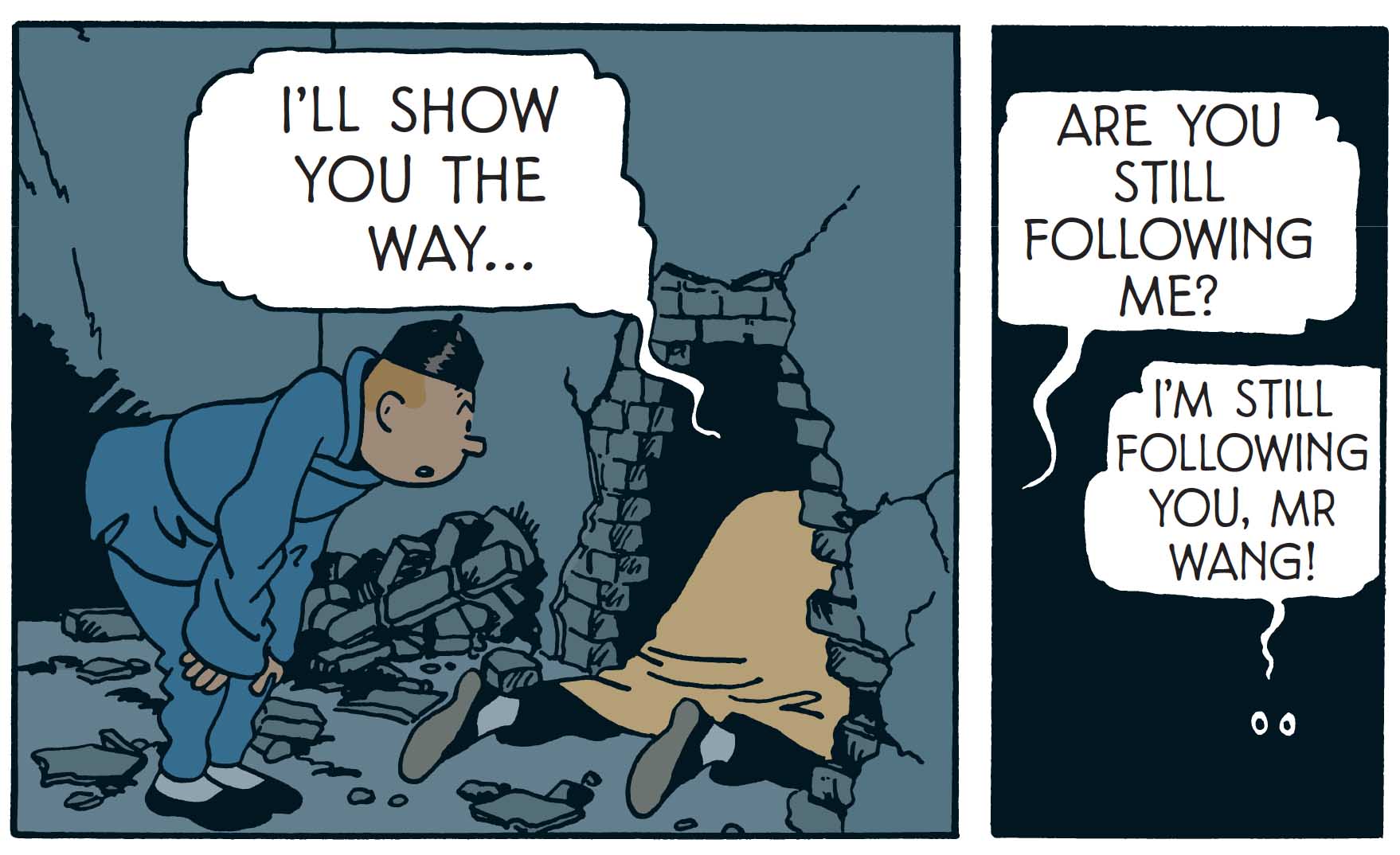
But for Hergé, darkness was not just a question of contrast, it was also an extension of the narrative language. Thanks to darkness, he can transform a vignette into a place of tension, where the elements take shape simply by means of cut-out shapes and shades of black. This creates a particular rhythm, a kind of visual pulse that accompanies, in particular, the announcement of the denouement. At this precise moment in the story, Tintin's silhouette, groping his way forward, melts into the darkness as if the suspense itself were engulfing him for the last time, before finally offering him a way out.
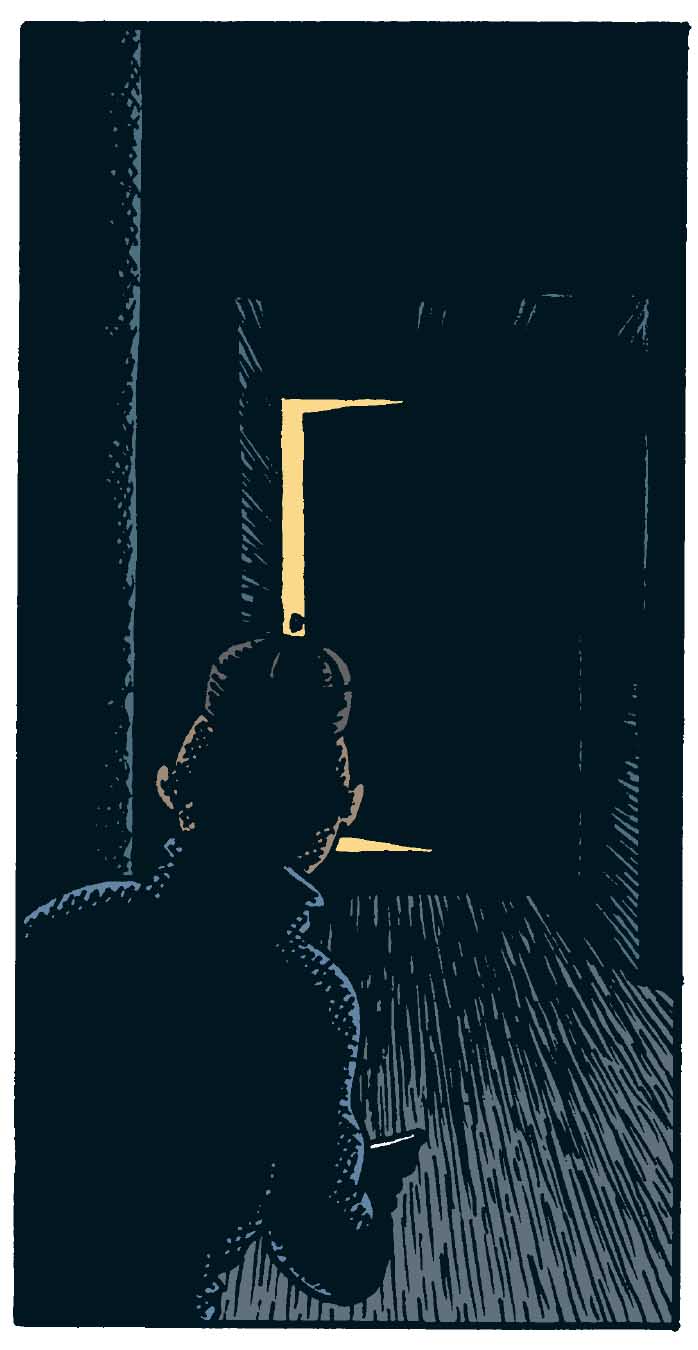
Nor will it have escaped the reader's attention that, throughout the adventure, night serves as a transition between the different high points of the story. Hergé contrasts nocturnal sequences (in which new plot elements are the plot) and daytime sequences (during which the investigation continues). In this way, as well as modulating the pace of the story, the transitions from darkness to light give it a metaphorical dimension.
They illustrate the principle of Yin and Yang. In other words: the balance between the opposing forces (in this case, those of good and evil) that manifest themselves throughout the plot. Night and its dangers are set against the radiant truth of the day, leading to a resolution. These two aspects complement each other perfectly, giving the story its richness and depth.
This is the end of the story. Thank you for your attention. See you next month
with a new topic.
Texts and pictures © Hergé / Tintinimaginatio - 2025