


 News
News Contest
 Forums
 Collectors
 Videos
 E-books
Jean-Claude Carrière: the adventure started with Hergé
This portrait about Jean-Claude Carrière is the first in a series about Tintin fans who recall their "Tintin years". They reminisce about their early reading and their youth. To them, Tintin became a never to be forgotten friend.
Son of a wine grower
Jean-Claude Carrière was born in Hérault on September 17, 1931, into a family of winegrowers. He was destined to follow in his father's footsteps, but he was a gifted student and gained a literary diploma and master's degree in history. He was only thirteen years old when he arrived in Paris. After military service in Algeria he had the decisive meeting with Jacques Tati the film maker, whose films Vacances de Monsieur Hulot (Mr. Hulot's holiday) et de Mon Oncle (My Uncle) had recently been re-edited. ("They've just been translated into Chinese," Tati told him with delight). So there he was, immersed in the world of Paris. At 26 he published his first romantic novel, Lézard (Lizard), had written for the Argentinean filmmaker Luis Bunuel, and became known as a scriptwriter for films including Belle de Jour, Borsalino, Le Tambour, L'Insoutenable légèreté de l'Etre. But his most outstanding work was the adaptation for theatre and cinema of Mahabharata, directed by Peter Brook.
"Tintin, my hero..."
Jean-Claude Carrière: "I discovered Tintin in the weekly, Cœurs Vaillants, which we were given every Sunday when we came out of the vestry. The first adventure was Tintin in Congo. We didn't know about Tintin in the Land of the Soviets, and during those years we didn't even know that this book existed. The discovery of these stories which we read and re-read, at the rate of one page per week. Even now, I can still recite from memory some of the dialogue and some of the story's action. We didn't know that Hergé carried out such thorough research, but the adventures he told and presented, seemed real. Our parent's newspapers didn't include photos. Our photos of the world would be Tintin!?
The method of creating a joke
J.C. Carrière: "Subsequently I tried to understand Hergé's secret. While I was working with Jacques Tati and Pierre Etaix on films such as Vacances de Monsieur Hulot et de Mon Oncle, I came to understand that they shared with Hergé the sense of how to form a joke. For Hergé the joke doesn't isn't summed up by a blow to the head or a fall down the stairs. The blow and the fall are announced in advance, but their consequences are unexpected. He also plays with comical side of repetition such as wrong telephone numbers with Mr. Cutts the butcher, and the broken slab in the hall at Marlinspike Hall... The script for a Tintin story is very similar to the script for a film. Hergé was a great film enthusiast, and that can be seen in all his work."
A Buddha in the crib!
A childhood memory: "When I was six I found a statue about 30 or 40 centimeters high, which I thought was very beautiful. At Christmas I was allowed to place it in the crib - it was a statue of Buddha, which I still own now! The Priest consoled himself by saying I think it's a Chinese philosopher. There's nothing wrong in that." I learned to like the texts of the founders of Indian and Far East civilizations (Note: Jean-Claude Carrière is the author of a Dictionary, In love with India, published by Éditions Plon), which led me to an interest in Tibet, and the Dalai Lama whom I met in 1994. When I read Tintin in Tibet it made me realize how much I had spiritually in common with Hergé, whom, unfortunately I never met. For me, this story was like a cleansing. The story is linear and the scenery is extraordinary. White is omnipresent with plenty of nuances. Moreover, it is a celebration of friendship, which is both rare and also very representative of the imaginary Tibetan.
Hergé and the skills of the circus
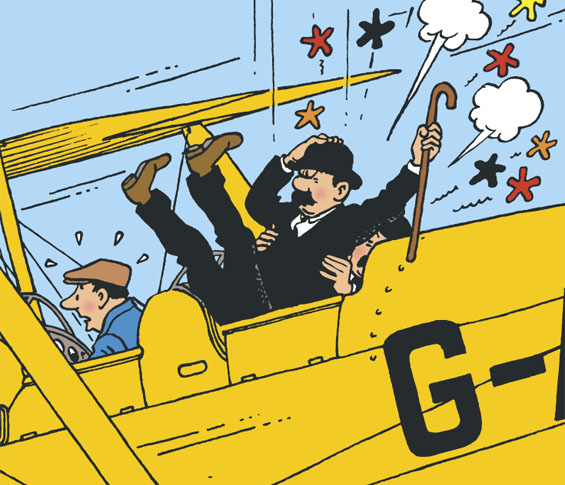
J.C, Carrière: I am constantly amazed by the fact that Hergé specialists rarely refer to Hergé's rapport with the skills of the circus. For example, when his characters fall, they end up on the ground with their feet above their heads. That's a typical clown posture. There is an explanation for this method of falling. It allows them to land on the ground in such a way that enables them to stand up very quickly. I have read that Hergé was an actor at heart, and that he could mimic the actions of all his characters, because he was an outstanding observer. I am sure he watched circus acts a great deal, especially the clowns, and that he used them in his depictions of daily life. Remember that in The Seven Crystal Balls the music hall artists were all pretty dull (the conjurer, the clairvoyant). It was Haddock who provided the comedy.
You always end up surrounded by Tintin fans!
Jean-Claude Carrière: "I knew Loriot the clown very well. He was a friend of Jacques Tati and Pierre Etaix. He reminded me of Tintin because he was the first person to portray "Professor Calculus" in the cinema, in the film Tintin and the Mystery of the Golden Fleece. You always end up finding yourself among Tintin fans. Today Jean-Claude Carrière is working on a collection of interviews with the great Italian novelist, thinker and linguist, Umberto Eco, author of The Name of the Rose and many other remarkable works. His motto, If you do one thing, then do another, has nevertheless left him enough time for his second daughter, Kiara, who just turned six. Her mother is a Sinologist, with a doctorate in Chinese. Her Iranian roots inspired the name Kiara, which means, "Jewel of the Dynast" A future reader of Tintin, like her father?"


