


 News
News Contest
 Forums
 Collectors
 Videos
 E-books
People of legend, legends of a people
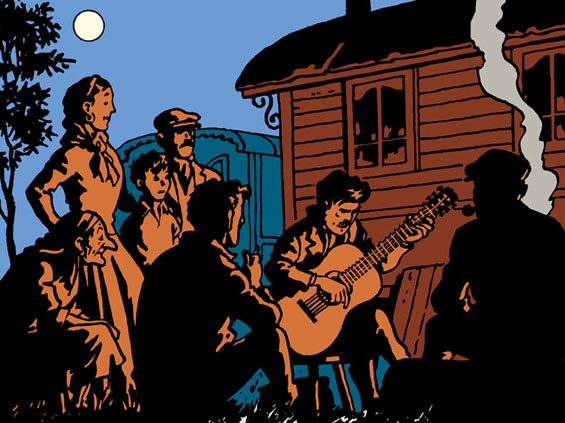
Before appearing in the book The Castafiore Emerald, the Gypsies travelled throughout Europe, from east to west and north to south, always driven away, pursued, despised and suspected of all sorts of evils. The lesson of Emerald: every people has a right to dignity, which can only come from dialogue.
Who are the Gypsies?
First of all, they are a little-known group of people. The most widely accepted view is that Gypsies are among the last descendants of the Scyths who reigned over part of the Indian subcontinent and Eastern Europe thousands of years ago. Today Gypsies include a population estimated to be between two million and 5 million. In modern times they live worldwide, but principally in Europe. Six hundred thousand in Russia, 500,000 in Turkey, 200,000 in the Ukraine, 25,000 in Moldavia, 15,000 in Belarus, and 7,000 spread throughout Norway, Finland and the Baltic states of Estonia, Latvia and Lithuania. The largest gypsy community lives in Romania, where there are an estimated 2 million. These Gypsies are called "Rom", plural "Roma". This name is used to describe Gypsies, although they also have different names in some other countries.
A name? Yes, but what a name ?
The richness of Gypsy culture is worth studying, but there is one big problem. Most of the groups are not stationary, because persecution has forced them to become nomadic, and so there is very little historical archive material. We know that they left Rajasthan in Northern India during the ninth century, and that they speak an Indo-European language, similar to Sanskrit, the ancient language. Based on their origins and original region in India, they have adopted certain names, such as: "Rom", which means, "man" in Romanian, "Roma","Romnichel","Sinti","Manush" (Gypsies) or "Cale", which is the actual origin of the word "Gypsy". In Hungary, where there is a community of 600,000, they are called "Tziganes", while in Spain, which has the largest group in Europe, 800,000, they are known as "Gitans."
A history built on persecution
We can’t even count all the persecution to which the Gypsies have been subjected in the various countries where they stayed. Here is an overview of the situation in Europe today. In Poland they number over 45,000, in Germany, 140,000, in France, 400,000 and in Belgium, 35,000. England has 150,000 Gypsies, Slovakia 450,000, Serbia 500,000, Bulgaria 800,000 and Italy 120,000. For a long time, the Catholic Church believed that Gypsies were sorcerers and devil worshippers. This viewpoint increased the hatred and hostility experienced by these historically nomadic people. Today 48% of Spaniards say that they do not want Gypsies as neighbours, even though the people have been integrated in to Spanish daily life for a long time. The greatest persecution of Gypsies took place between 1933 and 1945, under the Nazis. During the Holocaust, together with the Jews, the gypsies were the most targeted ethnic group, and the Nazis murdered an estimated 400,000 Gypsies.
Loved, repelled…
An old Romanian proverb says, "From far off, the Gypsy is a human being." In spite of this phrase’s distasteful suggestion, it describes a general attitude towards Gypsies. In Spain large numbers of them can be found in manufacturing jobs. No wonder a famous cigarette brand features a Gypsy girl as its logo. We can also recall that Carmen, the Gypsy in Georges Bizet’s opera, was a cigarette vendor. Still, in 2008 Spanish Gypsies have predominantly unskilled jobs allowing them to maintain an itinerant life. Less than 1% go to university. They continue to be blamed for crimes, while the number of attacks against Gypsies is enormous. In Austria, too, where Gypsy music is famous, particularly in operettas, during the Nazi period almost all Gypsies were deported either to the gas chambers or to serve as guinea pigs in barbaric medical experiments.
The high price of Liberty
Gypsies have a reputation for their fierce love of liberty, which comes at a price. According to a 2005 Unicef report, 84% of Gypsies live below the poverty line. In Hungary it is 91%. In Italy they are vilified. A major magazine, showed a photo of a young gypsy under the headline, "Born to Steal". That tells us a lot about public opinion of these unloved people – in 2008. In Romania they are hemmed into ghettos, sometimes the same ghettos occupied by the Jews who the Romanian authorities easily rounded up for delivery to the Nazis. Too often Gypsies are forced to live in subhuman conditions.
The dialogue choice
On September 16, 2008 the first European summit dedicated to Gypsies was held, in an attempt to find solutions and help their situation. There are many obstacles. Gypsies do not constitute a unified group. Although their language is Indo-European in origin, they have developed local dialects, and this inhibits communication between groups. They are nomads in some countries, fixed residents in others, most notably in Romania and Spain. However, the biggest obstacle is, do we really want to open a dialogue with them? That is the precise lesson to learn from The Castafiore Emerald. In 1961 Hergé was one of the first to take a look at the Gypsies without animosity. By opening a dialogue with their unexpected visitors, Tintin and Haddock succeeded in freeing themselves of several preconceptions – which proved to be false.


