


 News
News Contest
 Forums
 Collectors
 Videos
 E-books
Peace and friendship - when?
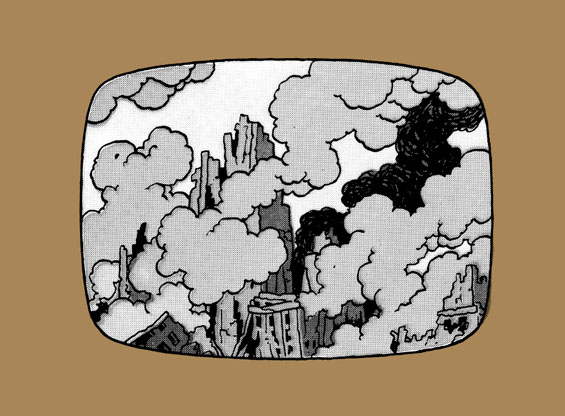
November 11 is a symbolic date, even though it refers to an event almost a century ago. On the 11th day of the 11th month in 1918, at 11 a.m., the opposing parties in the First World War signed a peace agreement. At the time, the whole world spoke of the battle as "the war to end all wars" - but that was not to be.
A symbol of opposition to the atomic bomb
On the first page of Tintin and the Picaros Tintin arrives on a motorcycle at Marlinspike Hall to visit Captain Haddock. On his motorcycle helmet is a symbol, which looks a bit like an upside-down fork inside a circle. In 1976, when this book was published, this symbol could be seen almost everywhere: on walls, record sleeves, clothing and … military barracks, where it was not particularly welcome. This was the symbol of the "peace and love" movement, which sprang up in the 1970s in response to the chaos of the Vietnam War. The symbol had actually been created in 1958, in England at the time of demonstrations against the Atomic Weapons Establishment at Aldermaston, near Newbury.
Semaphore
The English graphic artist Gerald Holtom created this sign, which represents the letters "N" and "D" in the semaphore alphabet. The semaphore is a method of signalling whereby the operator can transmit messages using optical signs. The letters N and D stand for "Nuclear Disarmament," a slogan soon to be replaced by a new one: "Ban the Bomb," as soon as the symbol was taken over by the anti Vietnam war movement. The anti-nuclear content of the symbol was widened and became "peace and love." Hergé did not choose this symbol by accident; he was a confirmed pacifist, as his readers can discover in The Blue Lotus, Tintin and the Broken Ear, King Ottokar’s Sceptre, Land of Black Gold and The Calculus Affair, where he condemns wars, military expansionism and belligerent regimes.
Down with nuclear arms
Opposition to nuclear arms arose long before Gerald Holtom’s famous symbol. On August 6, 1945 the first atomic bomb exploded over the Japanese city of Hiroshima, killing or maiming some 140,000 people during the last five months of that year. By 1946 a first wave of opposition to "the bomb" sprang up almost everywhere, fueled by the fear that all life on earth could be wiped out after a nuclear war. The world placed much of its hope on the United Nations, which was to end all wars. This illusion was swept away by the appearance of the Russian atomic bomb, and by Joseph Stalin’s creation of the "Iron Curtain" across Europe (see our journal article Cold War). That was in 1949.
Obama against nuclear bombs
In 1983, fear of a "nuclear winter" enveloping the earth after an atomic conflict once again strengthened after the Soviet Union (which Russia was called until August, 1991) pulled out of nuclear disarmament negotiations initiated by President Reagan. The end of all discussions, in 1986, signalled the end of the second anti-nuclear wave, as the world once again entered into an arms race. A third wave of anti-nuclear sentiment began in the mid 1990s, involving politicians such as Henry Kissinger and George Shultz, former U.S. Secretary of State, who became converts to pacifism after leading national war efforts. Among the opponents to nuclear arms who signed a call for their total suppression, was a young Barack Obama…
Nuclear terrorism?
We’re now entering the fourth wave of nuclear opposition. The first three were based on fear of future catastrophe, but this time the world has woken up to the dangers of nuclear terrorism. We know that terrorist organizations have tried to acquire medium range atomic bombs which were abandoned by Russia after the fall of the Soviet Union. That is what has led the United States to distinguish between "friendly" and "rogue" states. Rogue states are those which do not adhere to nuclear non-proliferation treaties. December 2 and 3, 2003 will mark the signing of a treaty to ban nuclear arms; 111 countries have promised to sign, in an meeting chaired by Ban Ki-Moon, secretary general of the United Nations.
When will peace come?
The December 2-3 accord will have one big defect: it won’t be signed by the U.S.A. Russia, India or Pakistan, as well as some other countries. Nevertheless, it must be supported, in order to do away with the most lethal arms ever invented by man. Of course, we must also remember the dangers involved in all types of arms sales, which are not limited by beliefs, patriotism or other noble sentiments. We can see reference in Hergé’s works to the ravages caused by these merchants of death (particularly in The Cigars of the Pharaoh in the 1930s, and in The Red Sea Sharks in the 1950s). Hergé would no doubt have affirmed with all his might the words of Albert Einstein: If man does not end war, war will end man.


