Called Father Christmas or Santa Claus in English, Père Noël in French and Weihnachtsmann in German, the jolly fat man in a red suit will be flying all over the world in his sleigh on the night between 24 and 25 December, distributing presents to children.
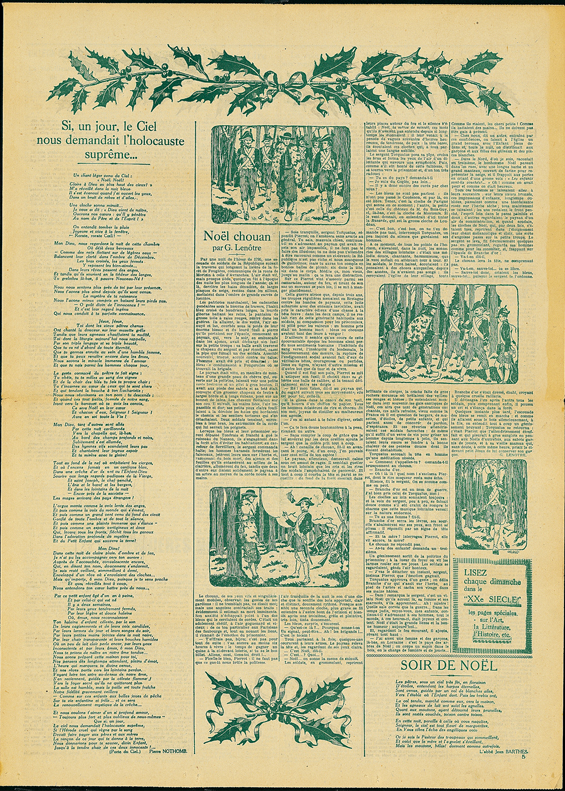
It is a great time to take a closer look at a fictional character and a time of the year that Hergé found particularly compelling. One of the author's oldest-known illustrations around this theme was created for a fairytale, Noël Chouan, that was published on 25 December 1927. Later on the author of Tintin also created many Christmas-themed cover illustrations for Le Petit Vingtième and Tintin magazine.
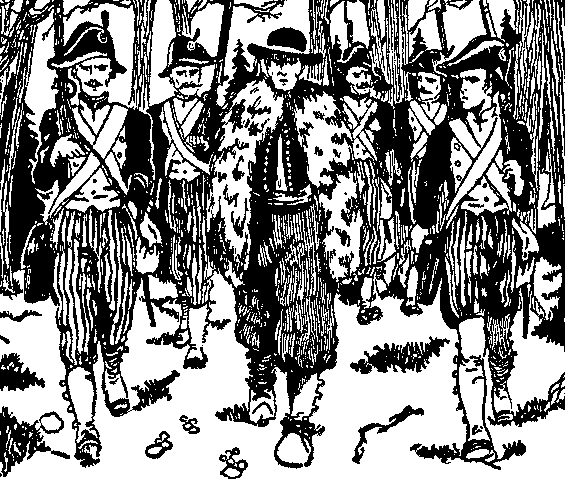
« Noël chouan » is a Christmas story written by Georges Lenôtre, which Hergé illustrated for publication in Le Vingtième Siècle in 1927. The story evokes the beauty of Christmas, even in the midst of war. In 1795, at the time of the Great Terror, French soldiers fought against the Chouans (royalist insurgents). Georges Lenôtre tells the story of a small troupe of soldiers who, having captured a Chouan, plan to take him back to their camp in order to execute him – in those days being captured meant certain death! Before setting off for camp the soldiers and their captive are sitting around a fire, when suddenly church bells start to ring for Christmas Midnight Mass. As the sound of the bells and the beauty of the holy night penetrates the men's hearts, the cruelty inside them melts and their hearts open as they recall happy memories. Images of snowmen, gifts and smiling children are all evoked in the middle of the darkness. The soldiers become human beings again as they share stories, and they decide to free their prisoner so that at least one of them may be able to rejoin his family. Then they set off back to camp. The horrors of war return quickly, but for a moment at least and thanks to Christmas, grace and humanity shine through the darkness.
Hergé drew many pictures and greetings cards on the theme of Christmas.
Although the legends and stories may vary from region to region, the man with a big beard, riding in a sleigh pulled by reindeer, is something common to many people all over the world. Explanations abound as to his origins and there are many aspects of Father Christmas to learn about. Here are a few of them...
Father Christmas is a legendary character whose appearance, in the past, changed according to country: tall, short, fat or thin... the colours of his clothes also changed. In Russia they were blue; they were green in certain Nordic countries and red in many other countries.
The Father Christmas that we all know today, came into existence in 1931. At this time, the Coca-Cola company was going through a crisis as sales were falling dramatically. The directors remarked that in winter there was much less demand for their fizzy drink. To remedy the problem, they hired an illustrator, Haddon Sundblom, to drum up enthusiasm amongst children and consumers to drink Coca Cola in December. The brief given to the illustrator was to portray Father Christmas enjoying a bottle of the drink.
Haddon Sundblom was an American painter and illustrator. He was born in 1899 and died in 1976 at the age of 76. He is remembered primarily for his pin-ups and Coca Cola Santa Claus advertisements.
The illustrator worked on the project and as a way to make his work more striking he ensured colour-coordination between Santa Claus and Coca Cola by maintaining the jolly man's bright red clothes, as they were represented in many countries already. The campaign was a great success, and as well as boosting sales of Coca Cola it also helped to popularise further the image of Father Christmas as a fat, smiling man with a huge white beard. There was now no stopping this particular incarnation of Santa Claus as it spread about the world. No longer was he portrayed in blue, or as tall or thin... from now on he was round and red.
And yet for a long time there was no consensus on the country and region in which Father Christmas lived. In 1927, a storyteller proposed that he lived in Lapland, and it stuck. The Finnish region became a tourist hot spot in the 1980s, partly thanks to the construction of a huge attraction, a Father Christmas village.
Londres-(c)-Boris-Zachy
So this is the story behind the Christmas known and loved around the world today. The true origins are of course Christian, but today the festival is celebrated by believers and non-believers alike. It gives us great pleasure to wish all our readers, all Tintin fans all over the world, and all their friends and family, a very Merry Christmas and Happy New Year!
No review
Log in or create a Tintin.com account to write a review.
Forgot your password
An email with a link to reset your password has been sent to your email address.
Create a Tintin account
Your email seems to contain an error.
Sorry, unknown user...
To access this content, you must be registered with Tintin.com.
Login / registration
To apply for your Syldavian passport, you must first create a Tintin.com account.
Tintin.com uses cookies to improve your experience on the site, to analyse its use and for marketing purposes. For more information, please consult the Privacy Policy.


 News
News Contest
 Forums
 Collectors
 Videos
 E-books


-Boris-ZachyJPG.jpg)


