News
News Contest
 Forums
 Collectors
 Videos
 E-books
Little Story of Infinity: Another look at the Universe
Each month, Gwenhaël W. De Wasseige tells us through her Little Story of Infinity the latest news about the universe and the domain of the infinitely small.
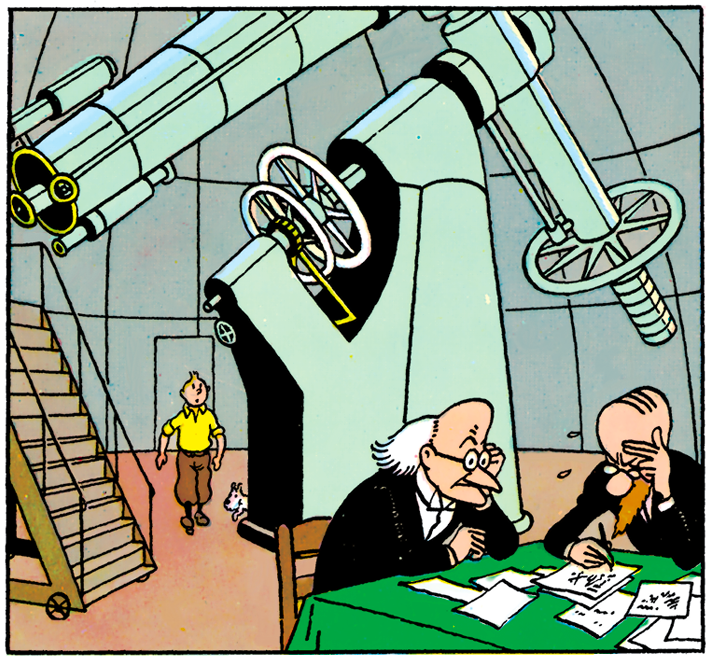
Professor Calys, director of the Observatory, would probably fall out of his chair…. Today's astronomers continue to study the universe but they no longer always have their eyes behind their telescopes! In just over half a century the world of astronomy has changed a lot…
The James Webb Space Telescope is a great example! Propelled into space by an Ariane 5 launcher (and therefore French!) from Kourou in Guyana on December 25th, the Webb, to make it shorter, is a NASA, ESA, and CSA telescope of a different kind.

Our eyes and those of Professor Calys allow us to observe the sky through a telescope in the “visible” spectrum, from red to violet.
As smartly illustrated by Hergé, the stars twinkle when observed from the earth. This rapid variation in their brightness is due to the effect of the atmosphere, composed of layers of different density and subject to variations in pressure and temperature caused by turbulence.
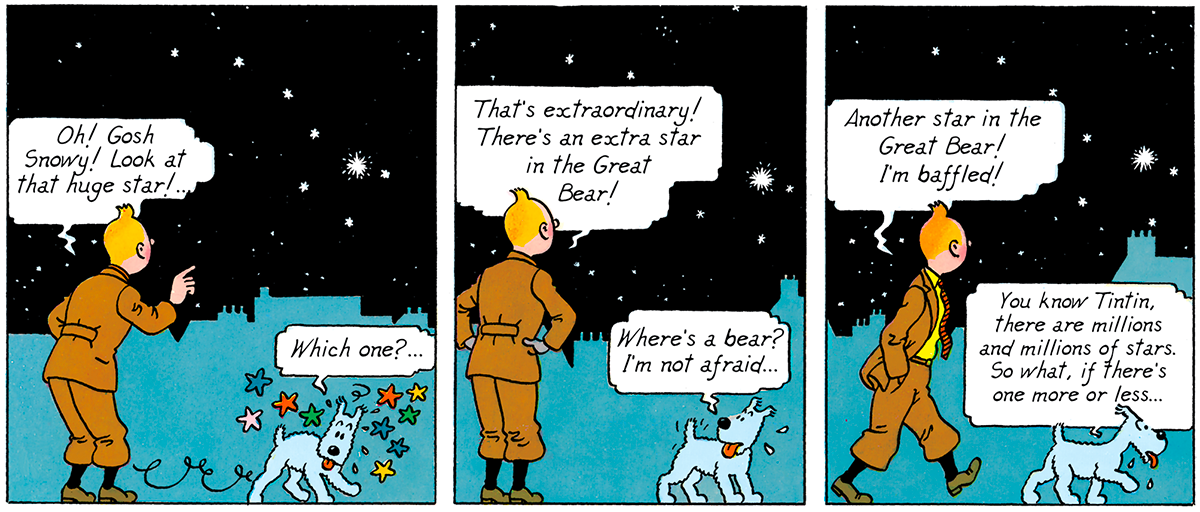
One of the solutions to limit this effect and therefore better perceive the variations intrinsic to the stars themselves is to observe from space!
The visible sky today looks like this:
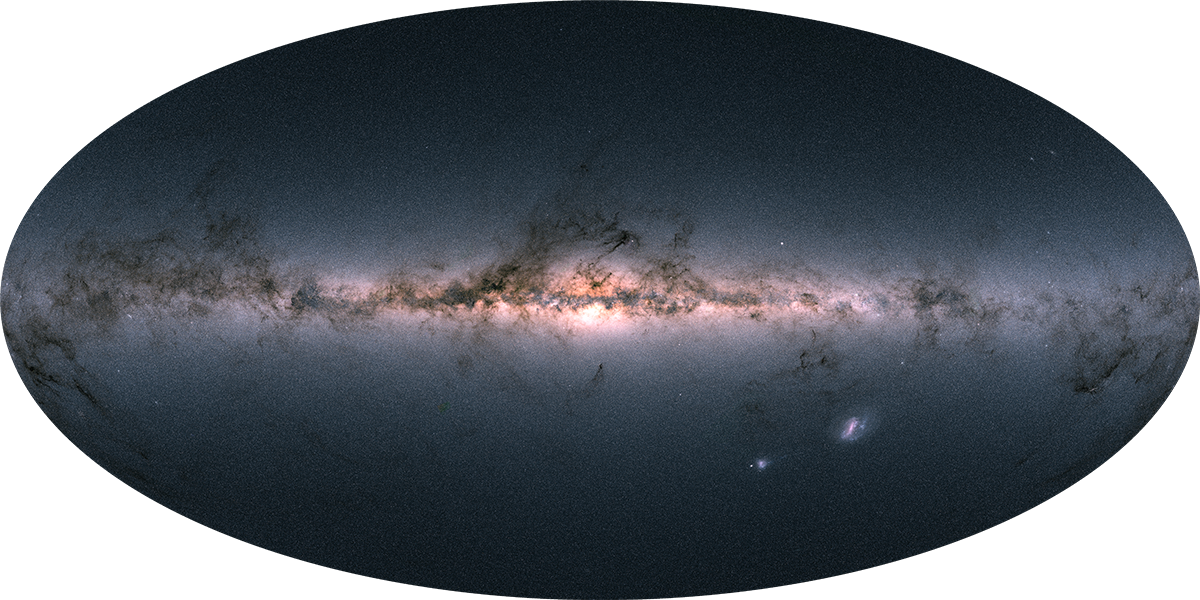
Of course, the instruments being much more sensitive than our eyes and protected from city light, many more objects are revealed in the celestial vault.
And yet, do you see these dark spots on the image, like screens preventing us from seeing what is behind? These black regions are not areas without stars but clouds of interstellar gas or dust that lie between the light source and our eyes.
How to unravel the mystery of these regions and other “in-visible” places? By taking another look at the Universe, by changing the wavelength! That's Webb's mission - to observe the sky in infrared (IR), a wavelength longer than that of visible light. Other missions have already done it before it and this is what the Universe looks like in IR.
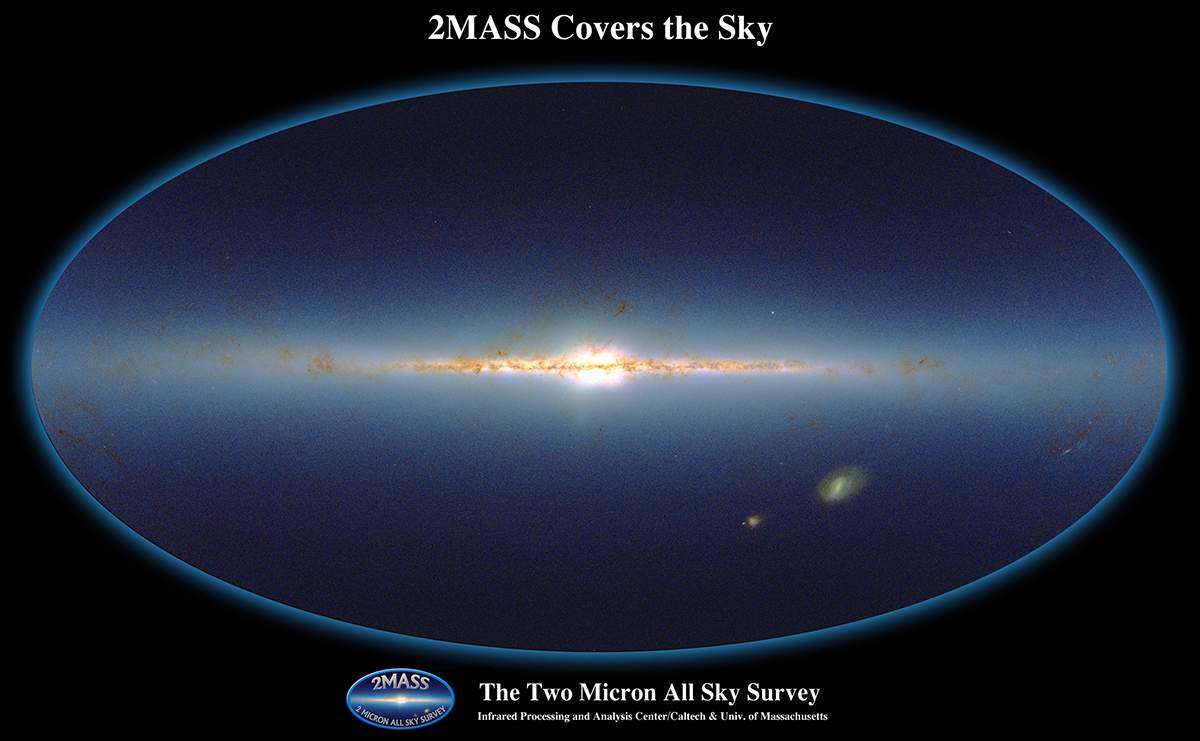
What will we learn more than what we already know?
Webb, which saw more than 30 years pass between the idea and its launch, is a far more sensitive instrument than previous missions. It is in a way the successor of Hubble, which observed mainly in the visible and whose breathtaking images have amazed several generations of curious people.
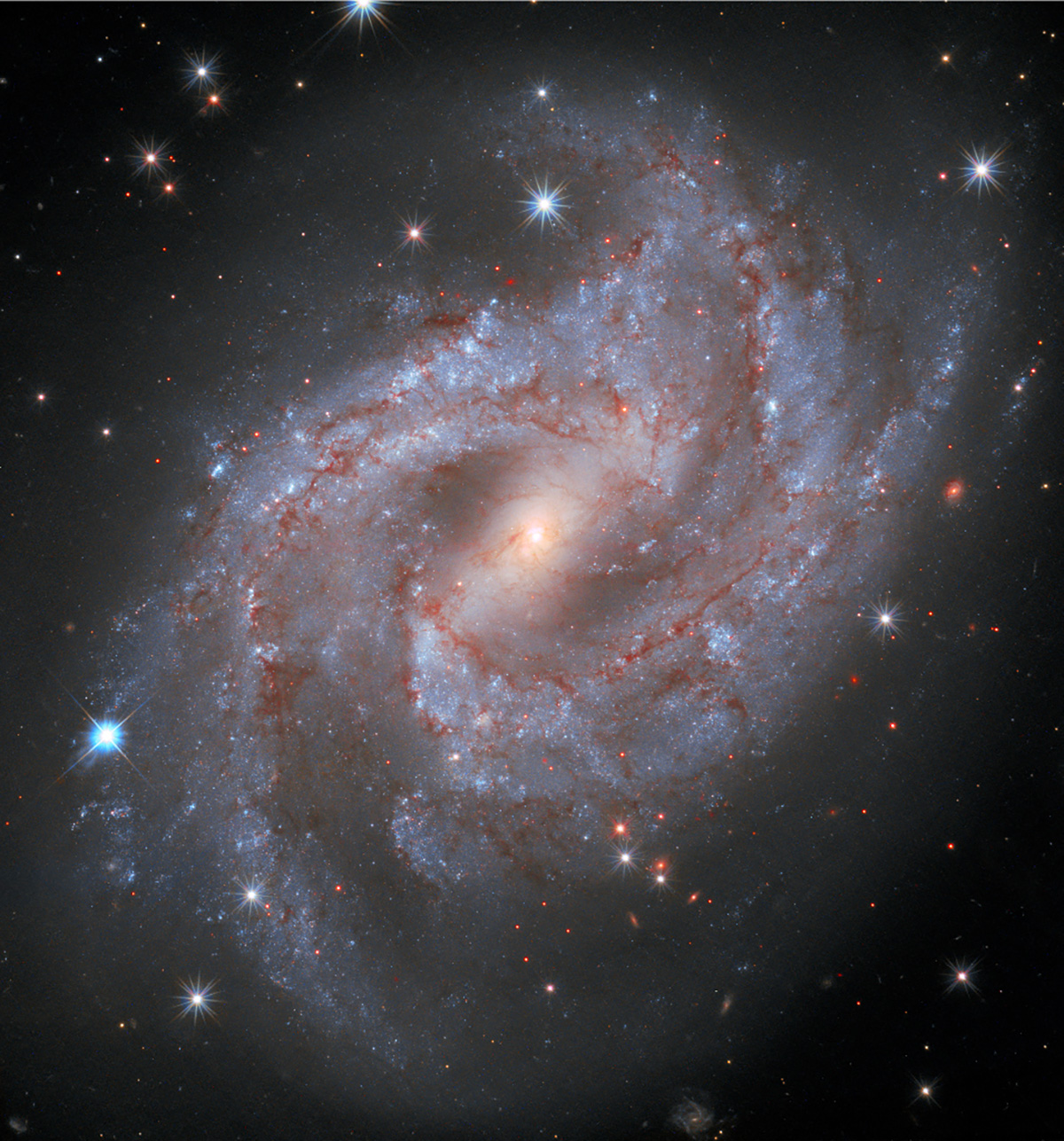
With Webb, astronomers will study the very first galaxies in the Universe, learn more about the evolution of galaxies and the birth of stars, but also about the planets of our solar system as well as exoplanets orbiting around other stars than our sun.
Why is the telescope more than 1.5 million kilometers from Earth?
To achieve its scientific goals, Webb was designed to be sensitive to the lowest IR emissions. It was therefore essential to protect it as much as possible from any IR emission coming from the Earth. Its instruments work at a temperature of -223 degrees Celsius and a shield protects them from any heating by the sun, the earth or even the moon.
But what does the Universe look like in other wavelengths? Astrophysicists today use the entire spectrum of light, from radio waves to the most energetic light there is, gamma rays. To unlock all the secrets of the immensity that extends above our heads and to have a complete picture of it, each wavelength is necessary like each piece of a puzzle. But that's another story !
And in Belgium?
Our Belgian scientists and engineers are of course part of the adventure! Curious to know more? Read for example the testimonies of researchers from the University of Liège.
Glossary
- Wavelength: Light can be seen as a wave. One of the characteristics to define it is then its wavelength, that is to say the distance between two maxima of this wave.
- NASA: National Aeronautics and Space Administration
- ESA: European Space Agency
- CSA: Canadian Space Agency

About the author
Gwenhaël W. De Wasseige is assistant professor at UCLouvain in astroparticle physics. Each month, Gwenhaël will tell us through her Little Story of Infinity the latest news about the universe and the domain of the infinitely small.