News
News Contest
 Forums
 Collectors
 Videos
 E-books
Little Story of Infinity : Studying the Universe by exploring the Earth
Each month, Gwenhaël W. De Wasseige tells us through her Little Story of Infinity the latest news about the universe and the domain of the infinitely small.
Let's once again discover the Universe like Hippolyte Calys! This time however, we are not going to use telescopes to scan the sky, but rather set sail towards the Poles in search of these “space pebbles”!
We are privileged to have a first-class guide for this trip: geologist Vinciane Debaille, professor at ULB!
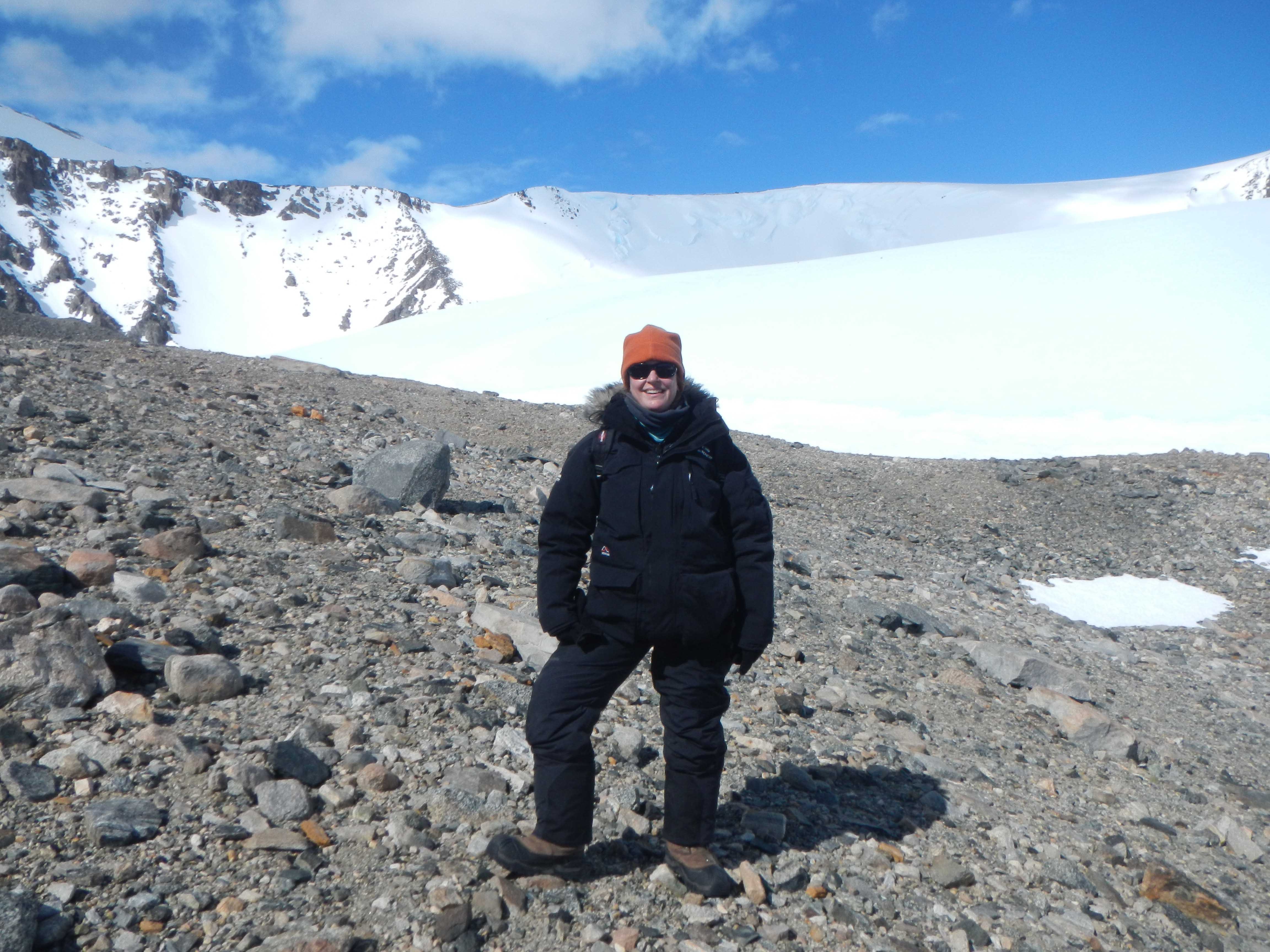
Senior researcher at the FNRS and director of its laboratory, Vinciane Debaille is an explorer and scholar of today. In addition to having discovered an 18 kg meteorite in Antarctica or having been selected to choose the rocks on Mars that will be analyzed, Vinciane Debaille is also a researcher determined to bring science out of the laboratories.
Could you explain in a few words what an asteroid is?
Vinciane Debaille (VD): It is a rocky body that orbits the sun with a more or less circular orbit. A large part of the asteroids in our solar system are included in the main asteroid belt located between Mars and Jupiter. Asteroids that orbit very elliptically may cross the orbit of other planets. If it's in Earth's orbit, they're called NEOs, and they're likely to become a meteorite one day, that is, end up on our soil. We try to keep an eye on those that are big and likely to cause damage if they ever fall to Earth.
What role do you play in the study of these asteroids?
VD: I study meteorites that come from these asteroids, among others. They contain dust and fragments that date back to the beginning of our solar system. With these, we try to understand the formation of our solar system by studying their chemical composition.
In other words, you are an archaeologist of our solar system! But one of the only archaeologists to work in Antarctica! Can you tell us a word about it?
VD: To measure the chemical compositions of these fragments, I need rocky material, therefore meteorites. Antarctica is the best place on Earth to find meteorites because they will be concentrated in certain areas thanks to the movements of glaciers. In addition, you can see them very well on the ice, and finally, they are kept in the fridge for a bit. Thanks to this, 2/3 of the meteorites found on Earth come from Antarctica. But you still have to go get them in the cold!
In short, it's quite close to Tintin's investigation in The Mysterious Star, even if it was on the other side of the earth, in the Arctic. Other differences?
VD: In the mysterious star, we see big mushrooms growing on the meteorite that fell. None of this in reality, there is no life in asteroids or weird radiation. But on the other hand, asteroids contain the building blocks of life and it is likely that life developed on our Earth because meteorites brought these building blocks a very long time ago.
Your next challenge is Mars! What is the link with your work on land?
VD: The Earth is geologically active and the rocks that bear witness to its birth have disappeared. On Mars, on the contrary, the majority of the rocks are very old and allow us to trace the formation and evolution of the planets. The appearance of life on Earth also remains a big question, and it is hoped to understand how life can develop on a planet if ever traces of ancient life are found on Mars. We also go to Mars to understand the Earth's past!
Many thanks to Professor Debaille for this interview!
About the author :
Gwenhaël W. De Wasseige is assistant professor at UCLouvain in astroparticle physics. Each month, Gwenhaël will tell us through her Little Story of Infinity the latest news about the universe and the domain of the infinitely small.