News
News Contest
 Forums
 Collectors
 Videos
 E-books
Fantastic Beasts
As many of you know, the dragon has long held a special place in the pantheon of fabulous creatures. This is no doubt because it's present in all the world's cultures, notably through religions, myths, legends and heraldry, but above all through artistic creation as a whole (such as painting, sculpture, literature, cinema, games and advertising).
In other words, it's everywhere, even in Hergé's work. So how did it manage to find its way into his creations? That's what we're going to find out in this new article.
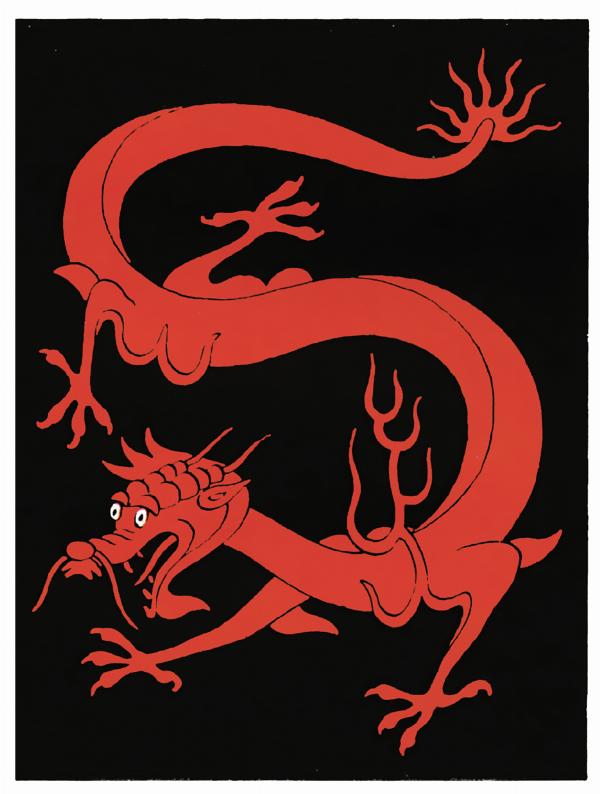
"Whoever wants to be a dragon must first eat many little snakes"
It would seem that Hergé heeded the wise advice of this Chinese proverb, since before delving fully into the matter, he first applied himself to depicting a well-known reptilian "model" in common use: the snake.
It's in the Congo - and twice - that snake-like creatures make their appearance in the young reporter's African adventures. First, they surreptitiously attack the leopard-man hiding behind Tintin, before swallowing Snowy like a mouthful of bread. Part protector, part aggressor. From the outset, snakes reveal their ambivalent nature.
_EN_o.jpg)
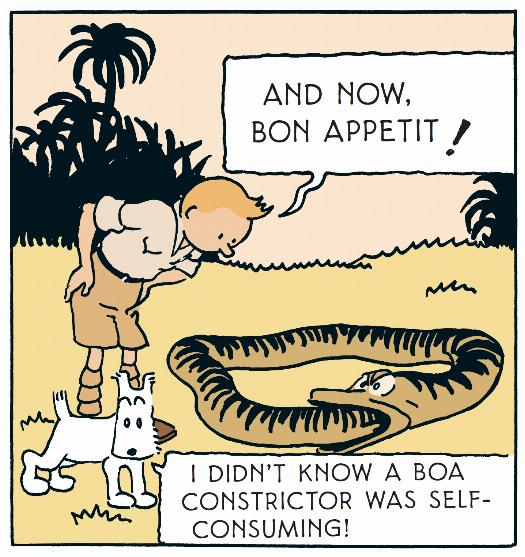
But before we go any further, let's stop for a moment to consider the story of the "legged boa", which calls for some comment. Hergé's inspiration here comes from a well-intentioned gag published eleven years earlier, by Benjamin Rabier, in the humoristic weekly titled Le Journal amusant. And the similarity between the two sequences is striking. So much so that the style clearly shows that the young Belgian student has perfectly assimilated - and even digested, too - the graphic precepts of his drawing master.
In fact, like the man who made animals laugh, Hergé's snake is expressive and unrealistic. So much so that his two heroes have to deal with a long, stylized snake, dorsally striated with a duck's beak! Is this an allusion to Gédéon (a character created by Benjamin Rabier in 1923)? Perhaps, but nothing is less certain. In any case, the point here is that this is an effectively simplified figure that has "retained the purity of its original forms", to quote the painter Paul Gauguin.
Thanks to this, it's close to the symbol. So close, in fact, that Tintin doesn't hesitate to add the finishing touch himself, to complete the circle and transform - once and for all - this common reptile into Ouroboros, the mythical snake that bites its own tail.
For Tintin, of course! Because in India, in Cigars of the Pharaoh, Hergé reserved for his intrepid hero an encounter with numerous snakes that he could have done without, unknowingly hijacking the words of philosopher Klaus Wentz as follows: "Wherever the snake(s) emerge(s), a god precedes (them)".
The artist places this scene under the aegis of Vishnu, before making things worse. And rightly so, since in Hindu cosmogony, this protective deity of the universe, balance and time is almost always accompanied by Ananta, an endless polycephaly cobra.
As usual, Hergé offers a personal interpretation here, replacing the huge original creature with an army of bespectacled cobras. In fact, this sequence can’t be compared to the Indiana Jones films, because Tintin, unlike the famous archaeologist fifty years his junior, doesn't suffer from ophidiophobia.
_o.jpg)
Due to his lack of fear, he defeats his attackers on their own turf, thanks to his composure. Because, once the surprise effect has worn off, the young reporter immediately regains his usual self-confidence, and with it the idea of a "Belgian-style" joke to neutralise them. So, knowing that chocolate - just like music - soothes the savage beast, he doesn't hesitate to toss them the precious chocolate bar he keeps in his pocket. So much for his snack, but at least he prevented them from attacking him.
Seeking to seize this providential offering, his adversaries then engage in a merciless, headless battle, to the point of forming a veritable sack of knots... or rather a head of knots, since this singular configuration is reminiscent of the hair of Medusa, the petrifying Gorgon defeated by Perseus. When it comes to reptiles, Hergé certainly enjoyed playing with their iconicity. And there's more to come…
So far, Tintin has always fared well in his confrontations with the beast. But he now faces another major challenge. Curiously, as he jumps from one adventure to another, the calibre of his adversaries only increases. Gone, then, are the gentle snakes with mad legs and other slithering, bespectacled gluttonous creatures.
This is proof that the artist and his character are getting bolder. The former, on a technical level, because his creatures are more and more strikingly realistic and, therefore, frightening. Secondly, on a personal level, with these muscular duels, Tintin asserts himself. Better still, he fulfils himself - acquiring, in the process, a new heroic dimension.
 copie_o.jpg)
But isn't this just a modernised interpretation of a well-known symbolic struggle? Of course it is. The Manichean struggle of Good versus Evil. And all the more so as Hergé now seems to be drawing almost unrecognisable dragons - although their outrageously oversized build speak for themselves. Irrefutable proof that Tintin is in the same league as a Hercules, a Perceval or one of those demon-slaying mediaeval saints.
In this case, Tintin's extraordinary adversaries are no more than a foil for his inner strength and nobility. For, to triumph over them, the young reporter will inevitably have to demonstrate bravery. A quality only true knights possess.
The awakening of the dragon
From the 1930’s onwards, Hergé must surely have sensed that the meeting between his paper protégé and the fantastic animal was just around the corner. For this reason, he was quick to improvise as a dragon creator. And since he knew that with these fanciful creatures, any stroke of the pencil was permissible, he tested several approaches before taking on the legend.
Equally at home creating comic strips and promotional illustrations, Hergé took advantage of a commission from the Belgian department store "A l'Innovation" to take the plunge. The store asked him to create its future toy campaign. Quite a programme!
And it was in the hustle and bustle of the moment that he found the star of his advert: the Scheldt monster, a sort of distant river cousin of the Scottish Nessie. Since the Highland giant first appeared in 1933, reports of sea monsters had been pouring in from all over Europe, including Belgium.
And so have the experts. In fact, according to them, even if they share many similarities with dragons, it would be more accurate - and more appropriate - to call them "dragonoids". But for Hergé, it didn't really matter. Above all, he wanted to deliver a project with an inspired appeal.
_o.jpg)
For the sake of veracity - and credibility, above all - he made sure his creature was perfectly adapted to its environment. So he designed it to be wingless and serpentine, with a broad body driven by powerful legs and a long tail with dorsal spines acting as a rudder.
But he didn't forget that his mascot was, above all, aimed at a young audience. So, to avoid frightening them, he transformed this agile-footed colossus into a gentle monster with soft, laughing eyes. He also took care to round off the angles of his "ridgeline" and to draw beautiful, ample ears, the shape of which resembled those of Snowy. And the icing on the cake... or rather, the hairs under his chin, he also endowed him with an amusing goatee in the shape of a tousled plume, which contributed, in its own way, to accentuating the jovial, good-natured character of his personality.
_o.jpg)
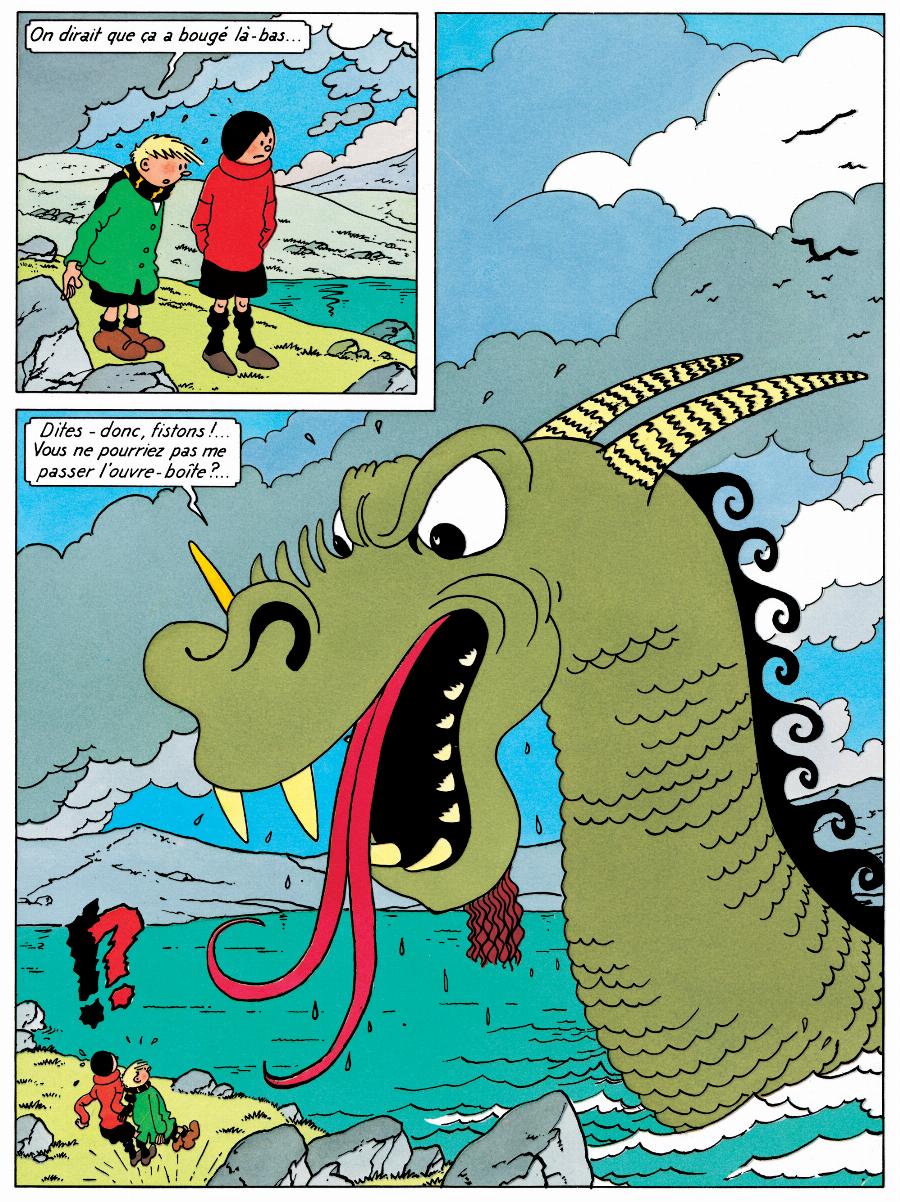
Speak of the devil!.. It seems you can see its head. Well, only sometimes. Because, as a certain Michel Sardou song confirms, "on certain summer evenings you can see him swimming (before) diving again for eternity". In fact, very few of us have had the good fortune to catch a glimpse of him. But Quick and Flupke, thanks to their creator, were among them.
In the January 18th, 1934 issue of Le Petit XXe, Hergé created an interview they'll never forget. And with good reason. The children from Brussels were furiously teased by a huge aquatic dragon, with torpid eyes, a wide-open mouth and upturned nostrils. The animal displayed a deliberately disproportionate anger when begging for a can opener. Yes, that's right, a can opener! Even though it has fangs as sharp as bayonets. Proof that the creature is only friendly in fairy tales and children's ads.
In addition to its guaranteed comic effect, this muscular interpellation allows us to appreciate Hergé's artistic work. This time, his task was to depict a frightening adult-sized specimen. In fact, he didn't hesitate to force his features and detail them, too, to assert his character.
By the way, why is the dragon so evil? Now that's a good question! Well, because in the West, the dragon has always been culturally associated with public enemy number one: Satan, king of the underworld. That's why the most ferocious species have long horns and an annoying tendency to breathe fire. Trained by its evil master and animated by the same fearsome, evil spirit, this figure of darkness could only logically sow terror and engender chaos.
In the East, however, the dragon shows a completely different side to its personality. As one of the four "auspicious" magical animals, it is a source of luck, abundance and knowledge. What's more, beneath his titanic exterior, he is said to have a noble soul and a pure heart. That makes it a powerful, strong and benevolent sage. Now that's something to look forward to!
In the meantime, Hergé had become an expert in dracology. In 1936, in The Blue Lotus, he sent his little hero to China - the land of dragons - to uncover a vast opium trade. For this reason, he used the animal as the main design of his cover illustration, even though it plays no part in the story. But thanks to his friend Chang-Chong-chen, he knew just how essential it was to the country's cultural life.
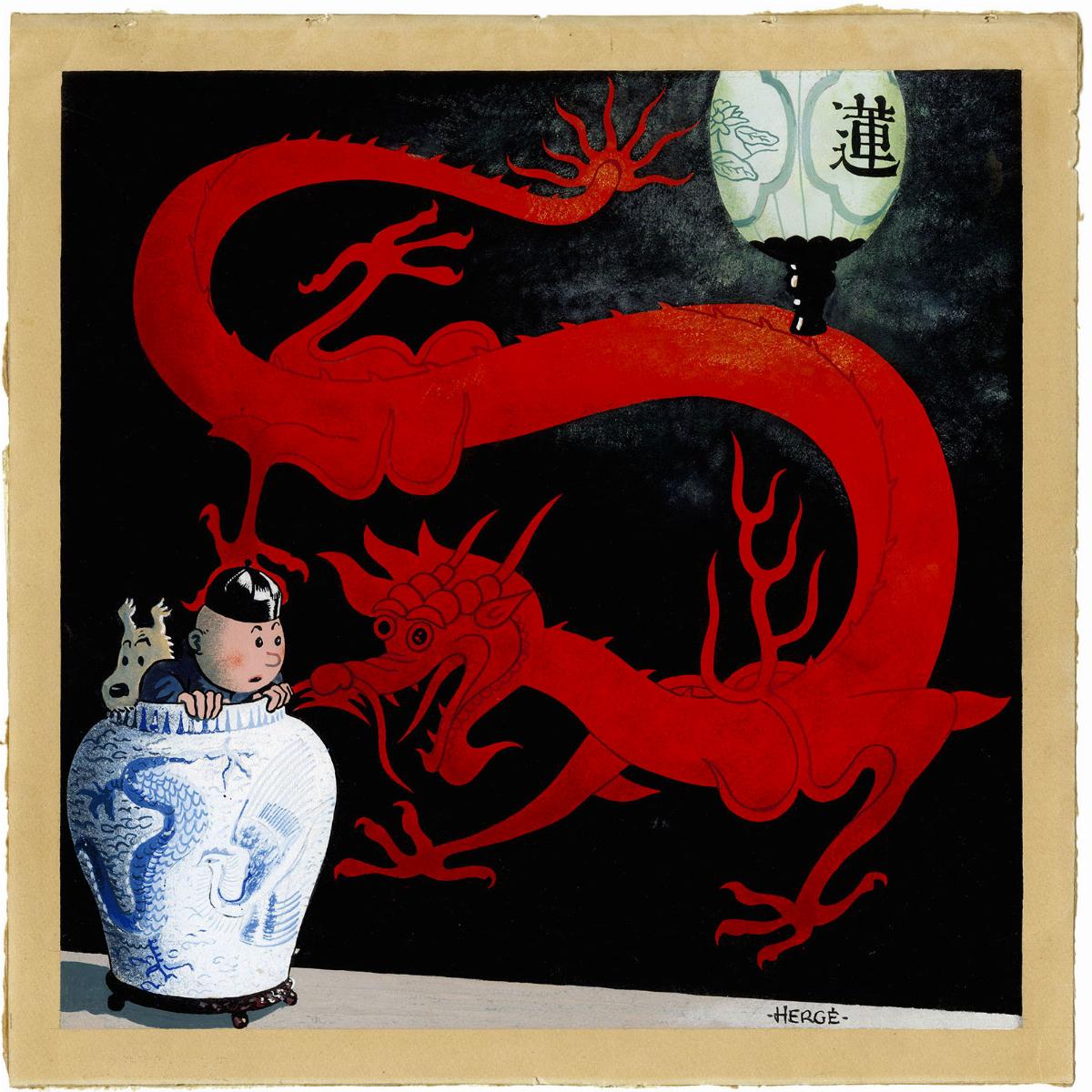
Also, as a protective totemic animal, he ensured that his character never strayed too far - or too long - from him. His presence is therefore discreet but recurrent throughout the story. Thanks to this, the dragon lives an independent life, gliding from potiches to lanterns and from wall decorations to traditional costumes.
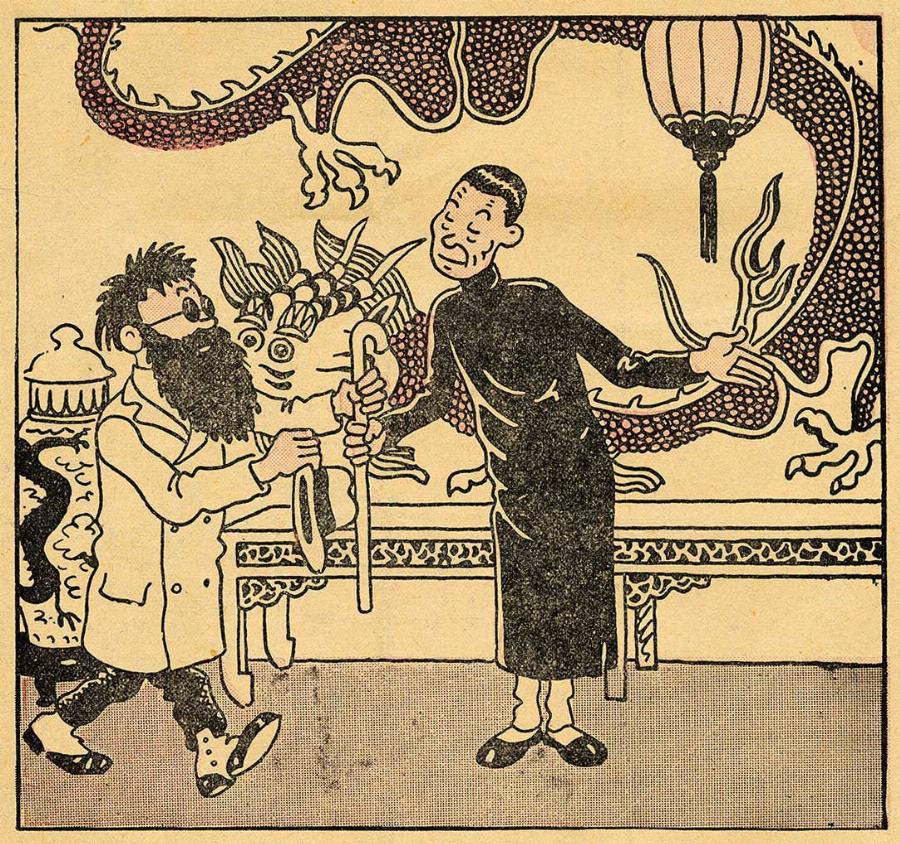
It's worth noting, however, that in the original black-and-white version of the adventure, published in 1936, his appearances were rarer than in the completely reworked and colorised 1946 version. The background is sometimes reduced to its simplest form - or even absent altogether - so as not to detract from the legibility of the action.
_o.jpg)
Although there is a wide variety of dragons and serpentine monsters in Chinese culture, Hergé chose to depict just one species. The best-known of these is the moustachioed and horned bearded Lóng, which he usually depicted in an undulating "S" shaped posture.
However, to vary the pleasure, he created them in different colours, all the more so as the colour adds an allegorical character to its initial symbolic value. Red, for example, symbolises happiness as well as good luck. Black is often associated with natural disasters (such as storms and floods) or acts of vengeance. Yellow, on the other hand, can control time and the seasons. It also evokes power, wealth or commercial prosperity. Blue - which here is directly linked to the porcelain technique - embodies peace, healing or rest.
_o.jpg)
Finally, to conclude on the symbolic charge of the Chinese dragon, let's remember that for two millennia, the animal was also the emblem of imperial omnipotence. For the simple reason that, according to mythology, every emperor was the son of a dragon. So it's only a claw's breadth to say that it symbolises the country itself!
Texts and pictures © Hergé / Tintinimaginatio - 2024