


 News
News Contest
 Forums
 Collectors
 Videos
 E-books
To life and death
Halloween is just around the corner. So to get you in the mood, this month tintin.com has put together an in-depth dossier that's downright deadly!...
Like two sides of the same coin, life and death oppose and respond to each other. One never goes without the other. That's why the spectre of the Grim Reaper often hangs over the souls that live and breathe in The Adventures of Tintin. Particularly that of the young reporter. It has to be said, too, that he's rather the intrepid type. He stops at nothing and often takes risks to solve his riddles.
So how does he always manage to escape unscathed - or almost unscathed - from the deadly traps set for him by his adversaries? That's what we're going to discover..
_o.jpg)
Symbolism of a death foretold
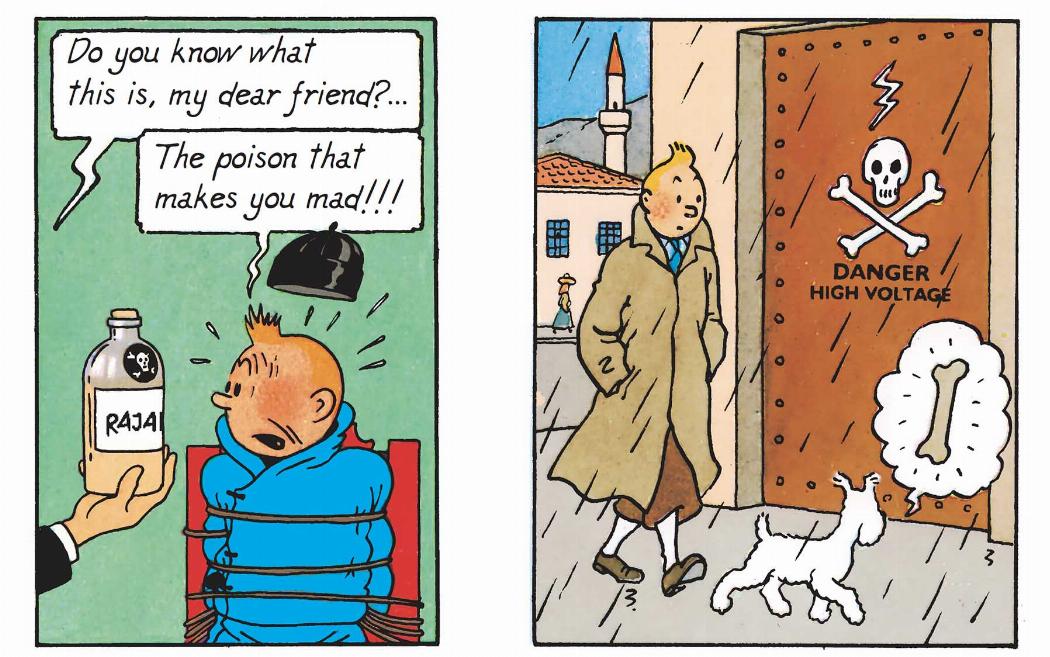
There's no denying it: death is omnipresent in The Adventures of Tintin. Recurrent, too. It awaits the young reporter around the corner, at every turn. But fortunately for him, it always rings several times before striking. It even announces its presence very clearly, leaving unmistakable warning signs in its wake. As a result, more often than not, Tintin comes across skulls... or rather, ‘warning signs’. Because when they appear, the young hero immediately understands the fatal effect of the product or thing on which they are affixed.
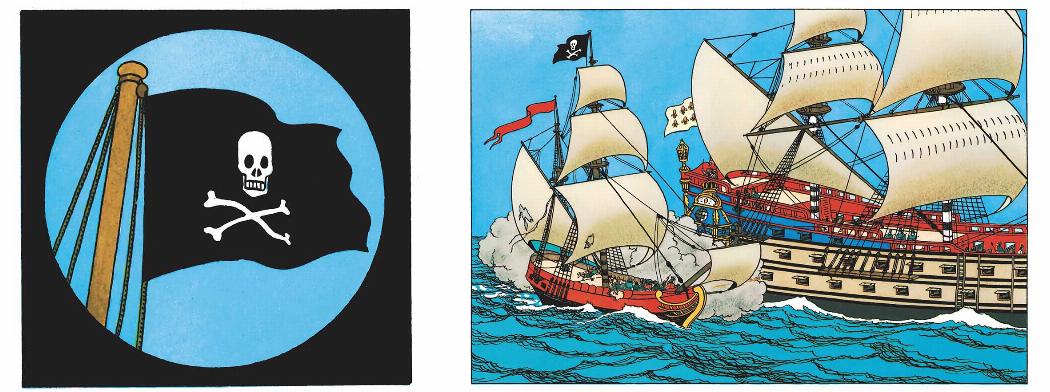
A pictorial translation of the Latin expression “memento mori“ (in other words, ”remember that you're going to die“), the human skull first symbolised death in mediaeval art and literature, before becoming a universally recognised visual warning. The first to popularise its use were pirates. In the 18th century, sea robbers used it to intimidate their enemies. This ruse gave rise to the ‘Jolly Roger’, the famous flag that has characterised them ever since. In The Secret of the Unicorn, it is thanks to this head on his shoulders... or rather, above his femurs that Sir Francis Haddock recognises the ship of Red Rackham, his infamous rival.
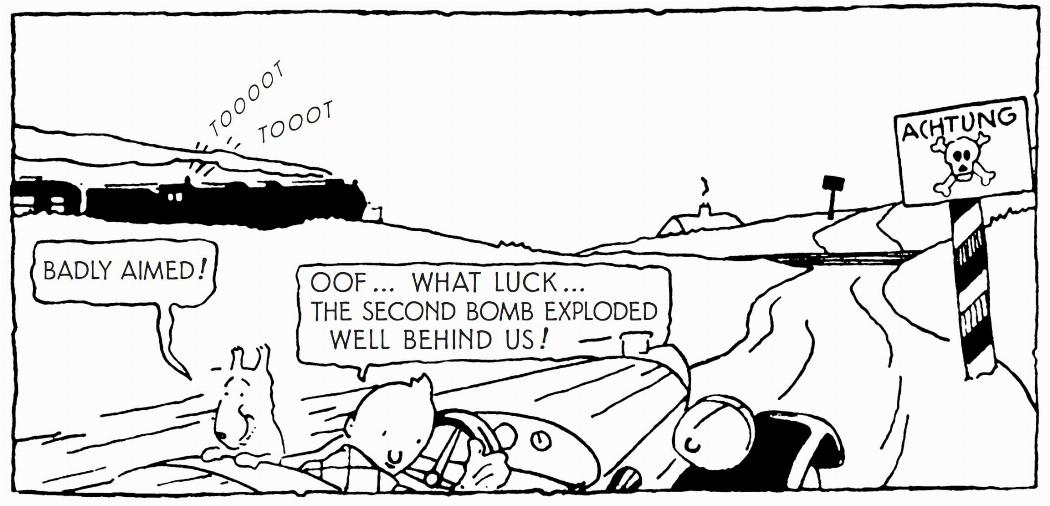
More than a symbol, the pirates made it an emblem. This helped to reinforce the long-standing association between the skull and death. In modern times, it took the form of a pictogram and became part of standardised international signage to signal all types of danger. So it's hardly surprising that Tintin should find this image in The Land of the Soviets, on a road sign warning of the crossing of a railway line.
Death on the heels
Because they are the high points of the story, the deadly situations follow one another at a frenetic pace. In Uncle Sam's country alone, Tintin is exposed to a festival of celebrations, each more dangerous and deadly than the last. Calamities galore. In fact, the young hero is constantly running from risk to risk: a car accident, drowning, an assassination attempt, and tied to a stake, shooting, falling off a cliff, hanging, fire of undetermined origin, ordeal on the rails, explosion or involuntary plunge into a gigantic crusher-mixer. In short, so many opportunities for him to die.
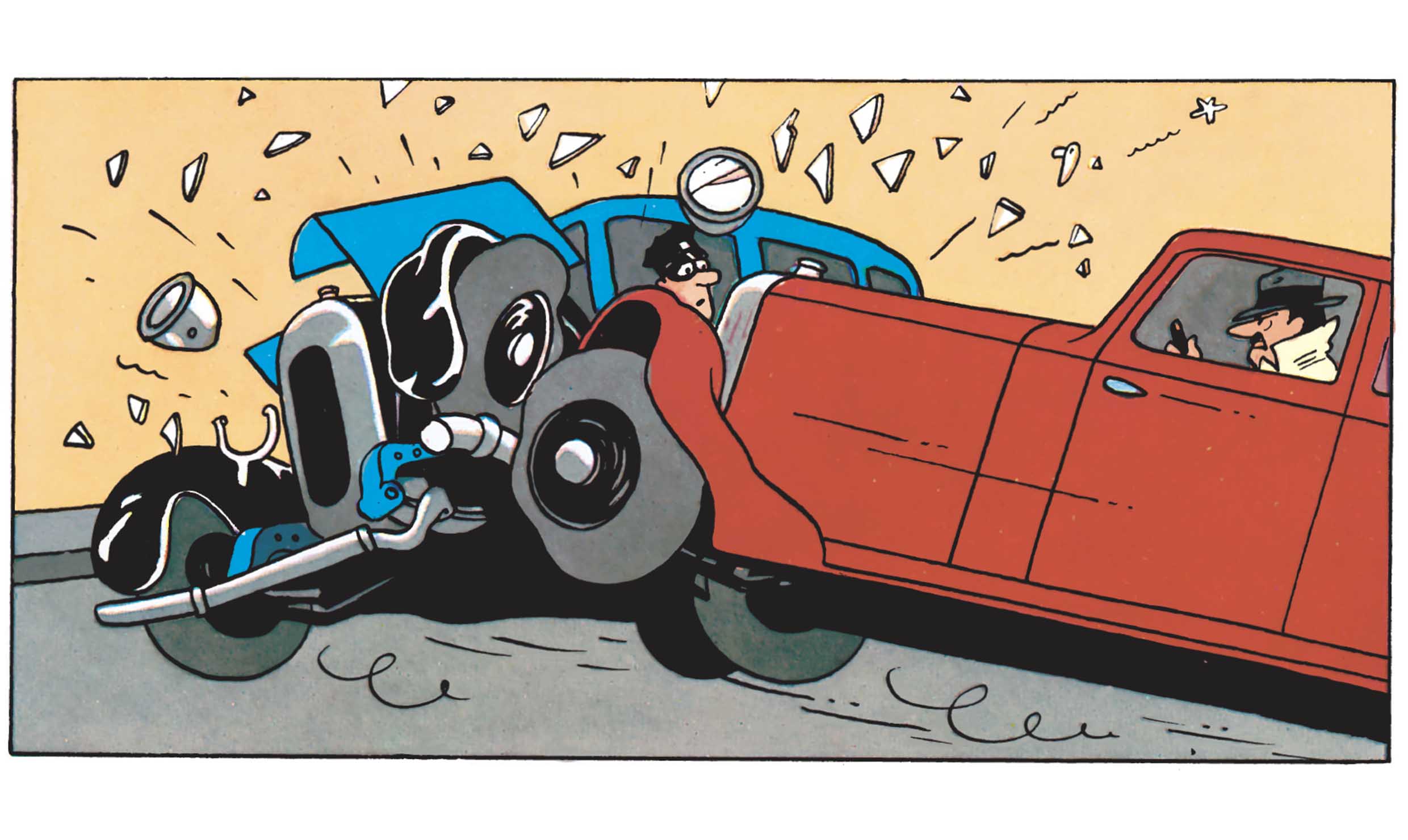
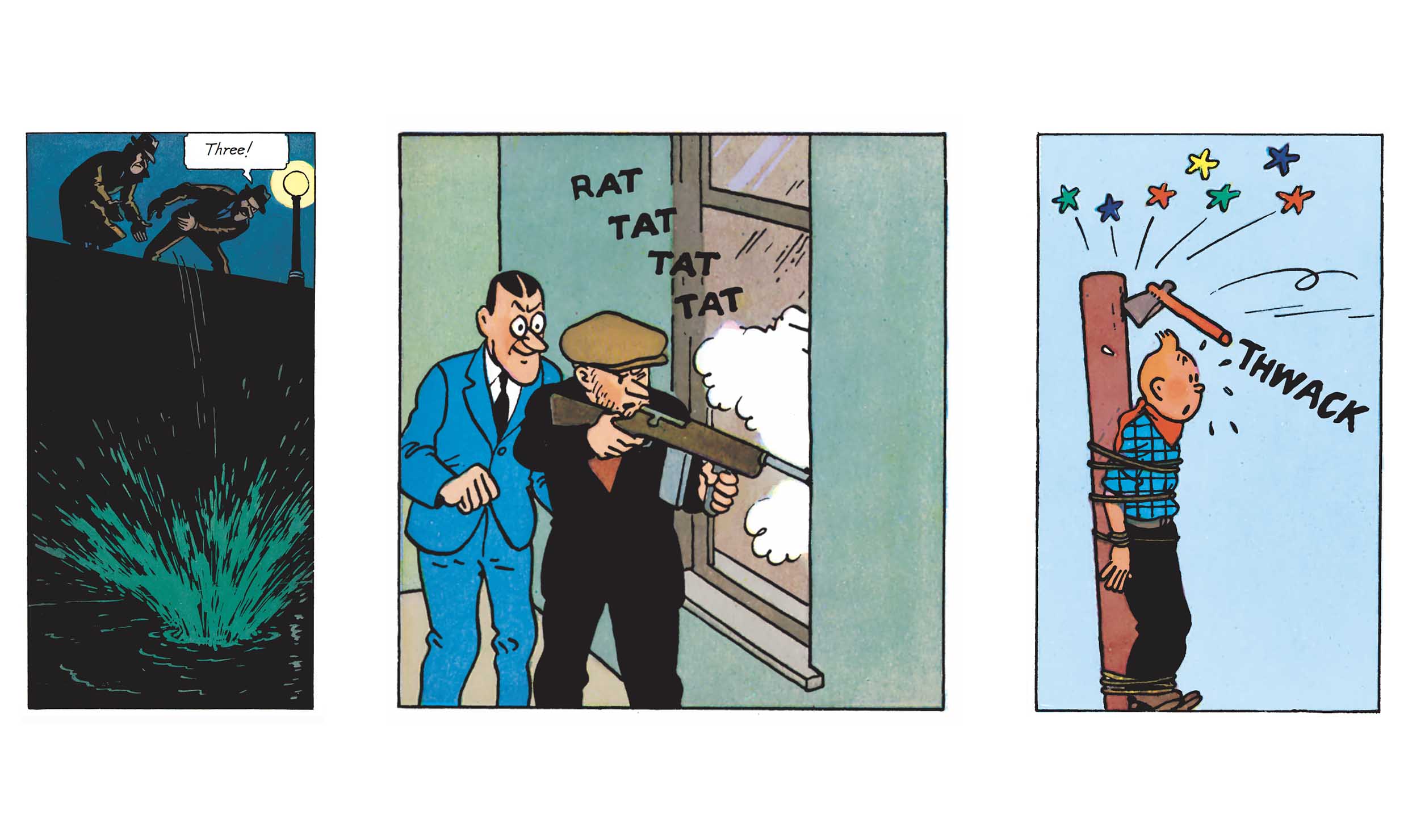
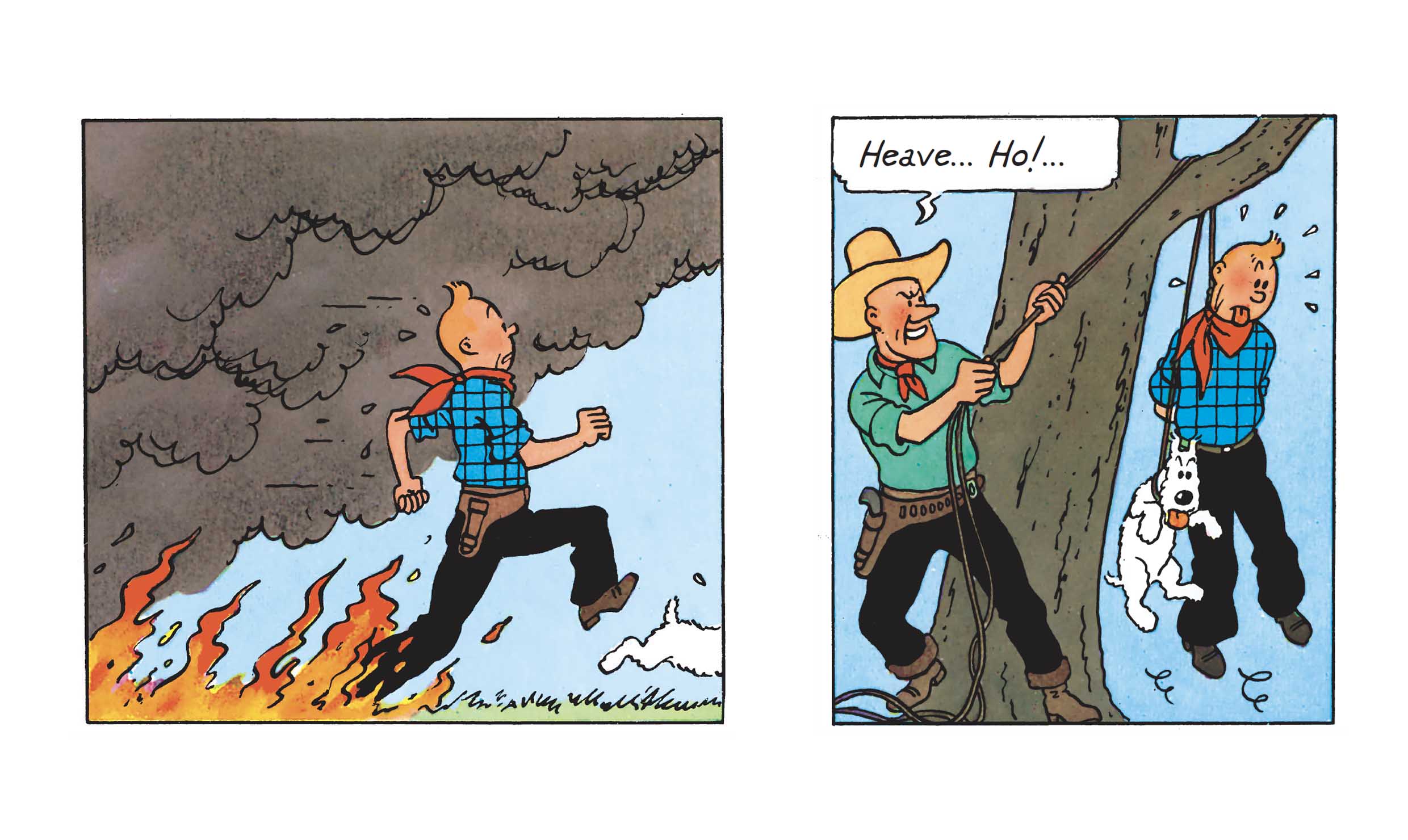
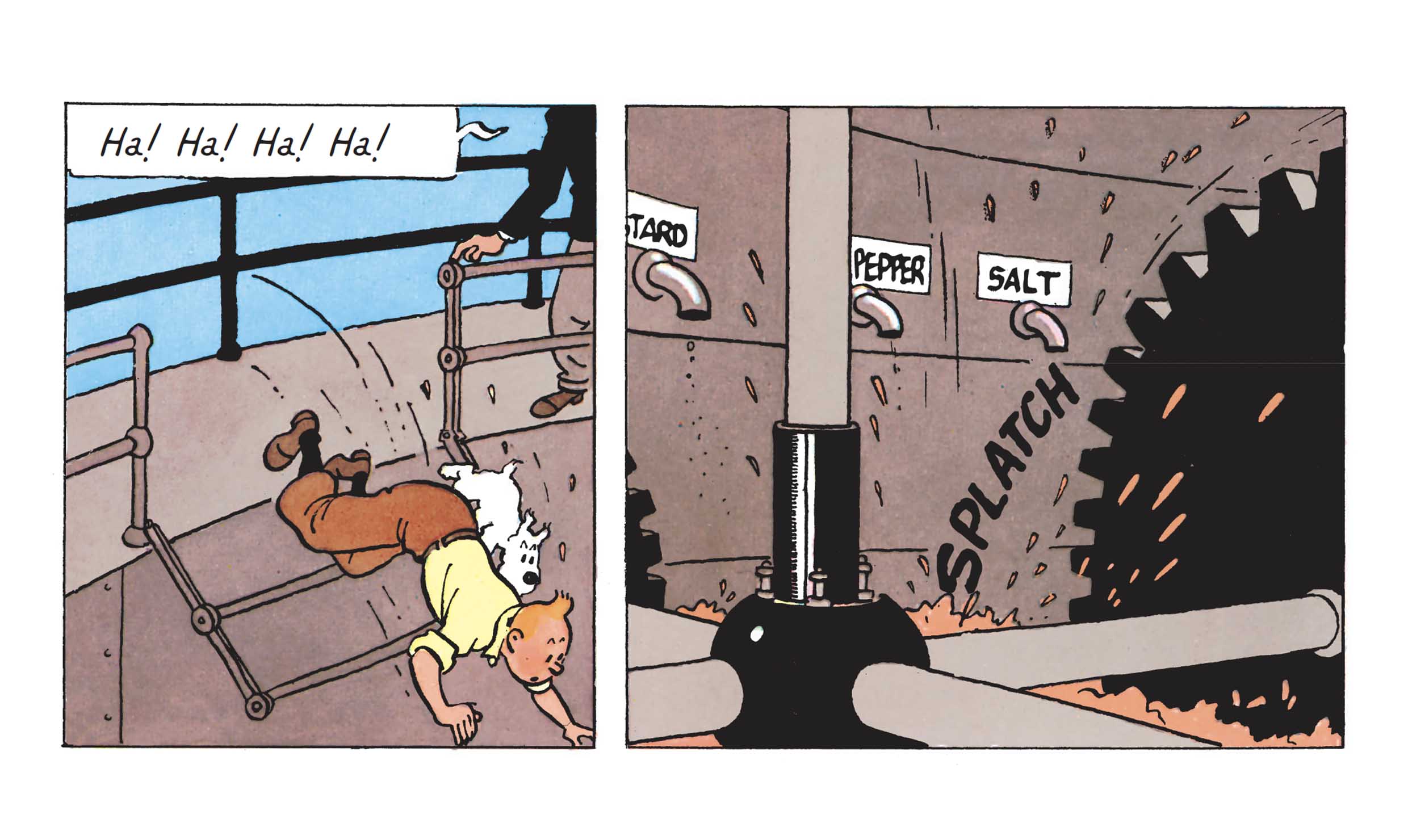

Extracts from the festival of calamities in Tintin in America
At the same time, if there were no danger in his adventures, he would not be the valiant hero we know. For it is by constantly risking the ‘ultimate prize’ - in other words, the price of his life - that he has acquired this very special status.
Of course, Tintin is also a talented cheater of death. And if he always rises from his ashes, it's not because he's immortal, but because the scenario dictates it. On the one hand, because as a hero, he embodies hope and triumph in the face of adversity (so he laughs at all the difficulties, including those that could prove fatal); on the other hand, because without this indispensable condition, goodbye saga and continuity (let's specify here that the disappearance of the main character always undermines the dynamics of the narrative universe of a series).
Finally, it should be noted that the death traps that Tintin must constantly avoid are, in reality, nothing more than visual allusions. Graphic suggestions based on the principle of causality. Because he finds himself in a situation that is at its most dangerous, the reader imagines the dramatic consequences that could potentially result. Thanks to this approach, no violent or shocking scenes appear in the vignettes.
Exquisite corpses
Indeed, given that The Adventures of Tintin is aimed at a young audience, Hergé always took care to spare his effects - and sensibilities - so that his stories remained accessible. That's why death is even more discreet and subtle. To achieve this, the Belgian author-comic strip artist never hesitated to play on... or rather, with words, but without ever forgetting to weigh them up. He knew full well that if they are well chosen, they will hit the nail on the head. And without offending or hurting anyone.
In the first volume of his lunar adventures, he regularly evoked the risks associated with the space expedition to maintain a certain tension, before spicing things up in the pre-launch sequence. He uses and abuses terms belonging to the lexical field of danger to build up the pressure. He also takes advantage of the group effect and the cumulative sequence of words spoken by his characters to heighten their importance.
Here's what it says: ‘We'll be watching anxiously from here as you race towards our satellite. A simple short-circuit and it's a crash into the Earth or the Moon, or an endless race through space. There are also the risks of landing, or rather landing on the Moon. Meteorites that can pulverise you. You know all these dangers and you've decided to face them. But there's something else too. [...] Enemies could try to [...] get hold of your rocket,’ explains Baxter. Haddock, who has no shortage of repartee, also makes his contribution with a short but well-felt sarcastic tirade: ‘Well, it promises to be a charming little excursion! Calculus bounced back and outbid him to deliver the coup de grâce: ‘Don't worry, Mr Baxter. Rather than come to this, we'd all rather blow ourselves up ‘.
_o.jpg)
Hergé may have been a master of verbal death threats, but he also excelled at graphic and silent black humour. All he had to do was illustrate the famous expression ‘skeleton in the cupboard’. So, in Tintin in the Land of the Soviets, he hides two of them in the ‘mysterious house’ discovered by his young protégé after he has crawled through the snow. The first, in the form of bones stored in the hearth of a fireplace; the second, in the form of a skeleton hidden in a Comtoise clock striking the 12 strokes of noon... er, midnight, since it's night time.
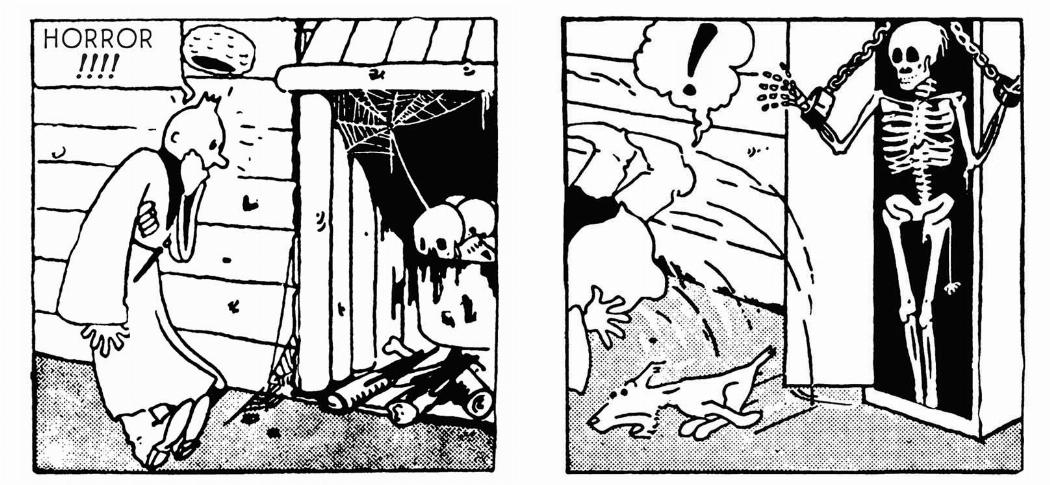
The gag worked like a charm. So much so that Hergé did it again, 24 years later, in Destination Moon. But this time in a lighter, more scientific version. Thomson and Thompson chase their own X-ray skeletons down a corridor. Classic comedy! Proof that Tintin's creator is also capable of making us laugh out loud at a sensitive subject.
Death that kills
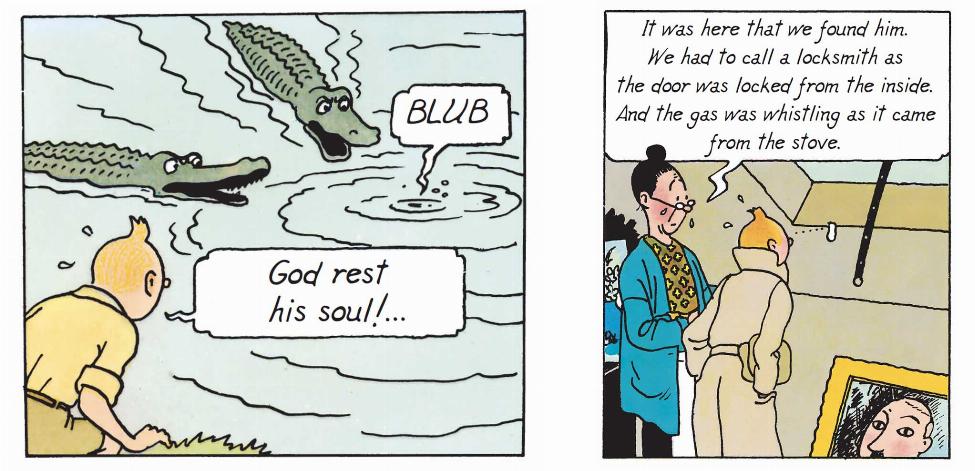
In the end, in Hergé, death is more often a hostile intention than a real end in itself. On the other hand, when it does its work, it doesn't beat about the bush. In Tintin in the Congo, for example, wildlife knows all about it, because it pays the price, both in terms of types... or rather, species and numbers. Among the victims: a herd of gazelles, a monkey, a snake, a group of crocodiles, an elephant and a rhinoceros. Generally speaking, the animal kingdom pays the heaviest price in the adventures of the young hero. Examples include the killing - and boxing - of the ox in Tintin in America, and the impromptu safari at the Prisoners of the Sun, with the forced executions of a condor, a boa constrictor and several alligators.
_o.jpg)
On the human side, while Tintin and his fellow adventurers always escape, this is unfortunately not the case for certain secondary figures. In Tintin in the Congo, Tom is eaten alive by hungry crocodiles after falling heavily from a cliff. On an equally accidental note, the sculptor Balthazar died. According to the press article faithfully reproduced in The Broken Ear, he was careless in leaving the tap on his gas stove open.
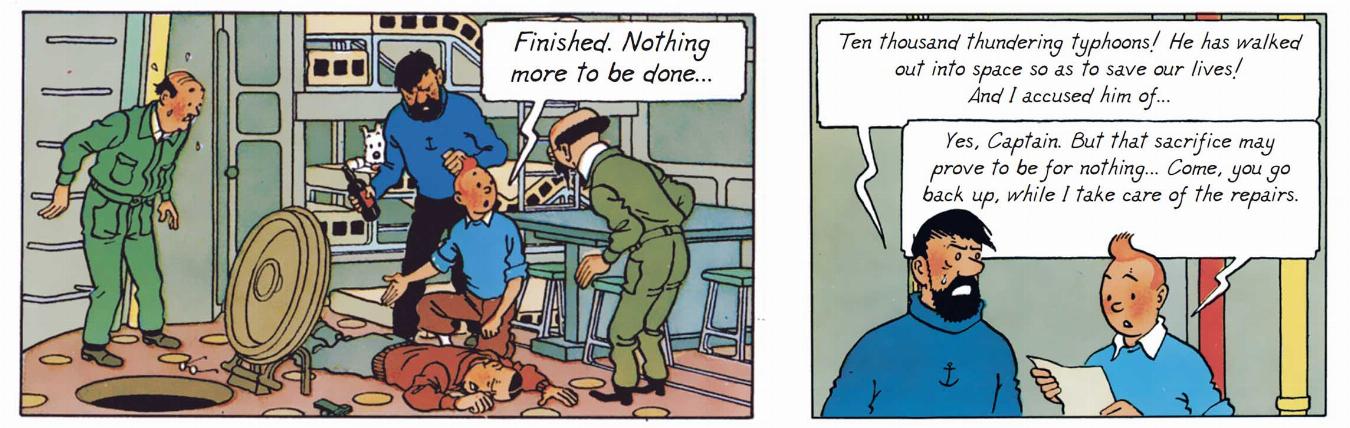
Finally, how can we talk about disappearances without mentioning those of Boris Jorgen and Frank Wolf in Explorers on the Moon. The former succumbs to his injuries after being hit by a stray bullet during a fight. His inert body is the only one to appear in the entire saga, and this is only because of the confined space inside the rocket. He is evacuated shortly afterwards, however. As for the second, he takes his own life to increase his teammates' chances of survival (at this point in the story, the rocket's oxygen reserves are at their lowest) and to make amends for the betrayal he inflicted on them (Jorgen blackmailed him into getting into the rocket). In the case of the felonious engineer, the word ‘disappearance’ takes on its full meaning, as his sacrifice is treated elliptically. He quietly takes his leave between the end of illustration plate 53 and the beginning of illustration plate 54. Only the farewell letter he leaves behind informs the others of his tragic end.
Talking of endings, we've just come to the end of this dossier. So it's time to wish you all a happy... or rather, a frightening Halloween!
Texts and pictures © Hergé / Tintinimaginatio - 2024


