


 News
News Contest
 Forums
 Collectors
 Videos
 E-books
Where did the shooting star fall? An investigation in the heart of the ice
It is a breathless chase, punctuated by dirty tricks and twisted moves, and ending with a finale that is anything but mild: trying to locate a meteorite in the white immensity of the Arctic!
And yet, in The Shooting Star, it becomes a great adventure that, in many respects, reminds us of the golden age of Arctic exploration. For our friends, the objective is a meteorite, a stone fallen from the sky that floats like an island, and two expeditions racing at full speed to be the first to reach it. The Aurora, captained by Haddock, moves forward between the icebergs, while another ship, Peary’s vessel, progresses at maximum speed through the ice to try to gain the advantage.
A genuine race begins against the cold, against time, and against the competition. Raise the anchor, hoist the sail, check the ship’s clock one last time, today we are steaming full speed toward a lost point in the Arctic!
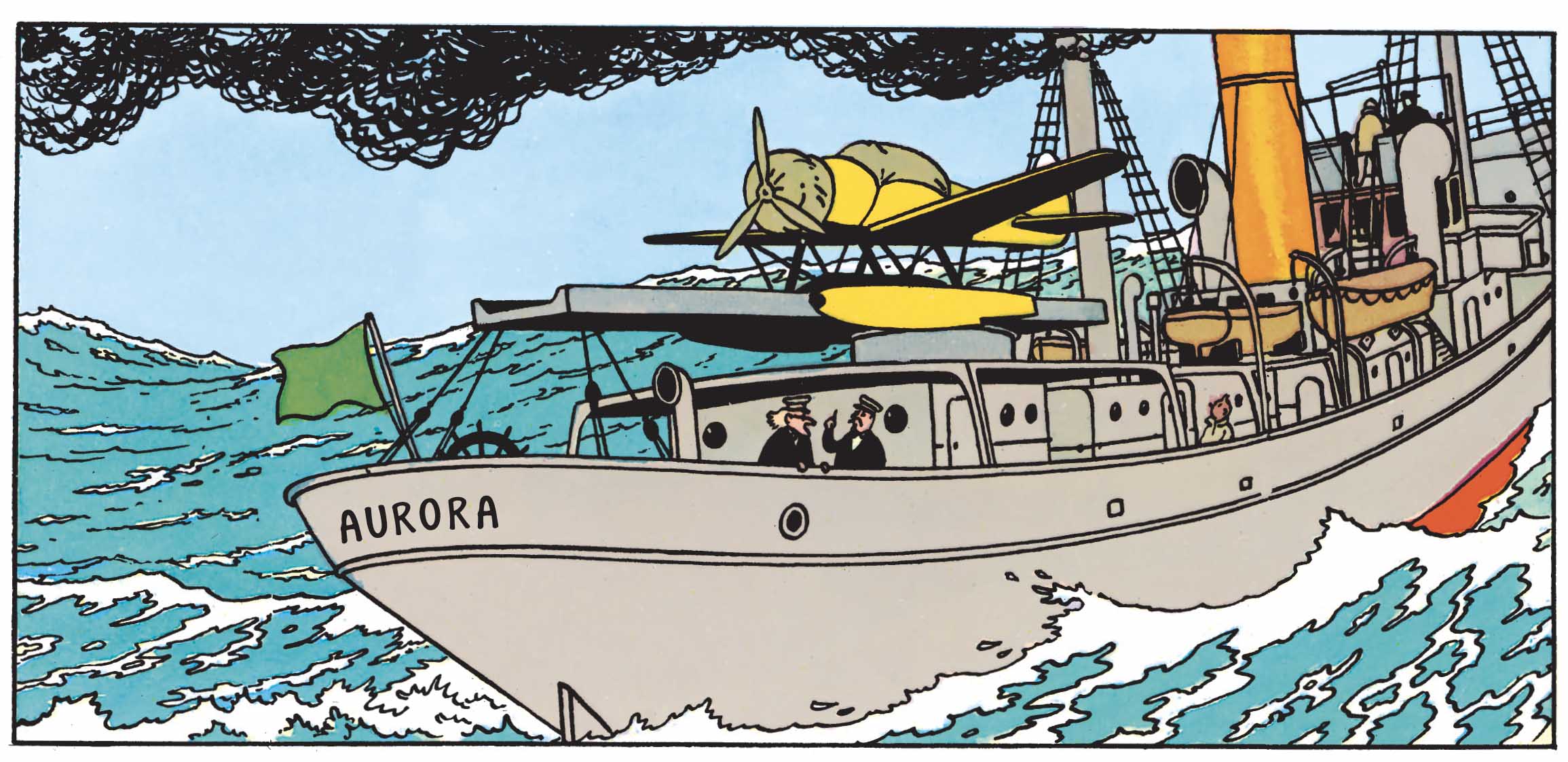
The end of time is here!
What strikes us today is how Hergé multiplied clues so that this chase could almost be reconstructed like an investigation. In the margins of the panels, on the dials of the clocks, in the dialogues exchanged by radio, appear bearings, directions, minutes, coordinates, latitudes which, taken together, draw an astonishingly realistic geography. The preparatory documents confirm it. From a handful of scattered data, it becomes possible to determine the probable impact zone somewhere in… but hush! not the reveal yet. A rare precision in a comic book, and once again a sign of Hergé’s fascination with exactitude.
It all begins when Tintin spots from the seaplane a column of steam rising in a clear sky. A strangely isolated, vertical phenomenon, appearing to the east like a still-hot scar. « Repent!... The end of time is nigh!.. » No, Philippulus, nothing of the sort.
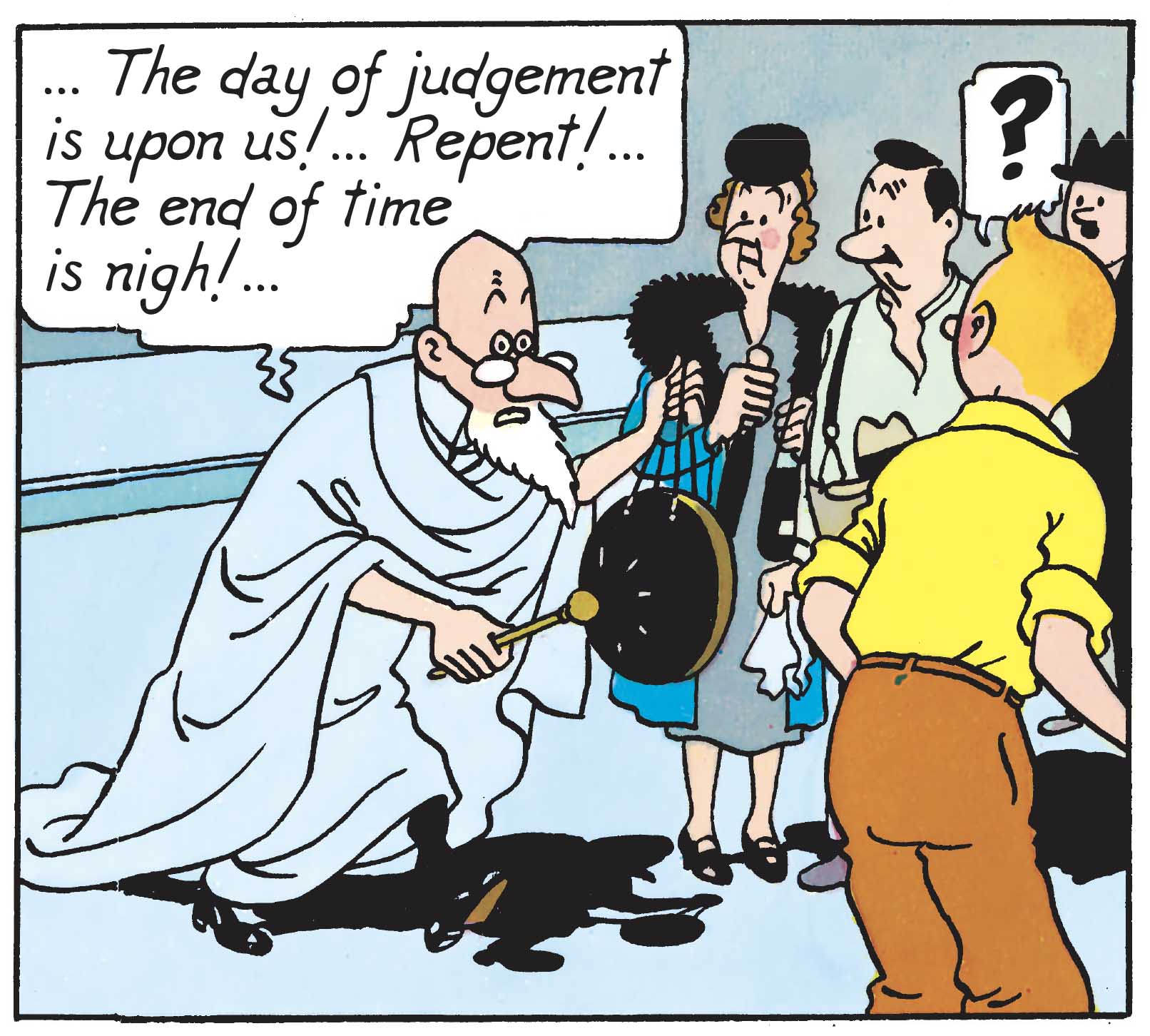
In fact, it is the first sign that the meteorite, upon striking the sea, triggered a violent release of steam. From there, everything follows. Tintin and Haddock fly for exactly two hours, from 10:15 to 12:15. Their aircraft, flying at constant speed, defines a perfectly delimited search zone. On the sea, the Aurora progresses following these indications, while Peary’s expedition, also experienced, tries to anticipate.
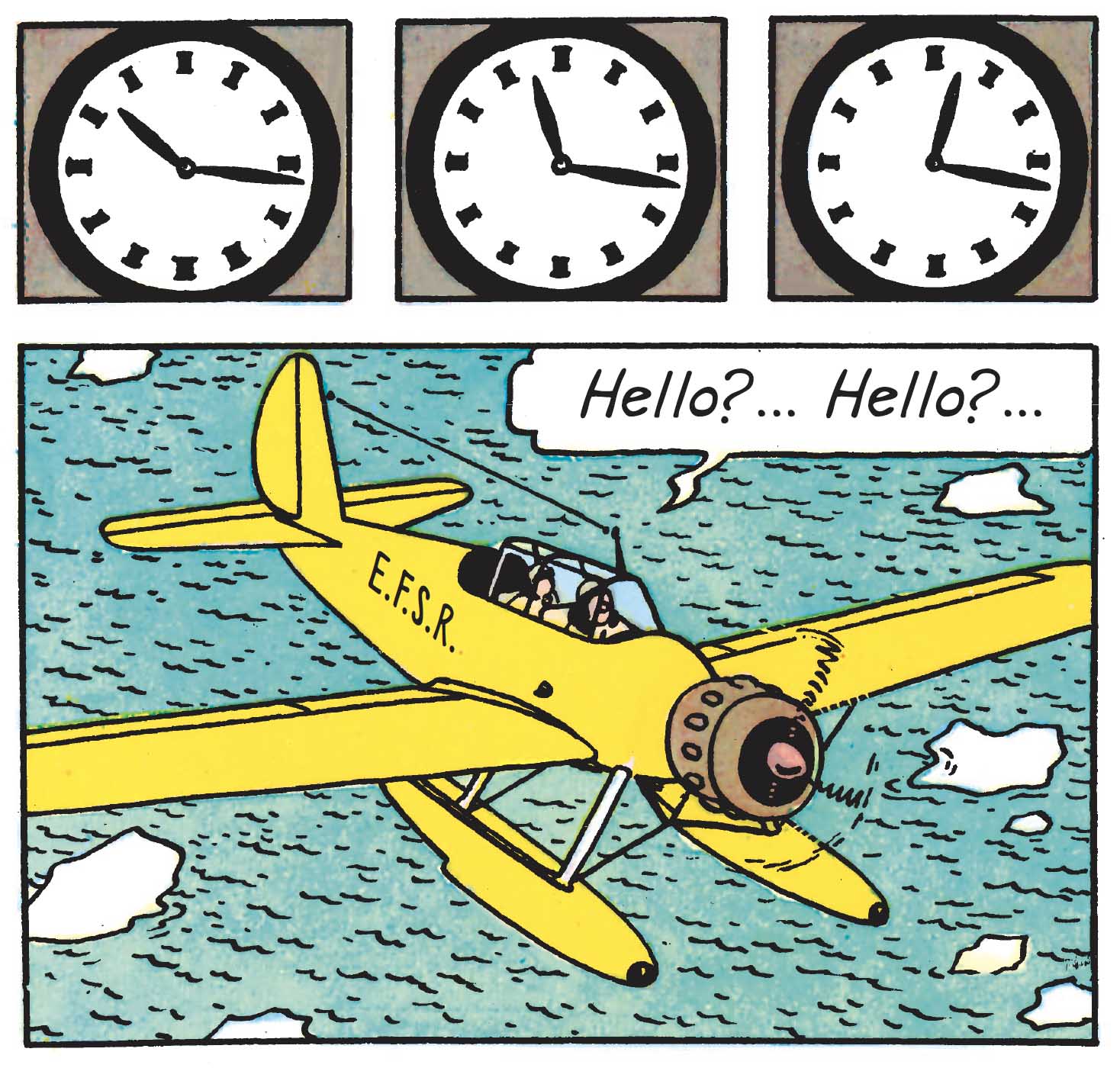
This play of cross-referencing allows Hergé to build true navigation. The bearings match, the latitudes match, and even the weather observations correspond to what one might really encounter in that part of the world. One could imagine a polar geography exercise, but everything comes simply from a comic strip whose panels suddenly function like a ship’s logbook.
The devil is in the details
It is no coincidence that Hergé included Peary in the race. The name belongs to the famous American explorer Robert Peary, a mythical figure in Arctic expeditions. By using him as a scientific rival, Hergé gives historical weight to the plot, as if Tintin’s adventure were inscribing itself into a long lineage of northern conquests. And sometimes such expeditions gather old sea dogs, like good old Chester. Every minute counts, every shift of the pack ice can win or lose the meteorite.
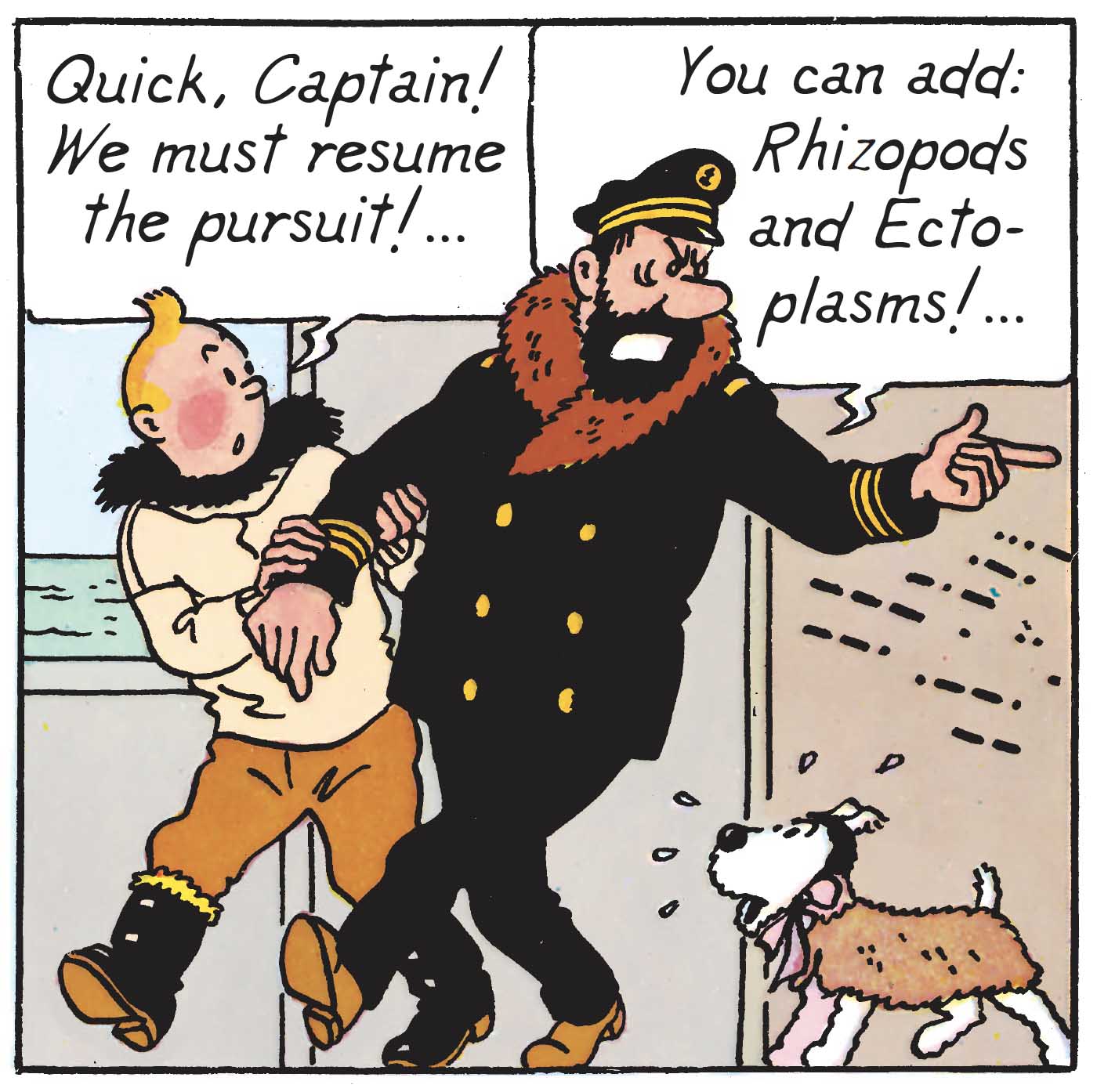
As the album progresses, the impact zone narrows. The cross-referenced reports and observations end up defining a strip between the 8th and the 13th meridian, forming a 20-degree angle with the 9th, as if the album itself were drawing a map. The meteorite can only be located at the intersection of these data, yet the mystery persists, because the fragment fallen from the sky melts before the very eyes of the explorers, eaten away by temperature second after second.
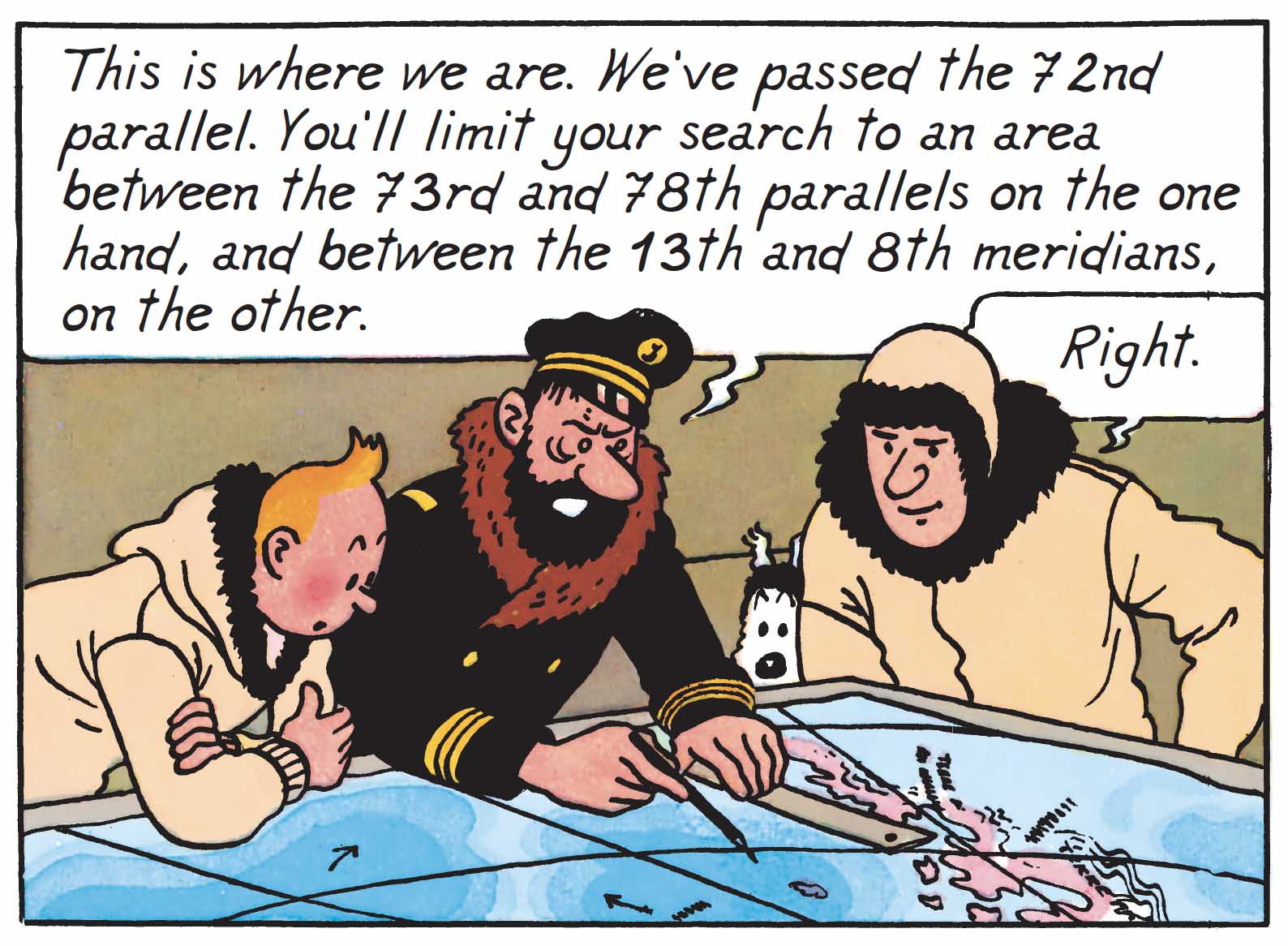
On the one hand, almost mathematical rigor, with Hergé flirting with the limits of reportage. On the other, a sense of wonder untouched, seeing Tintin and Haddock advancing in an immense world known to scientists… Jan Mayen, Spitzbergen, the Barents Sea, lines of latitude, longitudes marked in red, everything composing a map that is far from a simple illustration and points clearly to the Greenland region.
A denouement on edge
And in the end, rivalry is not what triumphs. What remains is the impression of a geographical investigation carried out in the heart of the Arctic, under a clear sky traversed by unexplained phenomena. The meteorite is not a treasure, not an artefact, not a state secret. It is a fragment of the universe fallen onto our planet, a piece of night washed up in the sea, and Tintin, true to himself, rushes toward it with the curiosity of a scientist and the heart of a traveller.
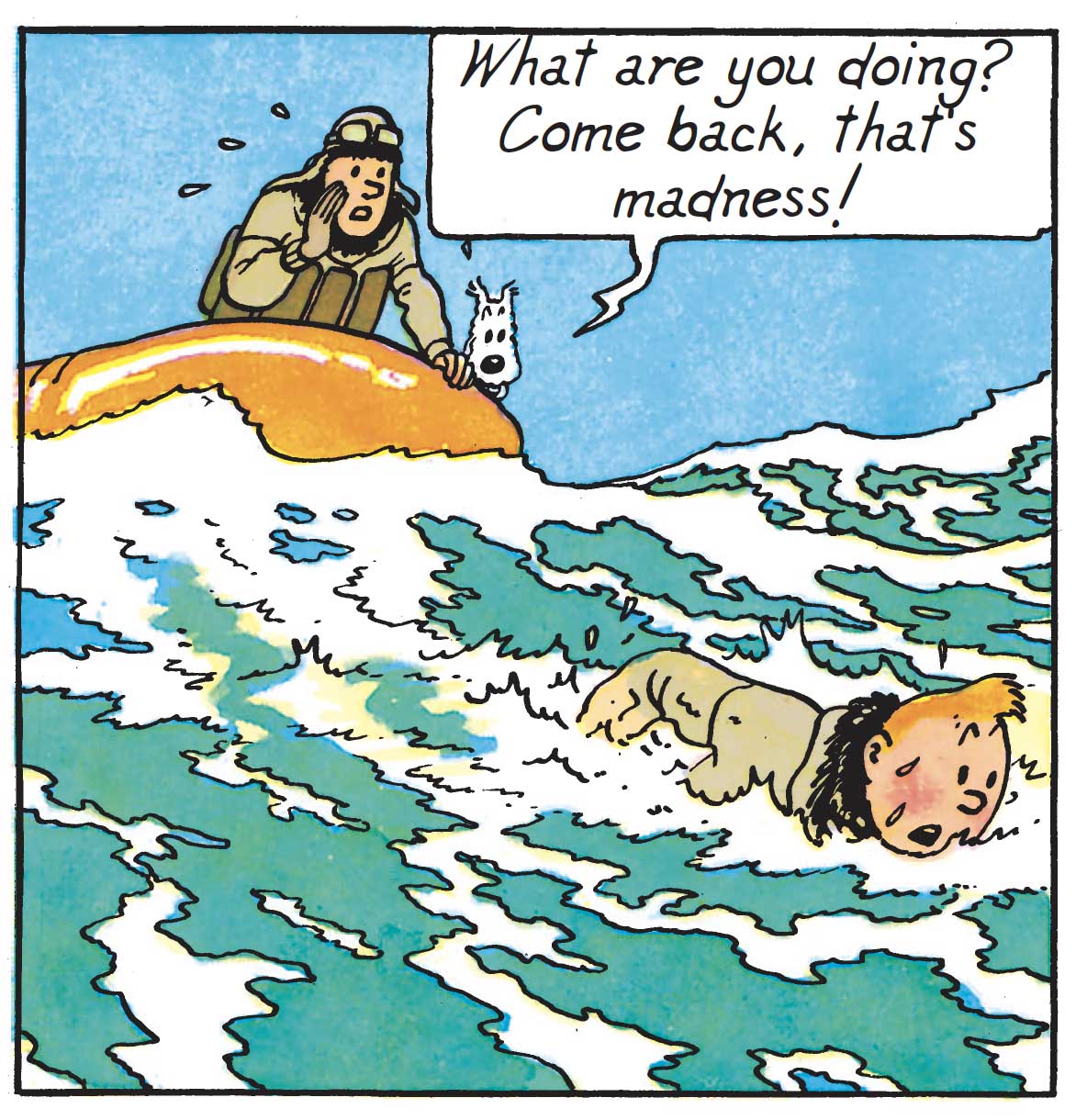
There he finds, in no particular order, outsized critters, including spiders far larger than the one that once dared to fall onto Professor Calys’s telescope lens, and gigantic mushrooms that dissolve in the blink of an eye… If one wishes to understand why The Shooting Star remains such a singular album, one simply has to look at that map where the trajectories intersect. It seems to tell us that Hergé never drew a simple background. He drew a world in which one can navigate, calculate, search and, sometimes, thanks to a few clues hidden in the panels, locate the exact resting place of a fragment of star swallowed by the northern waters.
And for those who follow the clues to the end, for those who accept to lose themselves among the longitudes, the bearings and the aerial observations, one conclusion emerges at last, almost timidly: deep inside the great polar hunt told by Hergé, everything points to one very precise place, we can locate the aerolith with a margin of error not exceeding 10% at G 20° E and L 84° N ”, not far from a promontory the maps call… Cape Morris. It is there, in all likelihood, that the fragment fallen from the heavens struck the sea before disappearing.
Texts and pictures © Hergé / Tintinimaginatio - 2025


