


 News
News Contest
 Forums
 Collectors
 Videos
 E-books
The Speaking Vignette: Marlinspike Fanfare Band
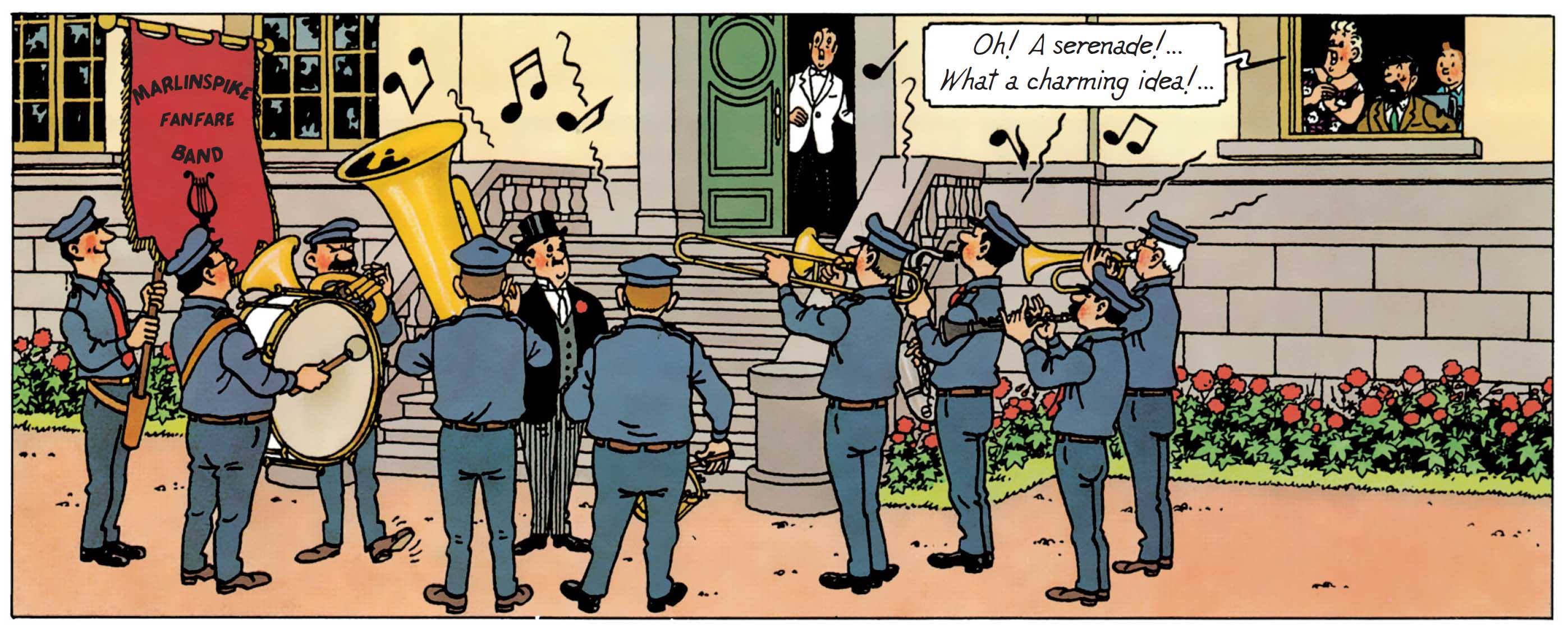
Trumpets, trombone, clarinet and snare drum slung over the shoulder, a group of musicians bursts in, almost impeccably aligned, uniforms crisp and instruments gleaming. What joyful occasion are they celebrating, all fire and flame?
The band is there to honour the supposed union of Bianca Castafiore and Captain Haddock, trumpeted by a sensation-hungry press. The spokesman of the Society of Friends of the Marlinspike Band does not hesitate to share in the delight of such a grand occasion, one said to have international resonance.
A few heroic bars, enthusiasm laid on a little too thick, and beneath the display of solemnity the musicians throw themselves into it with gusto, in a context bordering on collective hysteria. Thus « Marlinspike Fanfare Band » advances in procession before the grand front steps, come to salute a wedding that… will never take place. In The Castafiore Emerald, Hergé delivers a scene of irresistible burlesque, inspired by a very real personal anecdote.
But first, how could one forget that memorable couple: Castafiore and Karbock… or was it Kappock? Perhaps the diva prefers Kosack, Mastock, or some other variation in « -ock » spun from a slightly misfired aria. At Moulinsart, Haddock’s name changes with the rhythm of her vocal exercises, ready to be modulated, mangled and mistreated.
The band is therefore playing for a phantom event. In this month of February, when couples embrace tenderly, love here is manufactured out of thin air in the pages of Paris-Flash (a title inspired by the real-life Paris Match), embodied by the meddlesome Jean-Loup de la Batellerie and the photographer Walter Rizotto.
Yet the image goes further. Behind these figures lies a genuine memory. Hergé later recounted how a local brass band once descended upon his home in Céroux-Mousty, already « well oiled », as he put it, after having toasted their way through neighbouring chapels. Arriving in a wagon, the musicians made a triumphant entrance. They eventually raised a resounding toast… to the glory of Spirou!
The scene was so absurd it seemed scripted in advance. This recollection, later shared with Numa Sadoul in Tintin and I, casts the panel in a new light.
In Hergé’s work, reality often preceded fiction. The comic absorbs the anecdote, refines it, weaves it into the narrative, yet preserves its original flavour: polite embarrassment and fully embraced absurdity. A perfect device with which to honour our two would-be lovebirds. In The Castafiore Emerald, almost nothing happens, except the essential: the manufacture of an event born of a misunderstanding. The band, like the press, celebrates a most splendid mirage.
A few days after Valentine’s Day, let us spare a thought for poor Captain Haddock. True, he has not found love, but he has found a brass band: instruments raised, drum rolling, ready to celebrate a union he never knew existed.
The musicians disperse after Bianca Castafiore offers them champagne, departing in high spirits. The wedding evaporates as quickly as it appeared, and the adventure ends without a kiss. You can’t put one over on an old sea dog. But now you know that the Marlinspike Band once played somewhere between Céroux-Mousty (a town in Belgium) and Moulinsart.
Texts and pictures © Hergé / Tintinimaginatio - 2026


