


 News
News Contest
 Forums
 Collectors
 Videos
 E-books
One flew over the airplane’s nest
What if Tintin’s planes told far more than just simple journeys?
The question may seem surprising, and yet it becomes obvious as soon as you take a step back: from the improvised first flight in Tintin in the Land of the Soviets to the modern aircraft of Tintin and the Picaros, our reporter travels far more than continents, he moves through an entire century of fuselages.
Because in Hergé’s work, the airplane is never just a background prop, placed there to look nice or to speed up the plot for convenience. It is both a witness and a clue for those who enjoy following, from one album to the next, how these aircraft evolve. A nearly documentary trace of a world in transformation, where aviation, in just a few decades, moves from bold improvisation to the vast scale of modern fleets.
So let us follow Tintin not from one country to another, but from one aircraft to another, and see how these machines tell, in their own way, a broader story: that of the 20th century taking flight. This article does not aim to be exhaustive, it would require the logbook of an air traffic controller, but rather a journey at wing level through the machines that carry adventure itself.
Fasten your seatbelts, aviators, and, if possible, keep an eye on the propeller: we’re taking off!
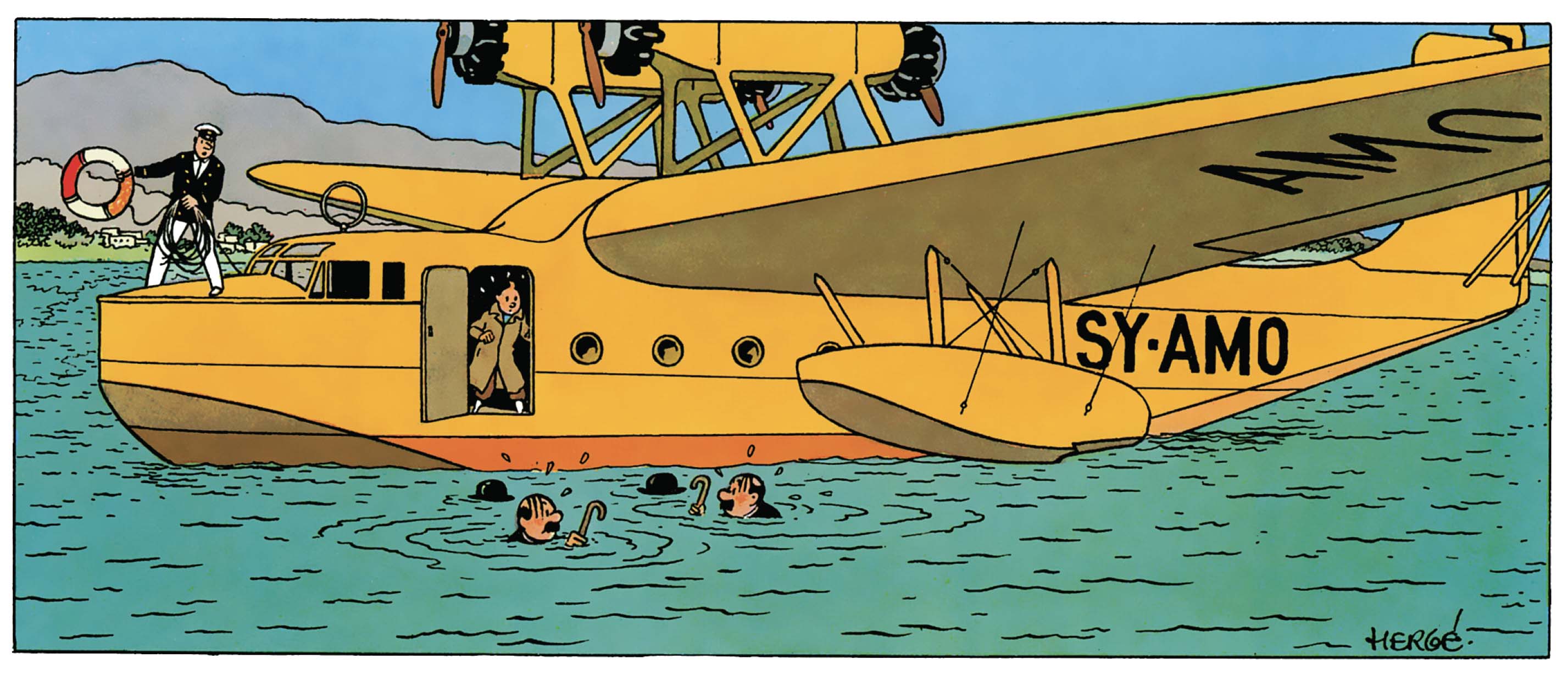
The Age of Pioneers
In the early days of aviation, flying machines were unsettling, and not just for Tintin. They shake, rattle, and seem ready to fall apart at any moment, reminding the reader that in the 1930s, flying was still an act of daring, bordering on recklessness.
In Tintin in the Land of the Soviets, Tintin takes the controls himself, as if flying were second nature, learning on the fly between two chases. Why not, after all? Snowy talks without hesitation, so why shouldn’t Tintin fly?
The airplane is not yet a structured means of transport, it is a tool of adventure, almost a dangerous toy. And not just any one: it is most likely a Polikarpov L-1, a rudimentary aircraft that seems to stay airborne more by luck than engineering. He crashes, pulls out his knife, carves a propeller from the nearest tree, gets it wrong, tries again… the second one will do, and off he goes again without batting an eye, even performing acrobatics on the wings themselves. Repairs have certainly been more complicated.
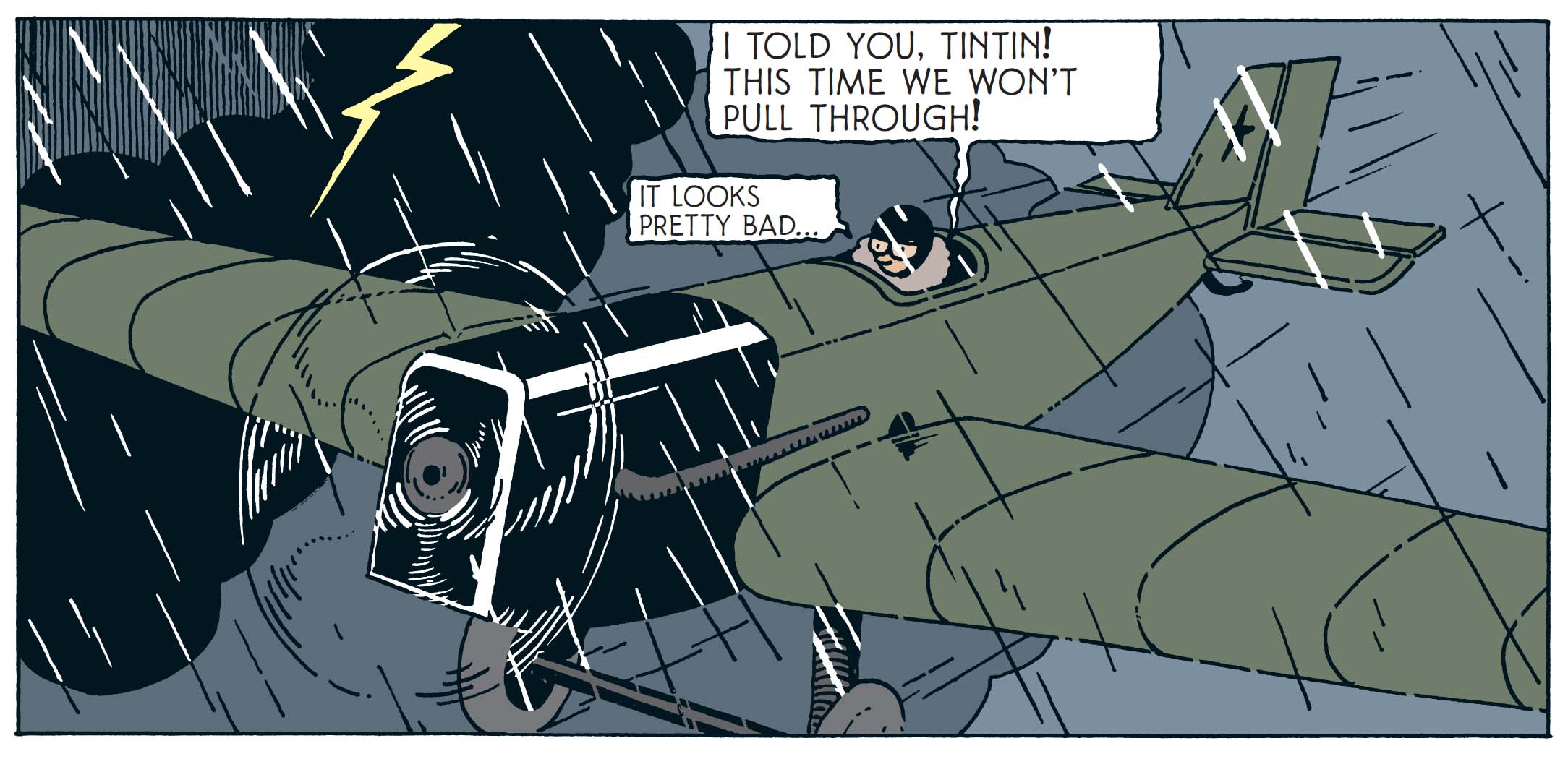
No comfort, no real control… far from modern aviation. But that hardly matters, Tintin plunges headfirst into adventure, trusting his life to a few planks of wood and a great deal of audacity.
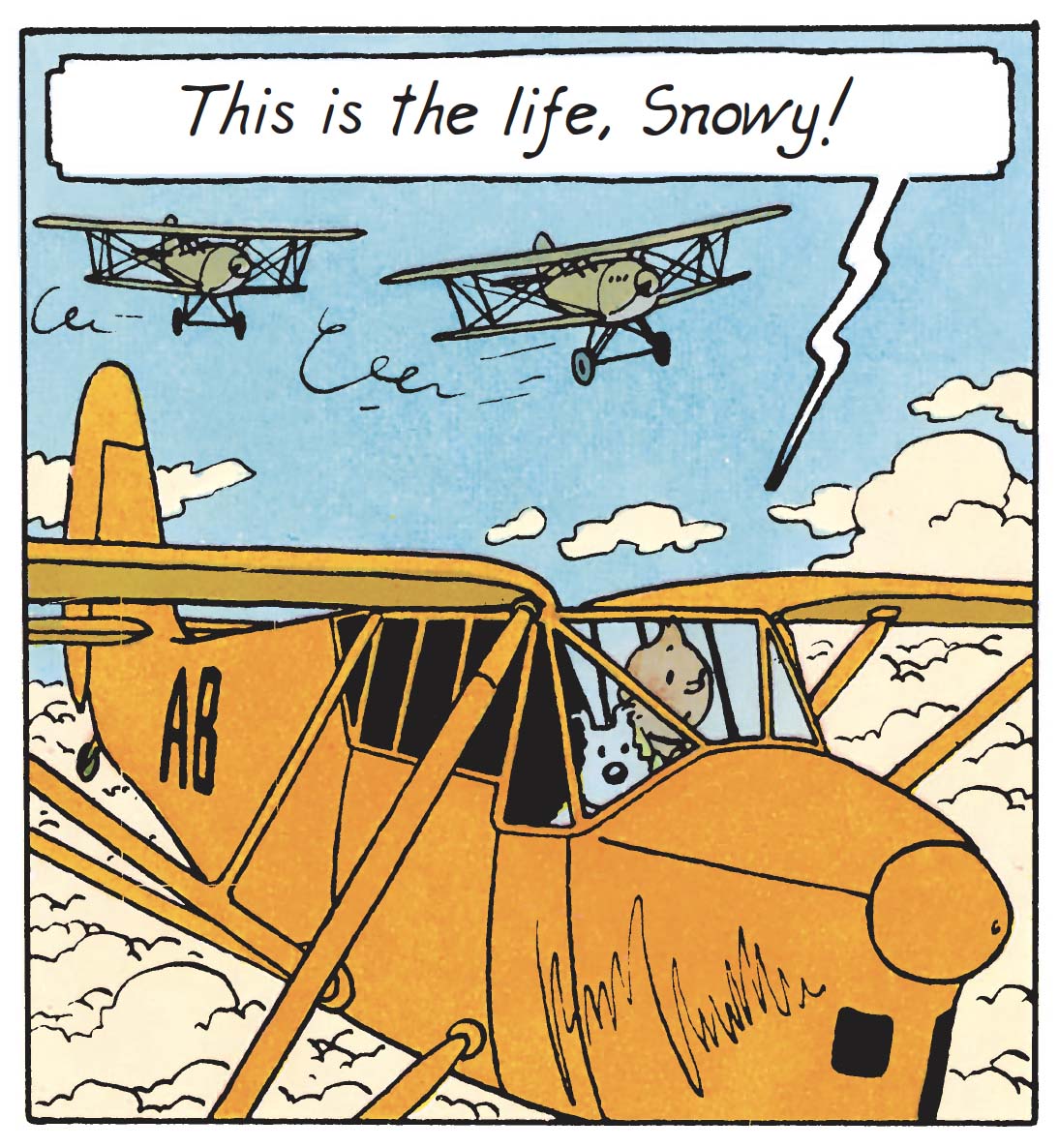
The same impression appears in Cigars of the Pharaoh, where the De Havilland DH.80A Puss Moth makes its appearance, elegant yet fragile, thrown into a desperate escape that feels more like a gamble than a plan. The aircraft slices through the sky as best it can, pursued by fighters, and inevitably crashes. Here, the crash is not exceptional, it becomes almost part of the journey. Reassuring, isn’t it?
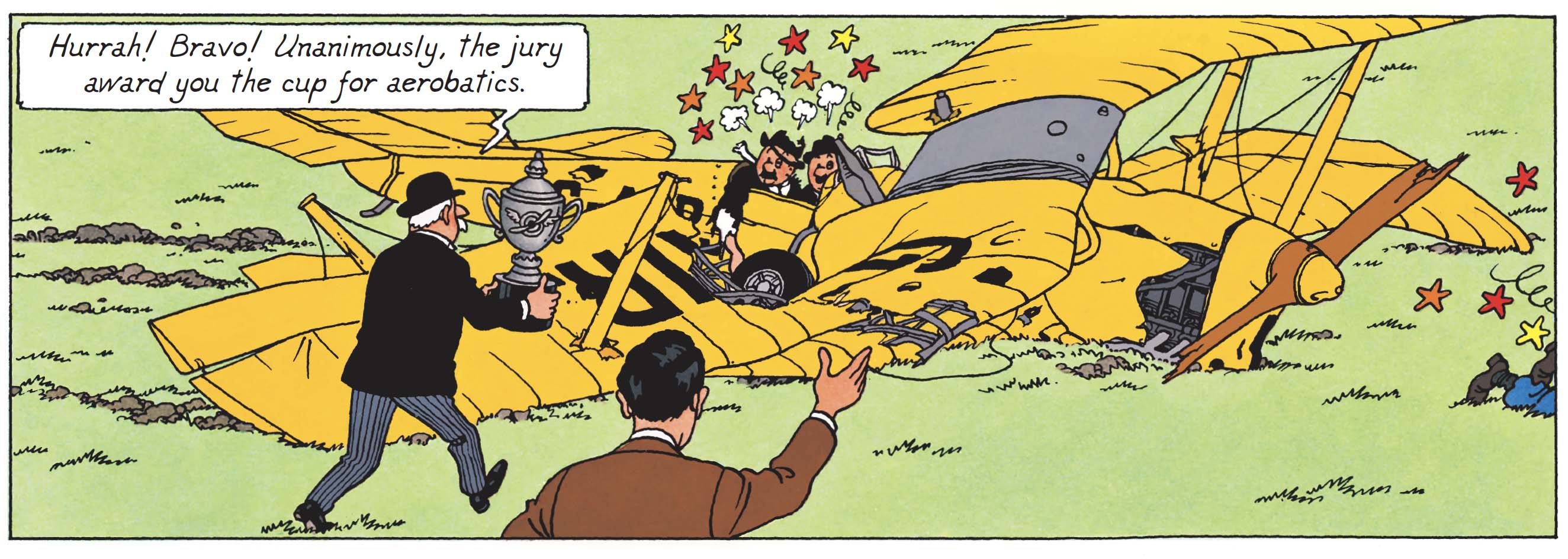
In The Black Island, biplanes perform uncertain acrobatics, and Thomson and Thompson, true to form, turn an aerial chase into an unintended balancing act. Flight exists, certainly, but control is still very much in question.
What these early aircraft reveal is an era in which aviation is still new and unstable, where progress outruns safety, and every takeoff remains a challenge to Newton’s gravity. In other words, landing is never guaranteed.
A Sky Under Tension
Gradually, the sky changes tone. Unpredictability gives way to threat. In King Ottokar’s Sceptre, the appearance of military aircraft such as the Messerschmitt Bf 109 gives the story a clear political edge. Flying is no longer just about travel or escape, the sky becomes a space of surveillance and pressure, reflecting the tensions of Europe.
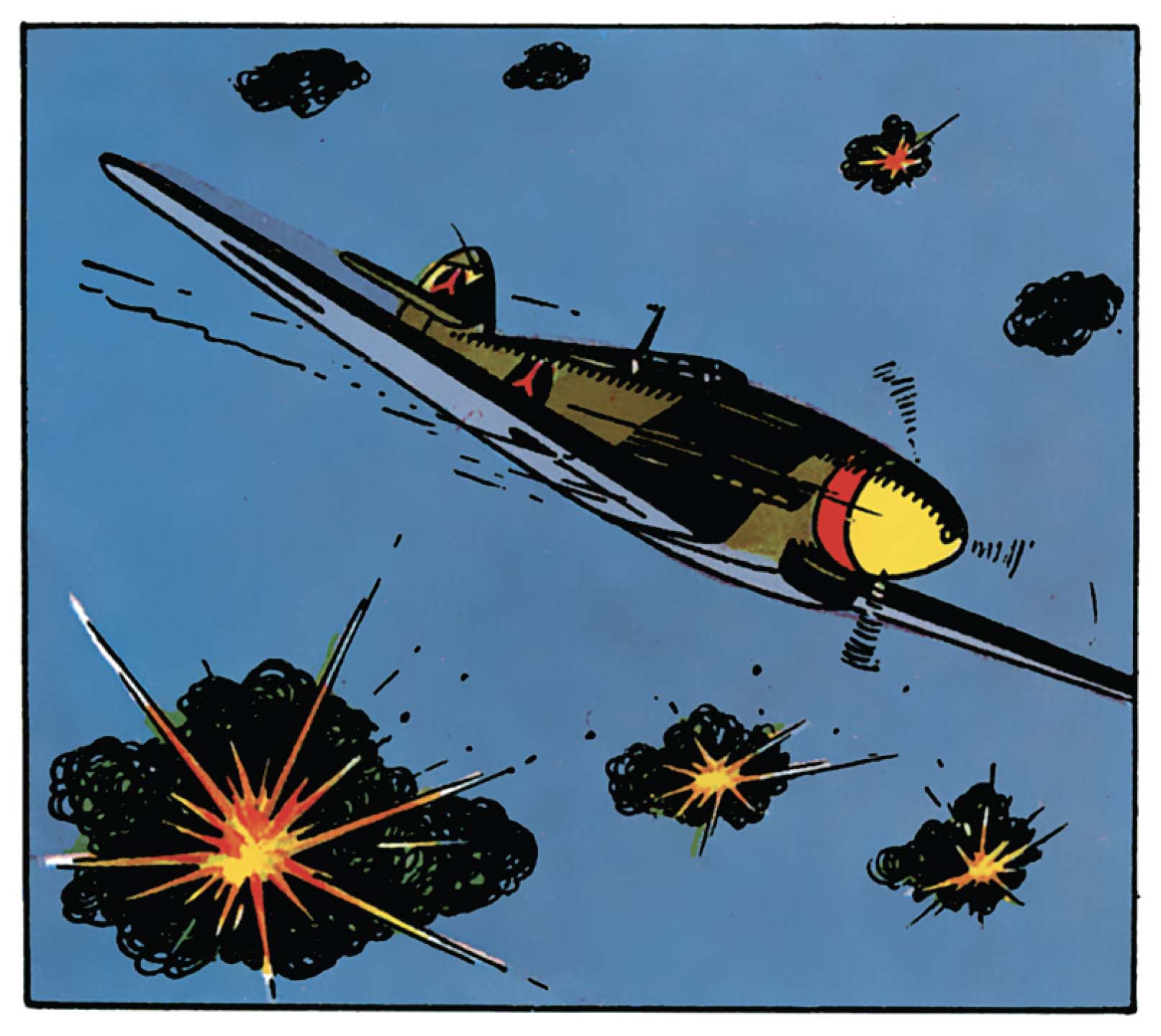
The same holds true in The Red Sea Sharks, where aircraft like the De Havilland DH.98 Mosquito take part directly in the action, turning the sky into a combat zone where anything falling from above is rarely good news.
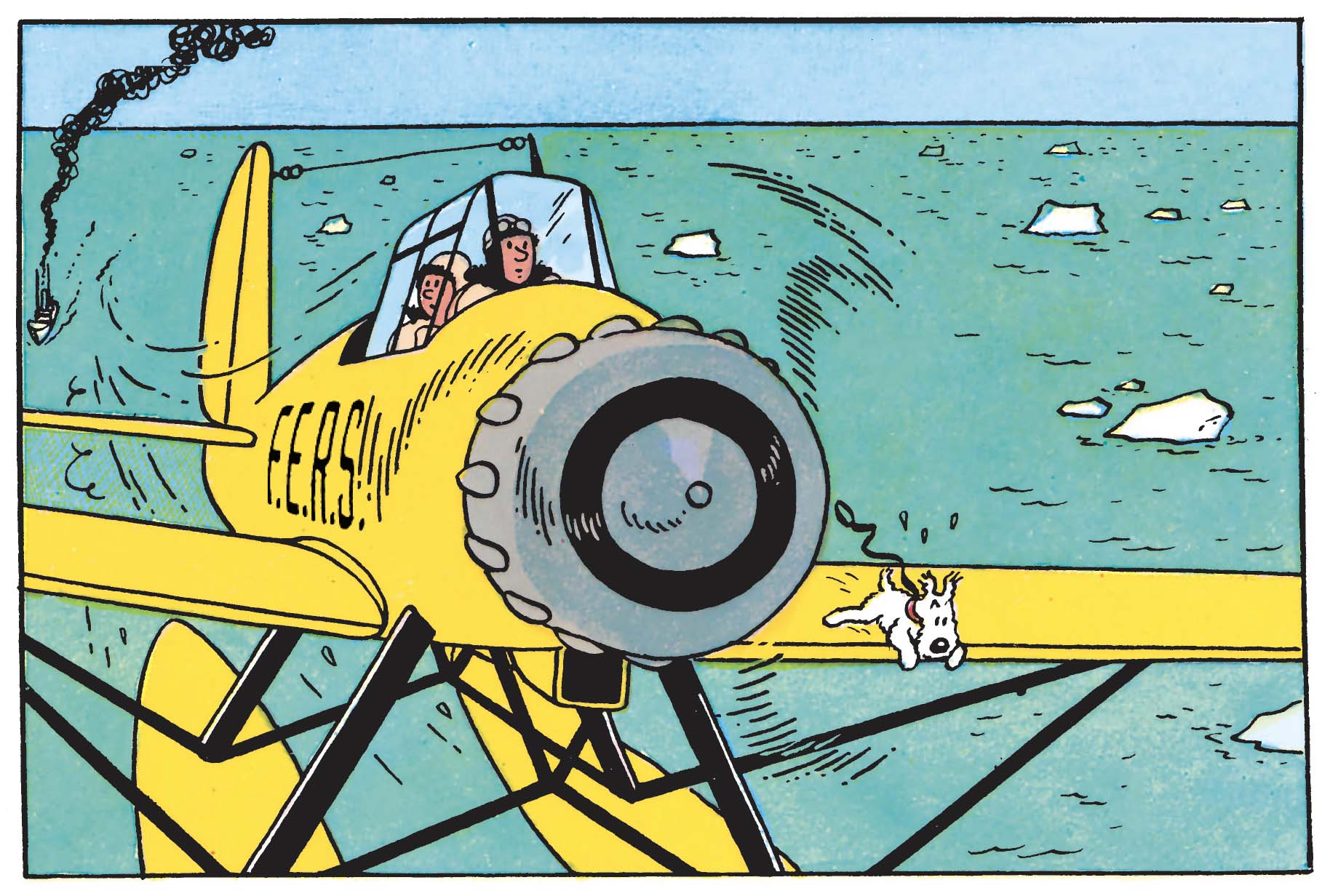
In Land of Black Gold, Supermarine Spitfires dominate the desert skies, a constant and oppressive presence, reminding us that control of the air has become a matter of power. And in The Shooting Star, the Arado Ar 196 allows access to a remote point in the middle of the ocean, as if aviation had now opened the entire globe.
The airplane is no longer a simple means of escape, and in Tintin, the real trouble often begins once you are airborne. Yet one thing never changes: Tintin remains fearless, even performing balancing acts on the wings. Staying on the ground is not always the worst option.
The Era of Great Journeys
After turbulence comes structure. The sky organizes itself, routes emerge, aircraft grow larger.
In Tintin in Tibet, the Douglas DC-3 and later the Lockheed Constellation represent this new commercial aviation, capable of connecting continents with reassuring regularity. The airplane becomes a shared space, where passengers travel seated, supervised, and guided. Yet Hergé never abandons drama, even in this modern world, crashes remain possible, sudden, reminding us that progress never entirely removes risk.
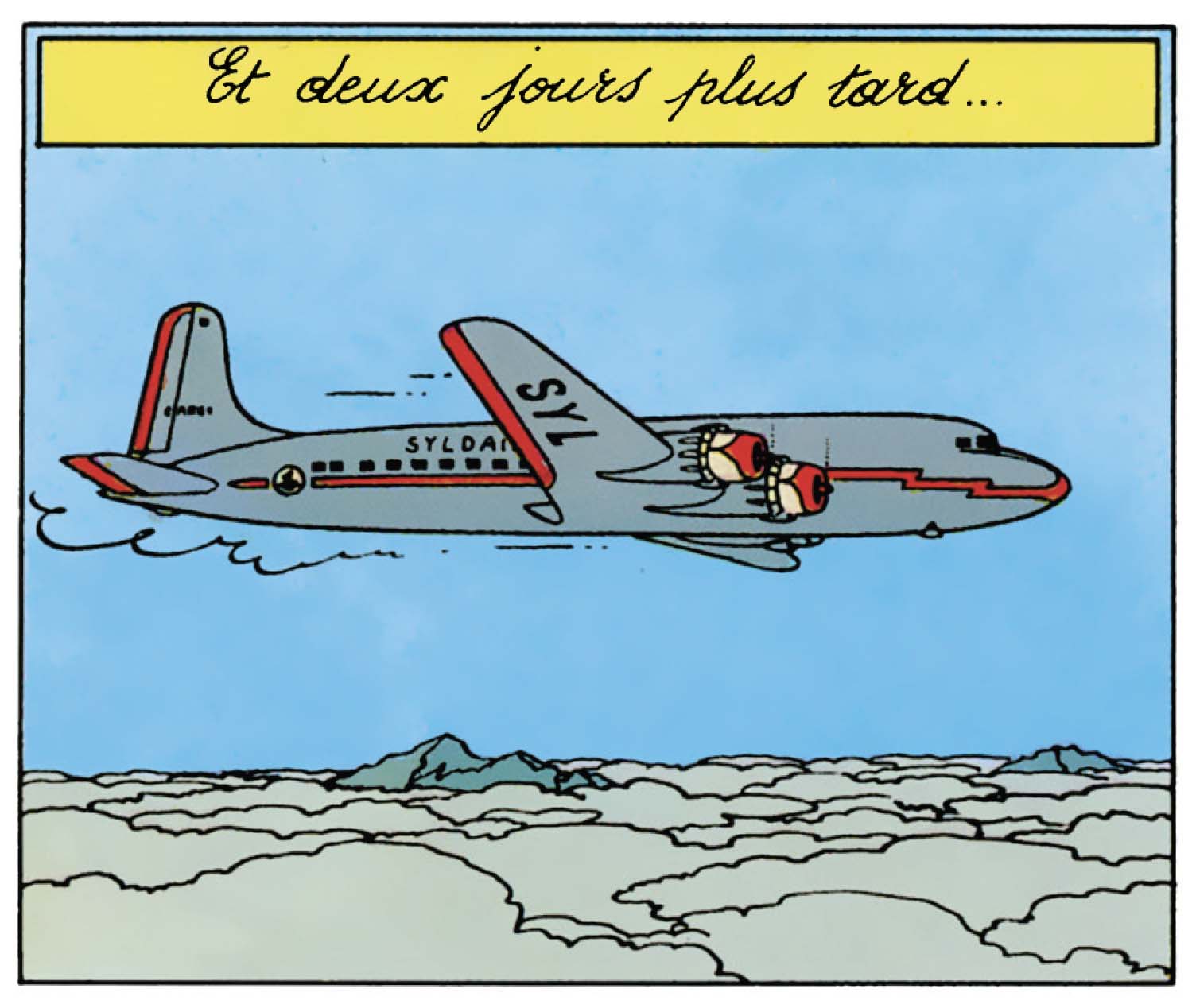
In Destination Moon, the Douglas DC-6 of the Syldair company carries Tintin and Haddock into a scientific adventure, showing how aviation has become part of an organized network, almost routine, at least on the surface.
Even flying boats like the Short Sunderland in The Seven Crystal Balls contribute to this global openness, linking distant territories with increasing ease.
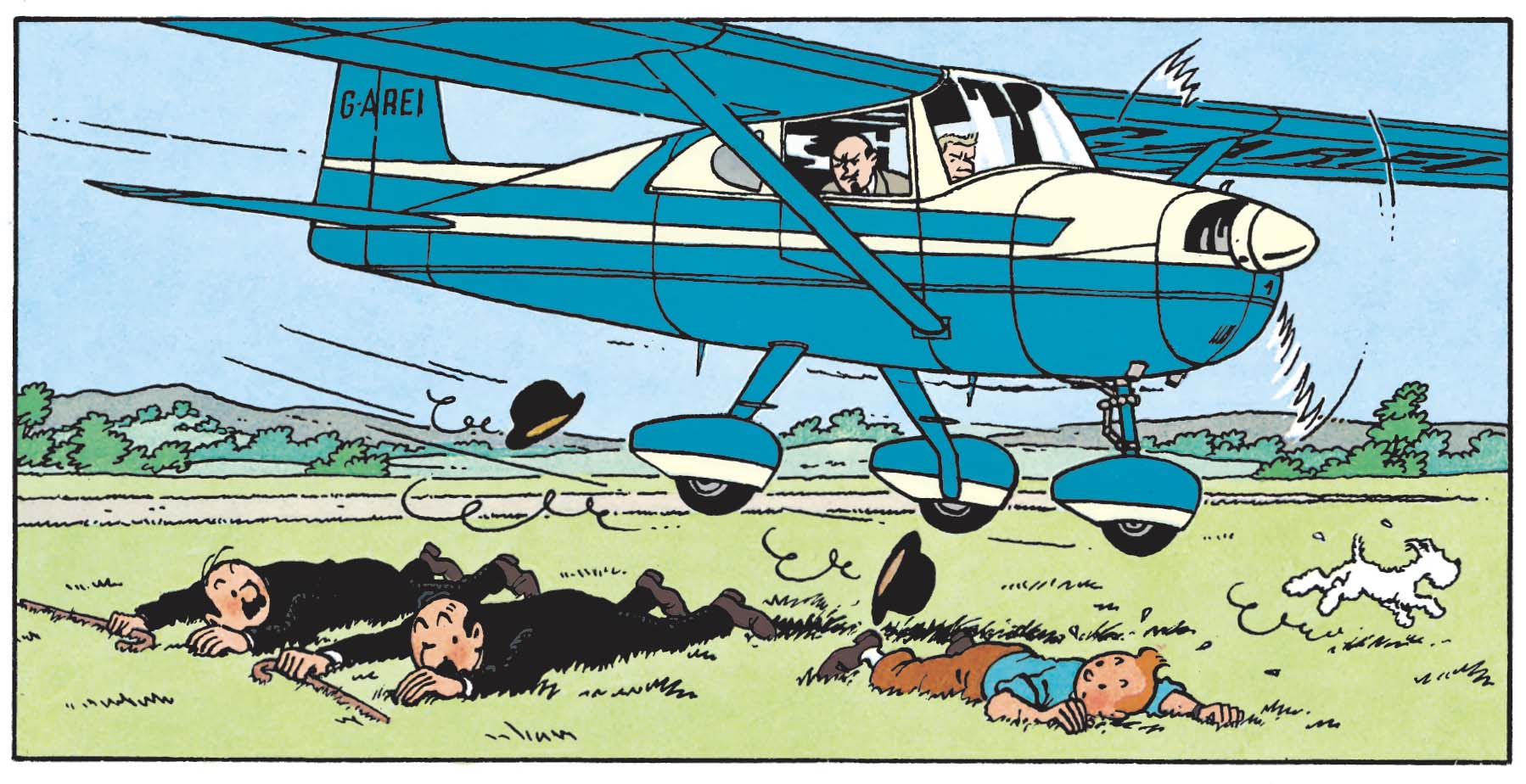
In The Black Island, this growth of aviation appears in another way, almost in the background. Aircraft multiply endlessly, from Müller’s small Cessna 150 to biplanes used in pursuit, all the way to larger models like the Savoia-Marchetti S.73 seen elsewhere in the series (King Ottokar’s Sceptre). Planes come and go with striking ease, as if the sky had become a playground open to all.
Yet Hergé keeps things unstable: chases spiral, paths cross, and any flight can suddenly go wrong.
Air travel becomes a bridge between continents, and between plots, allowing Hergé to expand his stories across the globe. The days of Tintin in the Land of the Soviets feel very far away indeed… and our reporter is far from finished with surprises.
The Vertigo of Modernity
And then, suddenly, like one of Professor Calculus’s rare bursts of anger, everything accelerates.
In Flight 714 to Sydney, the appearance of the Carreidas 160, inspired by the General Dynamics F-111, marks a clear turning point. The airplane is no longer just transport or strategy, it becomes a symbol of prestige, a technological showcase, almost a billionaire’s whim.
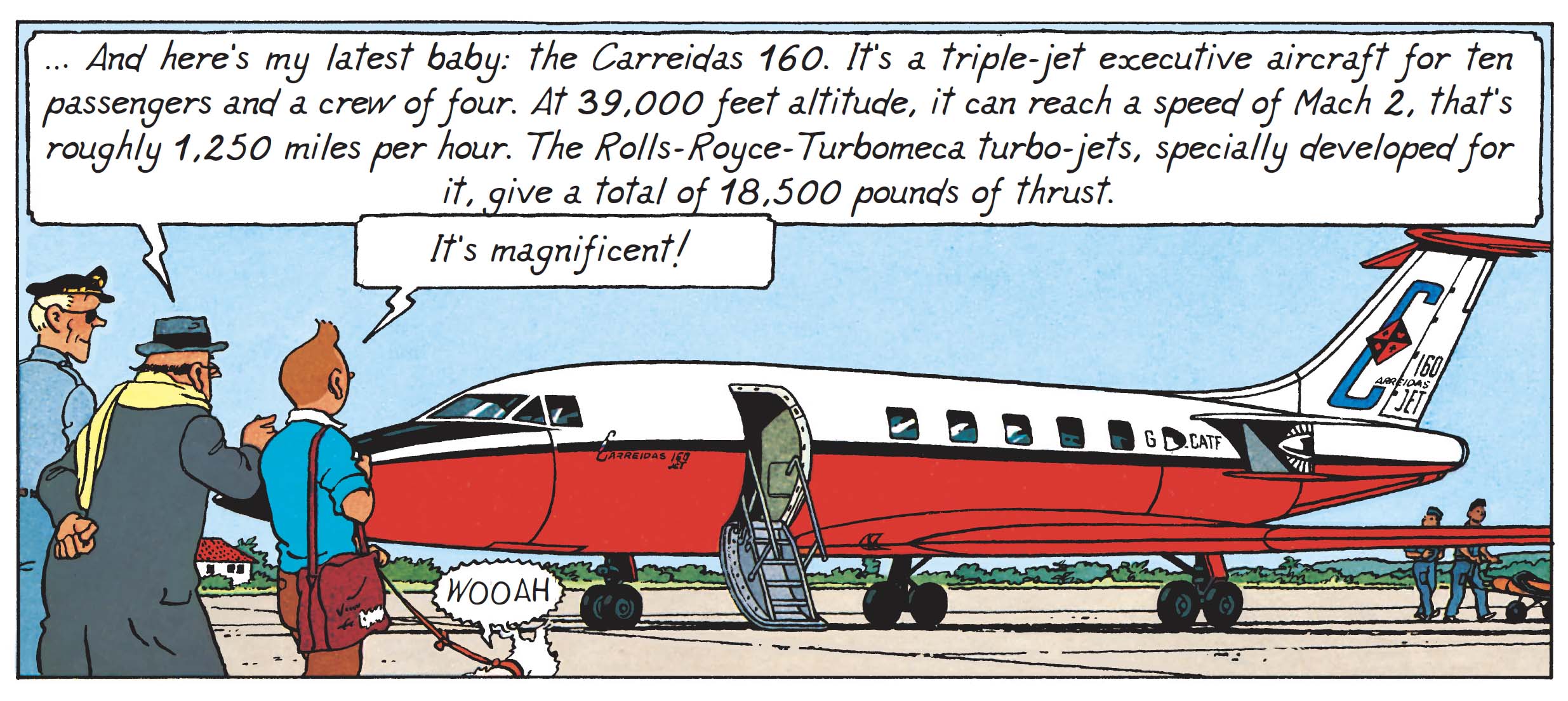
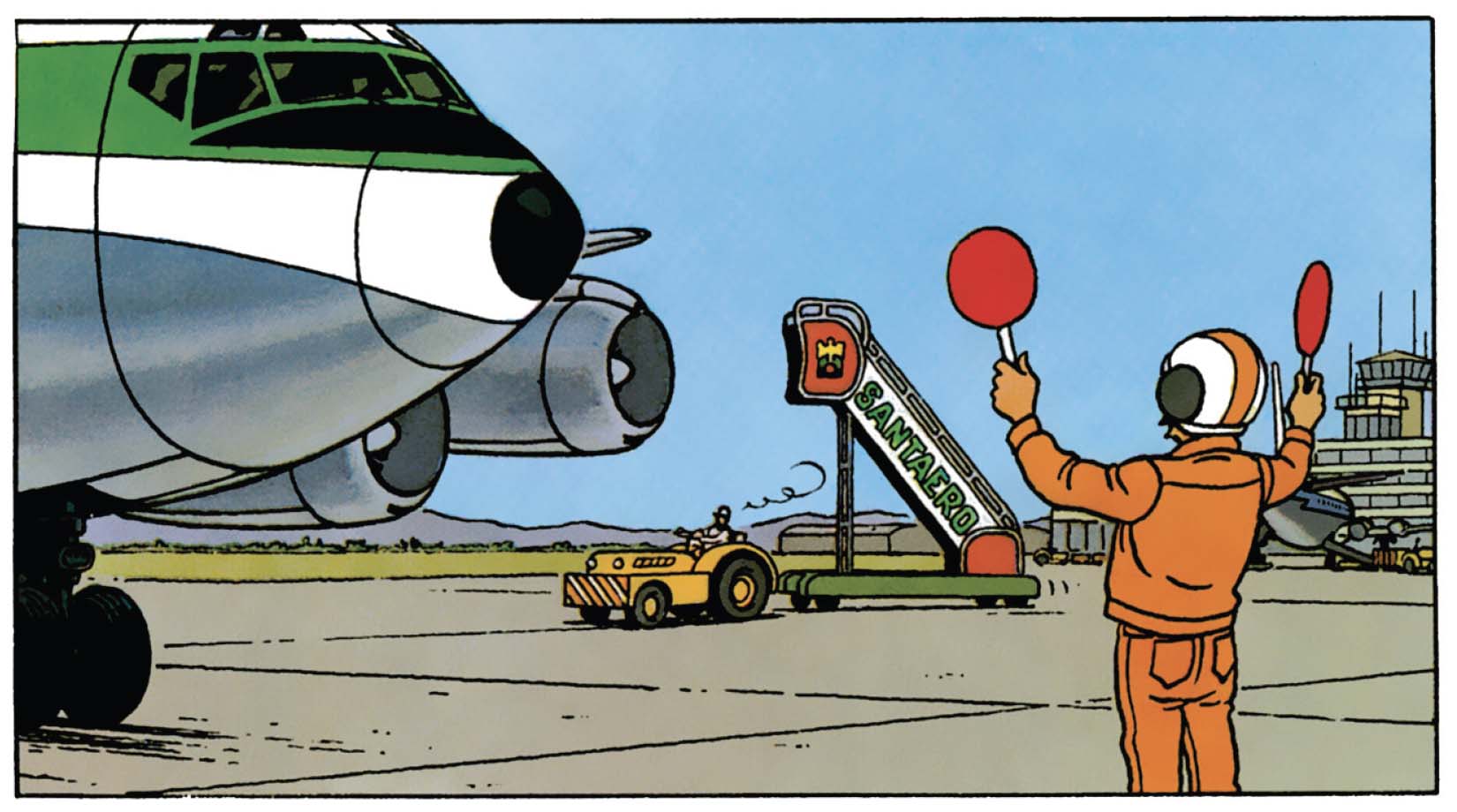
Alongside it, the Boeing 707 represents modern commercial aviation, fast, efficient, already globalized.
And in Tintin and the Picaros, the Boeing 747, immense and almost ordinary in its scale, signals the moment when flying ceases to be an adventure and becomes routine.
The contrast is striking: where Tintin once cobbled together a precarious takeoff, he now boards machines capable of carrying hundreds of passengers across the world, as if yesterday’s feat had quietly become today’s everyday reality.
And it is precisely this path that we find today, extending into reality itself, with a Brussels Airlines aircraft decorated in Tintin’s colours, proof that this imagination has become rooted in the Belgian aviation landscape.
A Century in the Cockpit
What stands out is not only the variety of aircraft, nor even their remarkable accuracy, but the way they accompany, almost silently, the evolution of the world.
In such a fast-paced universe, no one stops to notice what is changing. Between Rastapopoulos pulling strings and Piotr Szut being fished out of yet another disaster, the aircraft evolve almost unnoticed.
From hesitant biplanes to supersonic jets, from improvised adventure to organized travel, Hergé sketches, without ever stating it outright, a true history of aviation, embedded in the story, woven into the action, almost invisible because it feels so natural.
And when a modern aircraft bears the face of the young reporter, it is no longer just a visual nod, but rather a circle coming full loop, as if Tintin, after all these adventures, were finally stepping into the real world.
After all, the Belgian reporter has never stopped flying. He was even celebrated as the glorious winner of a raid from the South Pole to the North Pole, with a stopover in Berlin, no small feat. Recognize the album? Let us know in the comments.
Want to know more? Hergé, Tintin and the planes (in French only).
Texts and pictures © Hergé / Tintinimaginatio - 2026


