


 News
News Contest
 Forums
 Collectors
 Videos
 E-books
Tintin at the Heart of the Mystery
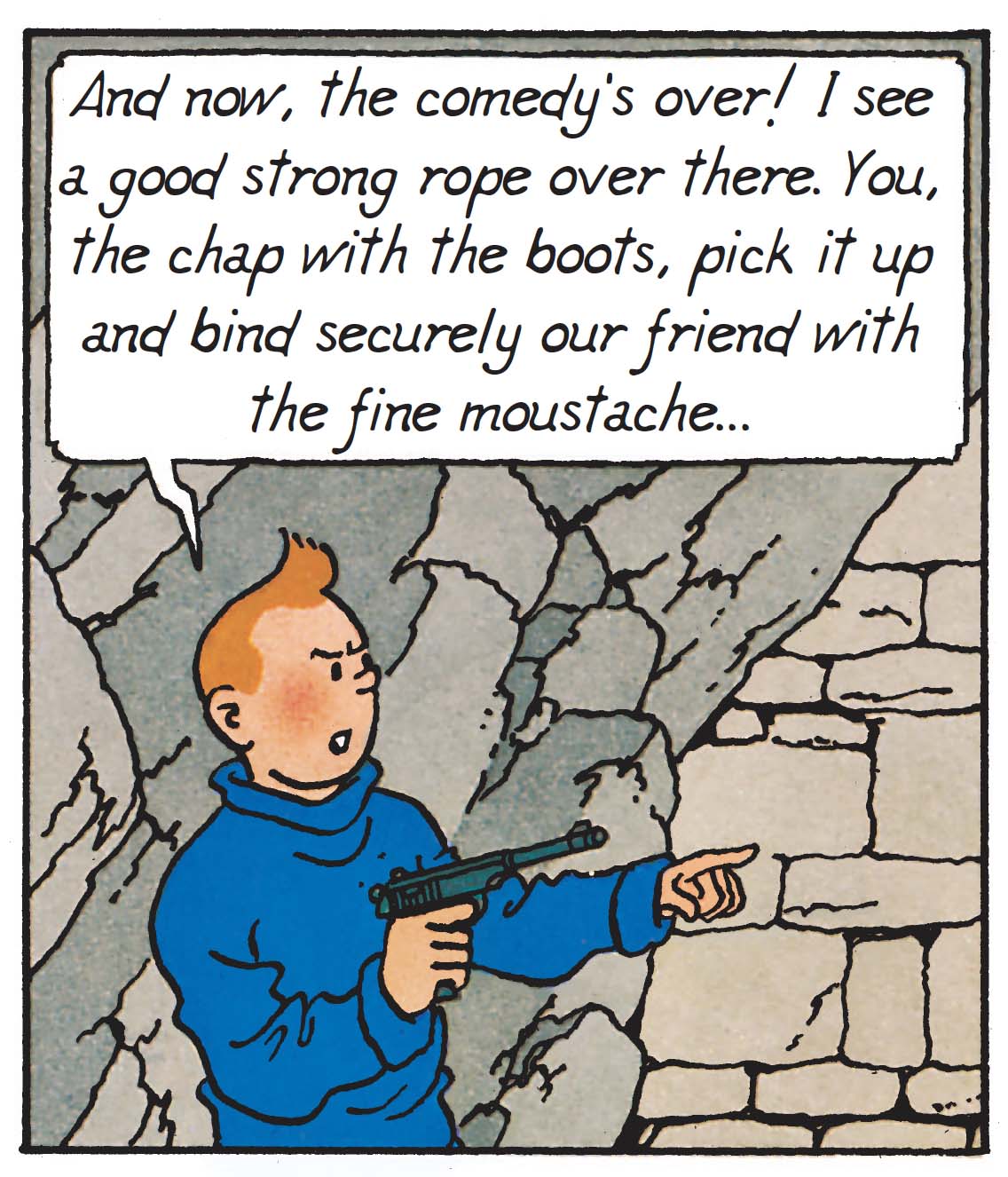
What if perched like a frozen rock in a hostile environment, this castle, with its vestigial Gothic appearance, could make even the bravest shudder. But not Tintin, who, despite warnings from all sides, charges headlong toward this overwhelming mass, as if detached from another time.
In The Black Island, the adventure no longer unfolds, it tightens. It abandons vast horizons to converge on a single, precise point, far removed from the exotic tumult of earlier escapades. First an island, barely discernible from the sea, then a castle, whose silhouette gradually imposes itself, massive and unsettling. A vision that seems to rise straight out of northern landscapes, of rock, wind, and isolation.
Nothing is left to chance in this construction. Behind the apparent simplicity of the setting lies a methodical process of composition, nourished by literary references, visual documentation, and a constant concern for credibility.
Yet this first impression is misleading. At first glance, the construction is designed to produce mystery, to sustain fear, to divert attention. But with Hergé, mystery never strays far from reality. Between the supernatural and a carefully crafted tale, one steps directly into the heart of a finely wrought intrigue. Let us now unravel this Ariadne’s thread, carefully tied.
A constructed geography
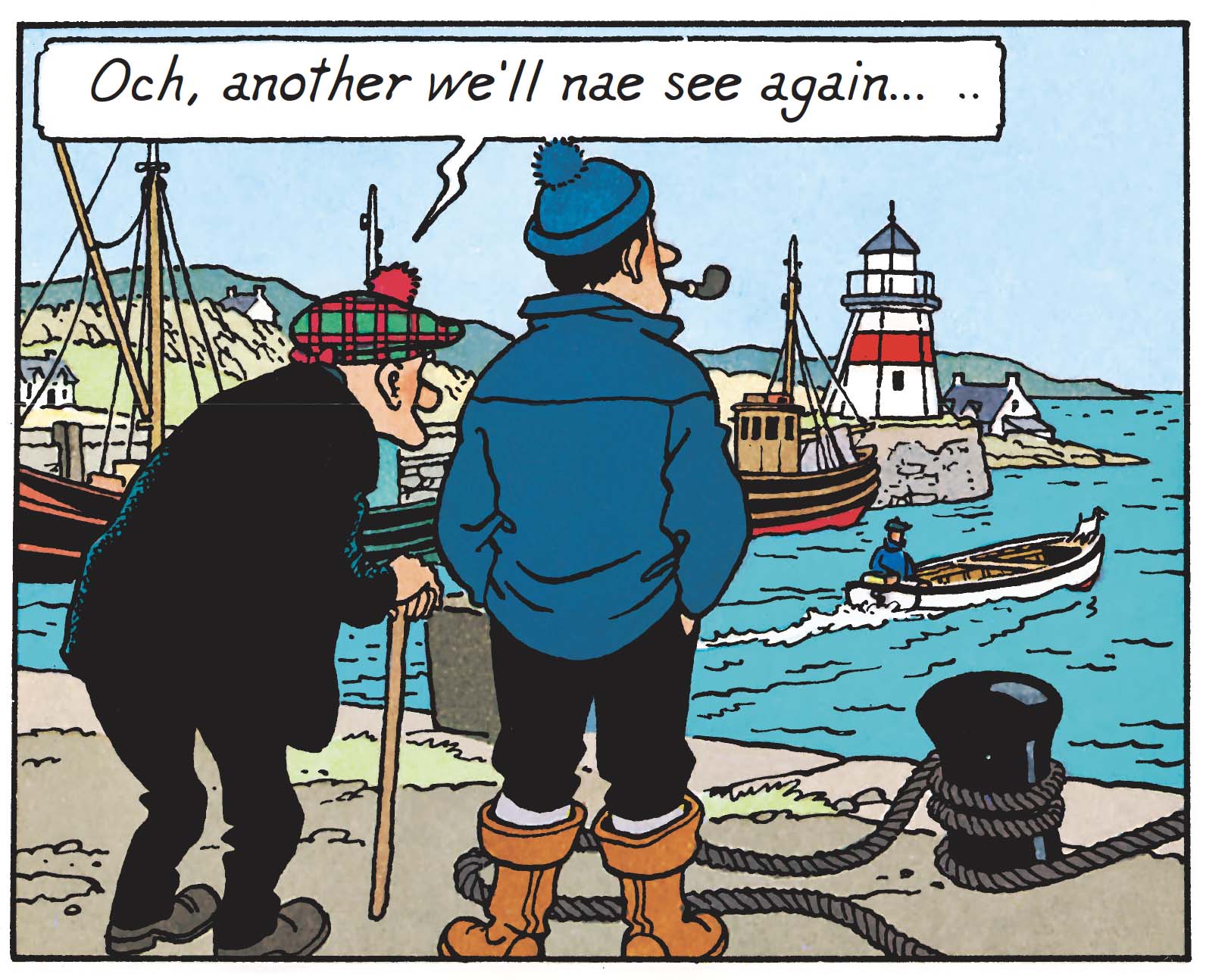
The Black Island is no abstract invention. Its distinctive shape, its isolation, enough to unsettle the locals, and its difficult access all belong to an identifiable geography: that of the Scottish coasts and Atlantic-battered archipelagos.
In the redrawn 1966 version, the landscapes are grounded in precise documentation, notably gathered by Bob de Moor during field research in the United Kingdom. The steep cliffs, narrow coves, and sea caves notably evoke those of the Isle of Arran on Scotland’s west coast, including formations such as King’s Cave. The rock becomes both shelter and trap, safely removed from prying eyes of any kind. These imposing coastal strongholds have, throughout history, given rise to countless myths and legends.
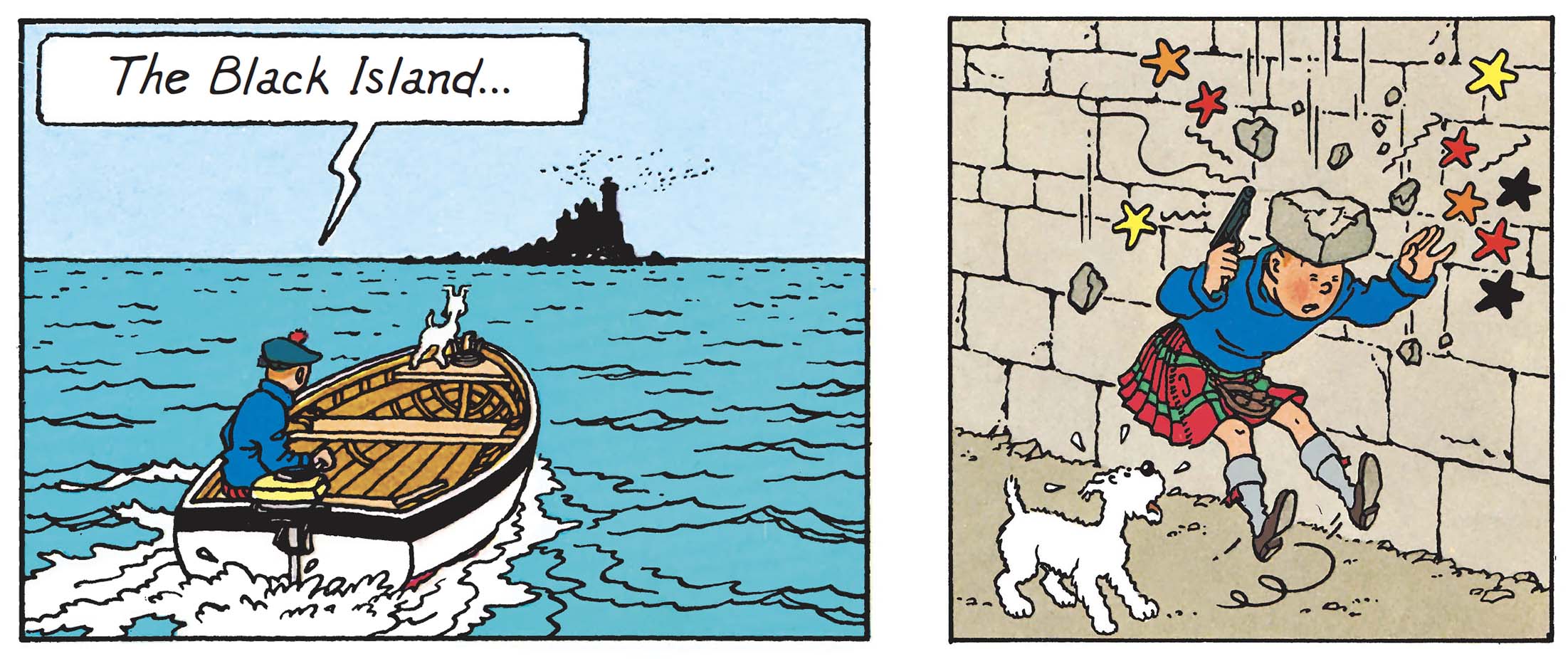
The island is not merely an isolated setting. It is constructed as a closed, almost autonomous space, where every element (terrain, access, even visibility) conditions the action. One cannot help but smile at the sight of Tintin in his Scottish attire, which immediately imposes a different sense of time.
There is no denying the pleasure of seeing our hero absorb, from one adventure to the next, the customs and codes of the places he visits, sometimes with a clumsiness that is not without charm. Here, Tintin encounters a distinctly European setting; accustomed until now to exotic locales, he finds himself in a medieval castle with a fearsome reputation…
Craig Dhui, a recomposed castle
The Craig Dhui castle does not correspond to any single structure. It results from a precise combination of real references, reworked to serve the narrative. Much like his journey to Peru, this amalgam of sources produces a unique edifice, whose layers one continues to explore.
In its original version, certain elements draw inspiration from Arundel Castle in Sussex, particularly for the central keep. The 1960s revision, however, marks a more systematic approach. The ruins of Lochranza Castle, on the Isle of Arran, provide a direct model for its seaside location, while elements borrowed from Warwick Castle, arches and defensive structures, complete this recomposed whole.
This process of recomposition is not decorative. It aims to produce a convincing effect. The castle appears credible and habitable, with striking coherence. Volumes, access points, and openings all obey a clear architectural logic. And beyond the stones themselves, there is more than one hidden mechanism at work within its turrets…
The narrative labyrinth
The architecture of the castle is not the only source of disorientation. Before reaching it, the album unfolds a far more diffuse mechanism, built on false leads, misunderstandings, scuffles, and thwarted pursuits. The investigation never progresses in a straight line. It veers between car chases and train pursuits, stalls, then resumes elsewhere, as if the narrative itself were constantly slipping away.
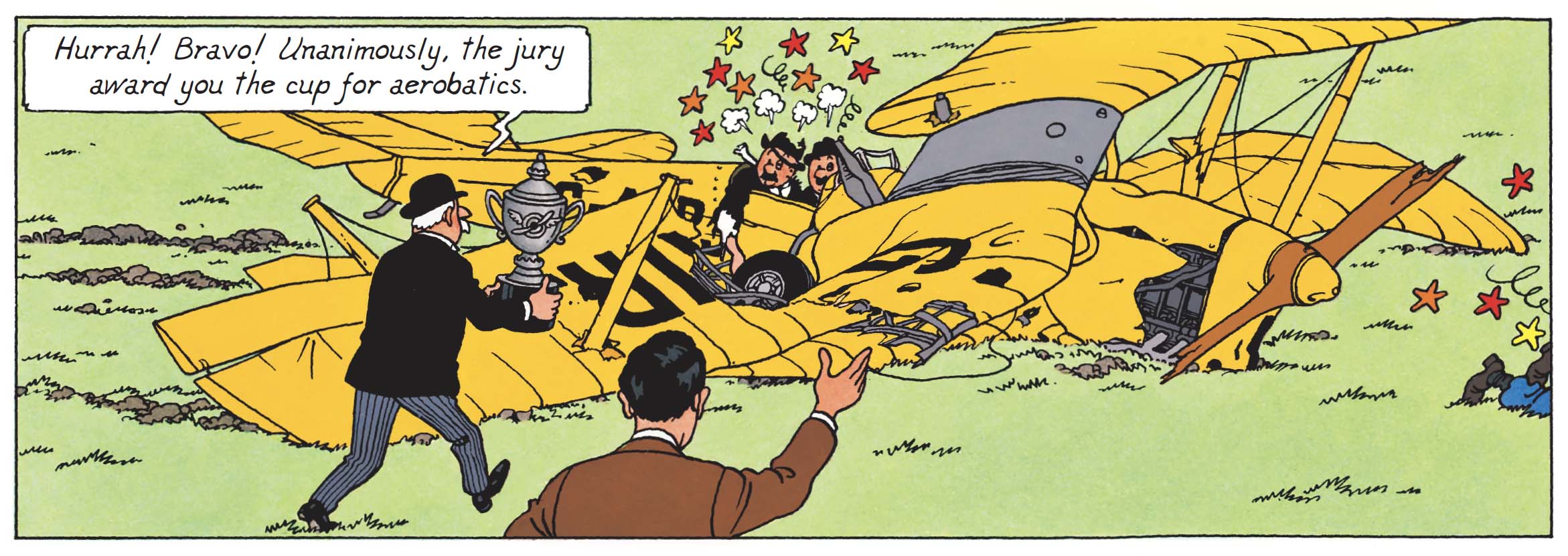
How could one fail to mention the two detectives, who miss no opportunity to render Tintin’s investigation, if not more difficult, then certainly more baroque than usual. Between mistaken accusations and blurred identities, the entire comic theatre contributes to this instability. In this respect, the presence of this famous duo of bungling investigators is far from incidental. By pursuing the man they believe guilty, they prolong the play of appearances and become its unwitting agents.
Their inability to read situations correctly is not merely a source of comedy: it reinforces a world where truth and falsehood circulate indistinctly. The adventure thus builds upon a chain of errors, misalignments, and false appearances, long before the castle reveals its underlying mechanics. Much to the dismay of the detectives’ acrobatic assertions.
Counterfeiting: a historical reality
The plot itself is rooted in a very real context. In the 1930s, counterfeiting was an international concern, facilitated by advances in aviation and the expansion of economic exchanges. Organized networks employed increasingly sophisticated reproduction techniques.
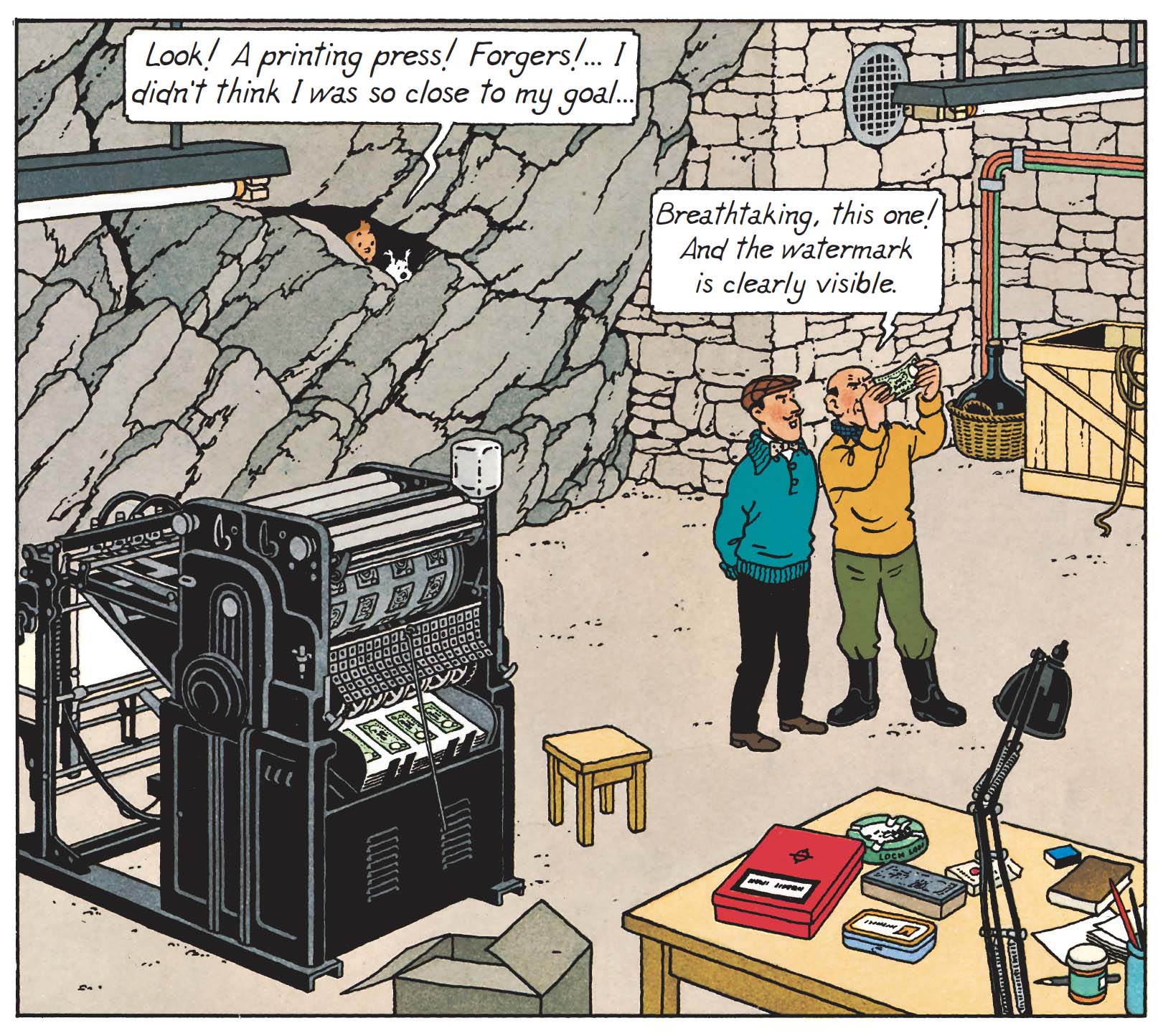
The character of Dr. Müller is partly inspired by historical figures involved in such practices, whether for political or economic ends. The presence of a clandestine workshop in an isolated, difficult-to-access location follows a credible operational logic.
Thus, the Gothic castle, far from being a mere literary cliché, becomes the ideal setting for a modern activity. The architecture of the past houses contemporary crime. In this respect, the château of Marlinspike Hall offers a revealing counterpoint: it too conceals hidden spaces and unexpected functions behind an appearance of stability, yet without resorting to illusion. Where Marlinspike brings things to light, Craig Dhui organizes secrecy.
An orchestrated fear
Any effective criminal organization is built upon a carefully maintained façade. Everything surrounding the castle belongs to a precise system: the rumor of a creature, sustained within the village, functions as a deterrent, enough to make its inhabitants shudder in unison. It proves far more effective than any « Beware of dog » sign.
This mechanism relies on a keen understanding of human behavior. Once established, collective fear becomes self-sustaining. It requires no proof. It operates through repetition, almost anticipation.
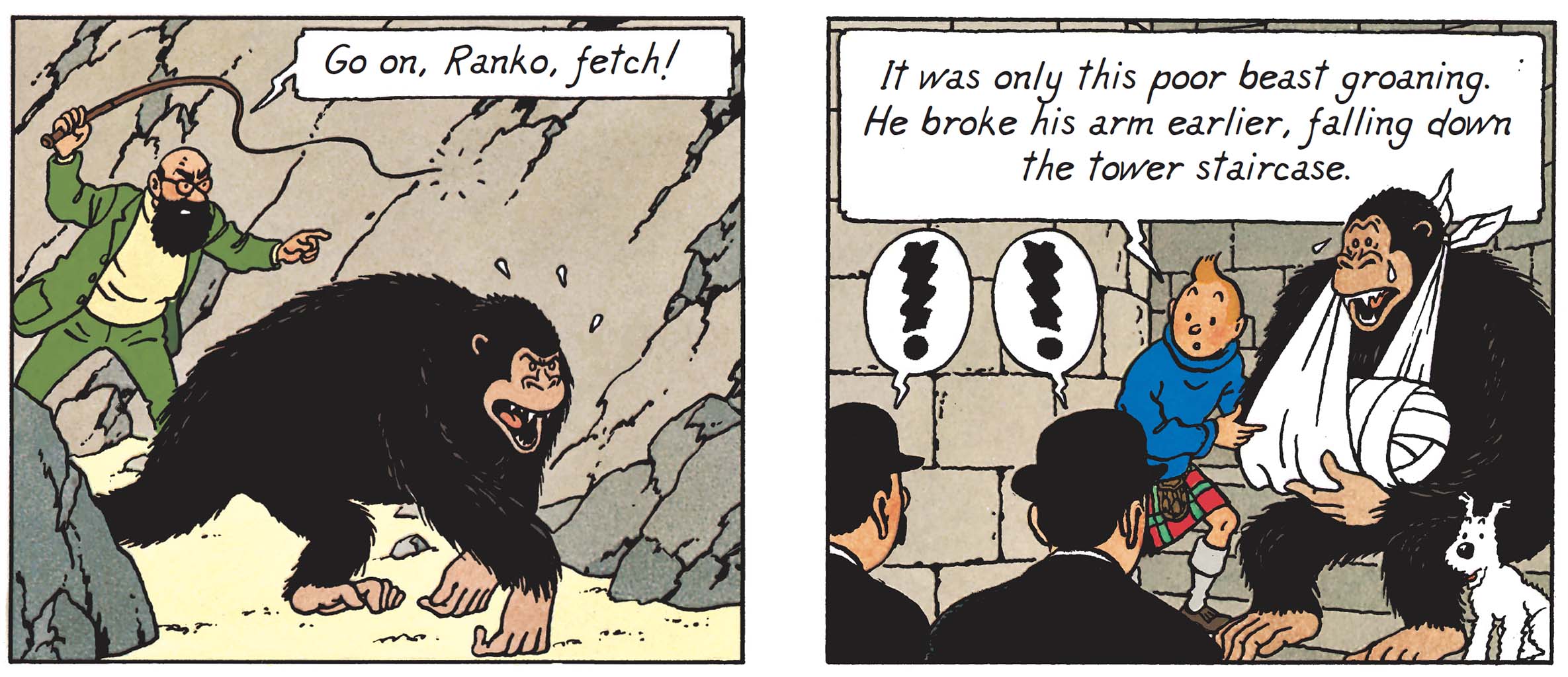
Yet the tale of the counterfeiters holds further surprises. The figure of Ranko serves as a tool: his physical presence gives substance to an already existing rumor, transforming belief into lived experience.
The choice of a gorilla is not arbitrary. In the 1930s, the image of the great ape was widely disseminated, notably through cinema, with the success of King Kong. This figure embodies strength, strangeness, and ambiguity.
Ranko belongs to this tradition, with an important nuance. His behavior is not purely aggressive. The unfortunate animal responds to a logic of training and forced conditioning imposed by his captors.
A staging of perception
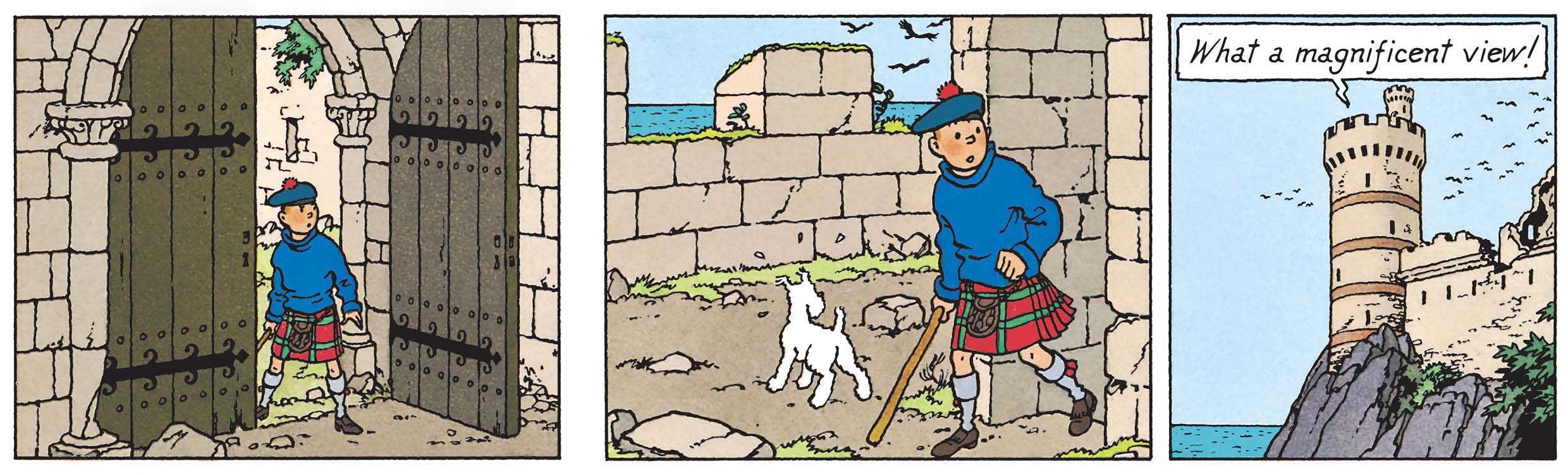
Throughout the album, the construction of images contributes to this logic. The castle is not shown frontally from the outset. It appears progressively, through fragments, silhouettes, and backlighting.
This staging does not rely solely on atmosphere. It is grounded in a highly precise construction of the image, reinforced in the 1966 version by the work of the Studios Hergé. The shift to a denser layout, up to twelve panels per page instead of six in the original version, profoundly alters spatial perception. Panels tighten, actions follow one another more rapidly, and viewpoints multiply. This visual densification reduces uncertainty while creating the illusion of a richer, more detailed environment.
This evolution is accompanied by a methodical approach to the settings. Hergé retains control over the characters, while relying extensively on his collaborators: Bob de Moor for architecture and landscapes, Roger Leloup for aircraft, and Michel Demarets for technical elements such as the counterfeiters’ press.
The castle does not merely house the mystery, it participates in its construction. Every visible element (access points, volumes, machinery) is technically credible.
The mystery of The Black Island
Between two aerial loopings by the detectives, the setting of The Black Island does not merely accompany the action, it forms its backbone. Each element (geographical, architectural, technical) contributes to the construction of the narrative, unfolding alongside Tintin’s investigation.
The island is rooted in an identifiable reality. The castle results from a precise process of recomposition. The plot draws upon historical practices. Even fear becomes a tool.
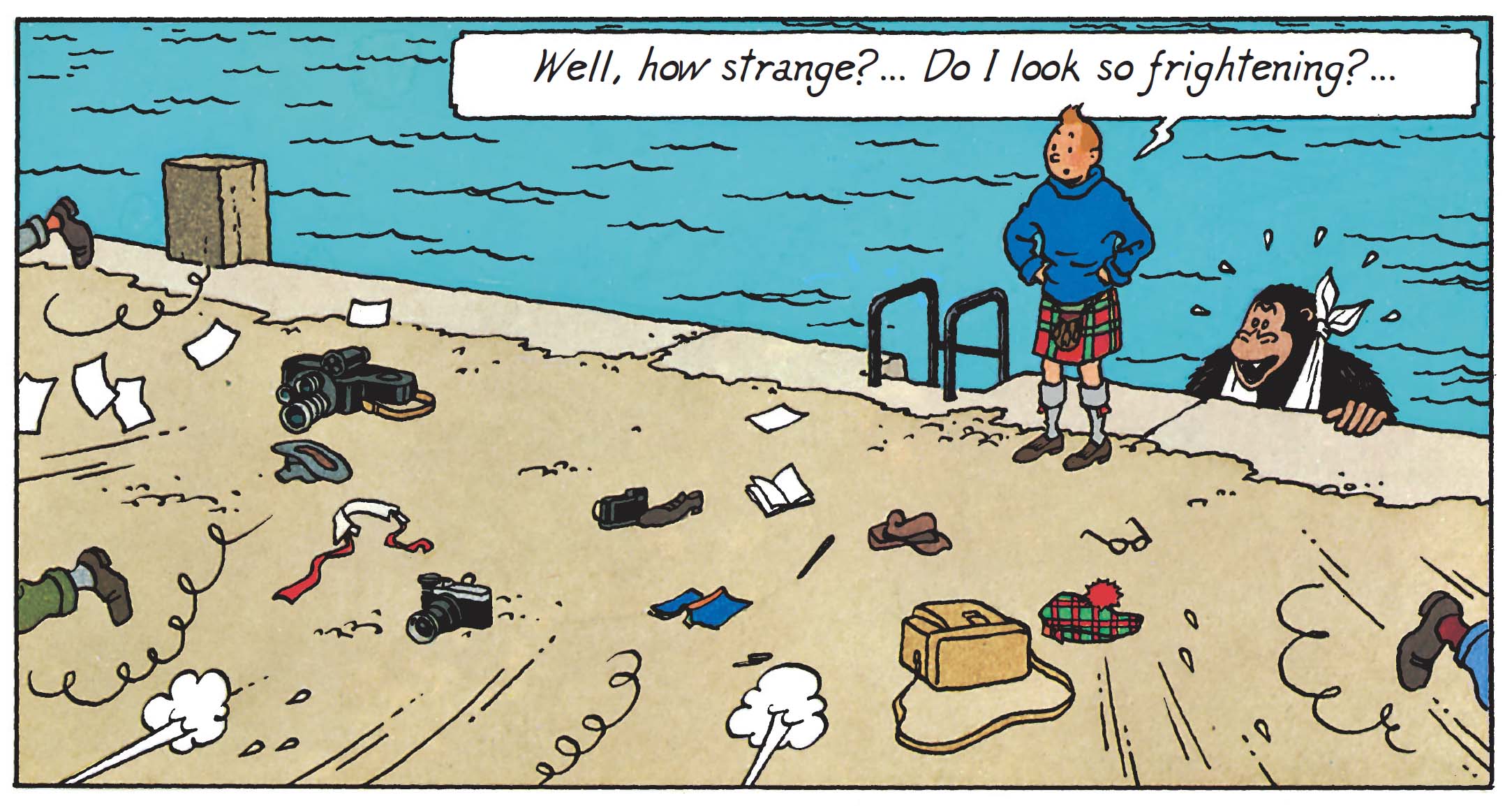
On the surface, everything appears mysterious. At its core, everything follows a logic. The hero returns, and with him a new companion who will soon make headlines!
Texts and pictures © Hergé / Tintinimaginatio - 2026


