


 News
News Contest
 Forums
 Collectors
 Videos
 E-books
The Speaking Vignette: Do You Speak Syldavian?
Where on earth has Tintin landed?
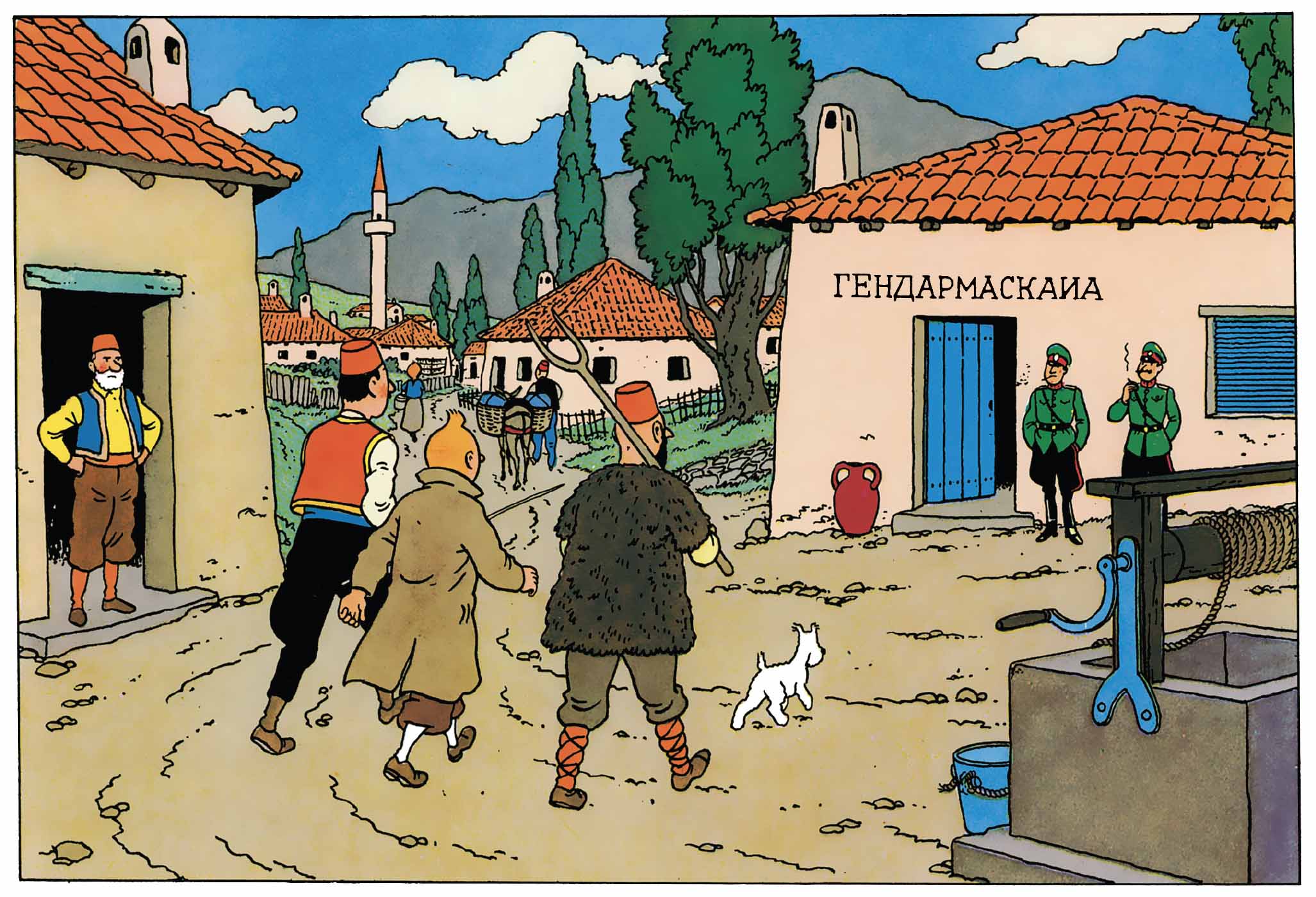
At first glance, this panel merely seems to serve as a transition. Tintin is walking through a Syldavian village after escaping an assassination attempt. The locals go about their daily business, the gendarmes (cf. police officers) chat in front of their station, and nothing particularly stands out, except perhaps for the strange inscription painted on the building to the right of the image. Yet it is probably one of the most revealing details in the way Hergé constructs his worlds!
Because the word written on the façade, “ГЕНДАРМСКАИА”, immediately creates a very specific impression in the reader’s mind. Even without speaking Russian, even without knowing the Cyrillic alphabet, we instinctively understand that we are somewhere in an imaginary Central or Eastern Europe, close to the Balkans or the Slavic world. The setting works almost instantly. In several albums, Hergé develops a very personal way of creating language and exoticism.
In fact, the creator of Tintin is not trying to produce an exact language. What interests him far more is the feeling of authenticity. He composes a form of believable pseudo-Cyrillic, close enough to certain Slavic scripts to create an immediate sense of displacement, yet vague enough to remain understandable through the image itself. The reader does not translate the word, he feels it.
This process runs throughout the entire album. In The Sceptre of Ottokar, Syldavia does not exist, yet everything is designed to make us believe the opposite. The villages evoke Bosnia or Montenegro, the minarets hint at the former Ottoman presence in the Balkans, certain uniforms borrow as much from Austria-Hungary as from Central European monarchies, and the landscapes blend several regions of the continent into a single perfectly coherent fictional geography.
The language follows exactly the same logic. Behind the Syldavian words actually lie fragments of Brussels dialect, Marollien slang and even Walloon. Scholars such as Rainier Grutman have shown that Hergé deliberately distorted very real expressions in order to give them a foreign sound. Still not convinced? Just turn back one page.
When a Syldavian peasant exclaims “Zrälùkz!” upon seeing Tintin falling from the sky, Hergé seems to be drawing from the Walloon word “rëlouke”, meaning “look”, to which he adds several consonants in order to create a pseudo-Slavic sound. Another peasant then replies, « czesztot on klebcz », a deliberately distorted expression in which « klebcz » directly echoes the slang word clebs, meaning dog. Other terms come directly from the Brussels dialect, covered with extra consonants to produce a strangely familiar Eastern European rhythm.
The reader believes he is discovering a lost Balkan monarchy, while in reality he is moving through a distorted mirror of Belgium and of 1930s Europe. Syldavia works because it is built upon a meticulous assemblage of credible details, precise enough to convince us, yet vague enough to leave room for imagination. Hergé’s magic strikes once again.
This ability to create reality without ever copying reality exactly says a great deal about his talent. Where others might have invented an entire language complete with grammar, Hergé instead prefers to create just a few words, sounds and inscriptions capable on their own of suggesting an entire unseen world beyond the panel.
And behind this fictional Eastern Europe that readers believe they are discovering, behind these lost villages and Syldavian peasants, linger discreet echoes of the working-class Brussels in which Hergé himself grew up, as though the artist had ultimately hidden a small part of his own everyday world inside this imaginary country…
Texts and pictures © Hergé / Tintinimaginatio - 2026


