


 News
News Contest
 Forums
 Collectors
 Videos
 E-books
The Speaking Vignette: Tintin, a Zen Master?
As soccer fever sweeps across the globe and sporting passions ignite on every continent, Tintin takes a rather different approach to staying in shape. Quite literally, he turns himself upside down. After all, travelling across five continents, chasing smugglers and escaping some of the world's most dangerous villains is no easy task.
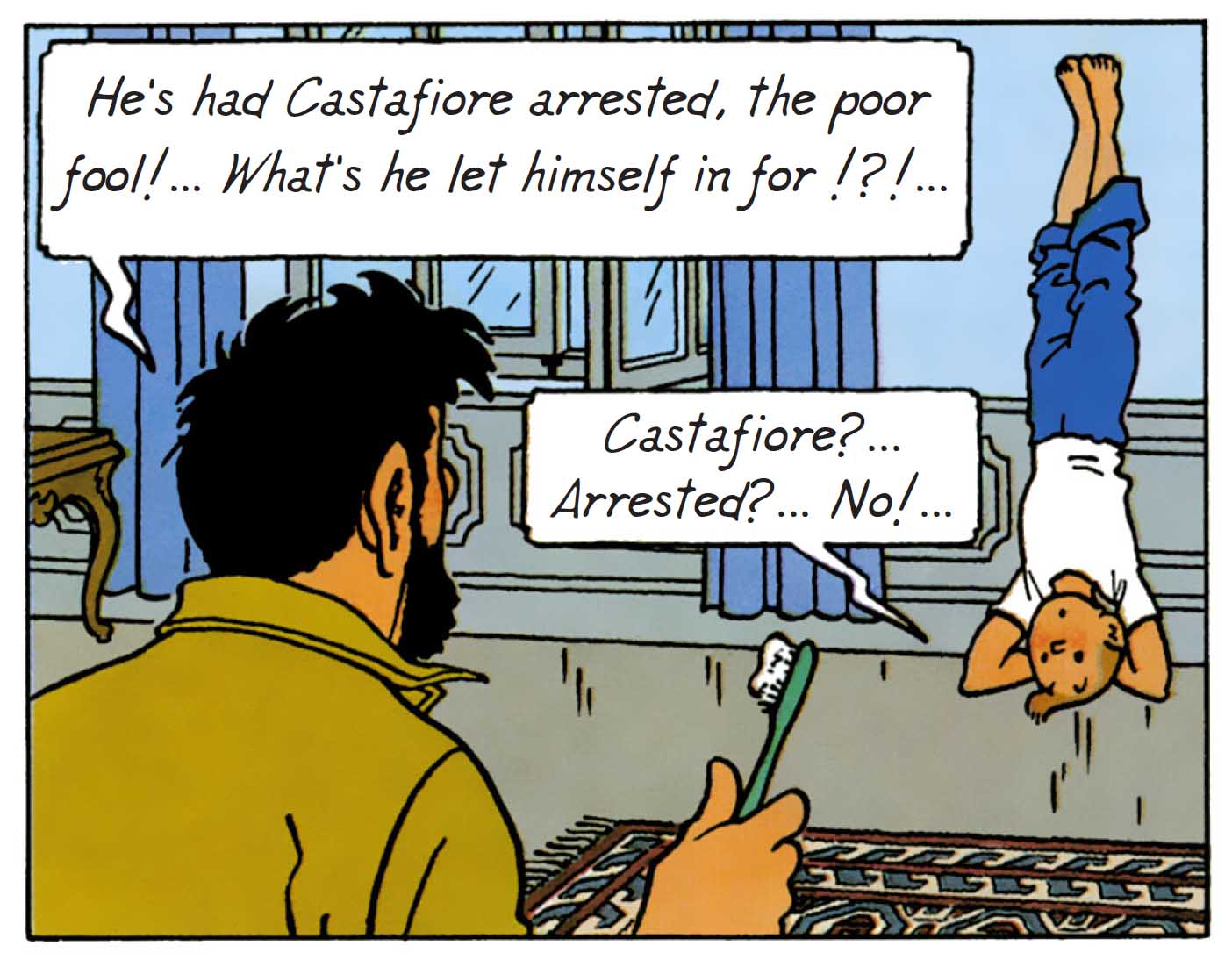
At first glance, this vignette from Tintin and the Picaros hardly seems worthy of special attention. While Captain Haddock reacts with horror to the news of Bianca Castafiore's arrest in San Theodoros, Tintin appears... standing on his head. Dressed in pyjamas, he calmly continues his exercises while his faithful companion rushes about in agitation.
Is this simply a way of keeping fit, or a sign that the character is evolving with the times? Because this Tintin is no longer quite the same as the one readers first met decades earlier.
For nearly forty years, the young reporter has crossed deserts, faced every kind of criminal, foiled international conspiracies and even walked on the Moon. Who could top that? Always on the move, always ready to leap into a new adventure. Here, by contrast, he pauses, breathes and concentrates, perhaps to prepare himself for whatever comes next. As the saying goes, every mile leaves its mark. Before the story has truly begun, Hergé presents us with a hero who seems somehow different.
This transformation is not limited to a yoga pose. Behind the familiar image of the reporter, the world around Tintin has changed. The 1930s are now a distant memory. We are in the mid-1970s, an era shaped by the growing popularity of Eastern philosophies, personal development and new ways of thinking about both body and mind.
The choice of yoga is therefore unlikely to be accidental. From the 1960s onwards, the practice enjoyed increasing popularity throughout Western Europe. Meditation, self-control and the search for balance appealed to a generation eager to explore new horizons. Ever attentive to the world around him, Hergé quietly incorporated these developments into his stories.
But this vignette also tells us something about the artist himself.
By the time Tintin and the Picaros was published, Hergé had changed considerably. The man who once produced adventures at a relentless pace was questioning more, doubting more and looking at his own hero with a more critical eye. Several commentators have seen the album as part of a gradual transformation of the Tintin universe. The reporter is no longer merely an indefatigable adventurer; he becomes a more reflective, observant and sometimes even more distant character.
Hergé's choice of pose is revealing. While such news might once have launched the adventure immediately, Tintin does not rush into action. He calmly continues his exercises while Haddock is already getting worked up. Perhaps this is Hergé's way of portraying a more composed hero, one who now takes time to reflect before leaping into action.
Beneath its playful appearance, this image marks the transition between two eras: that of the classic Tintin and that of a rapidly changing world. The reporter has not abandoned adventure, but he seems to approach it differently.
Head down or feet firmly on the ground, Tintin remains Tintin. Yet through this simple pose, Hergé reminds us that sometimes all it takes is a small detail to rediscover a character we thought we knew by heart!
Texts and pictures © Hergé / Tintinimaginatio - 2026


