


 News
News Contest
 Forums
 Collectors
 Videos
 E-books
The Speaking Vignette: Hergé among the Syldavians
What a spectacle, what splendour for our hero! But what is going on in this vignette? Ottokar’s sceptre has been restored to its rightful place, the borderland plot has failed, and King Muskar XII is about to reward the man who has, quite simply, saved his throne. Even Snowy has donned a little blue ribbon for the occasion. Around the young reporter, dignitaries are flocking to the ceremony.
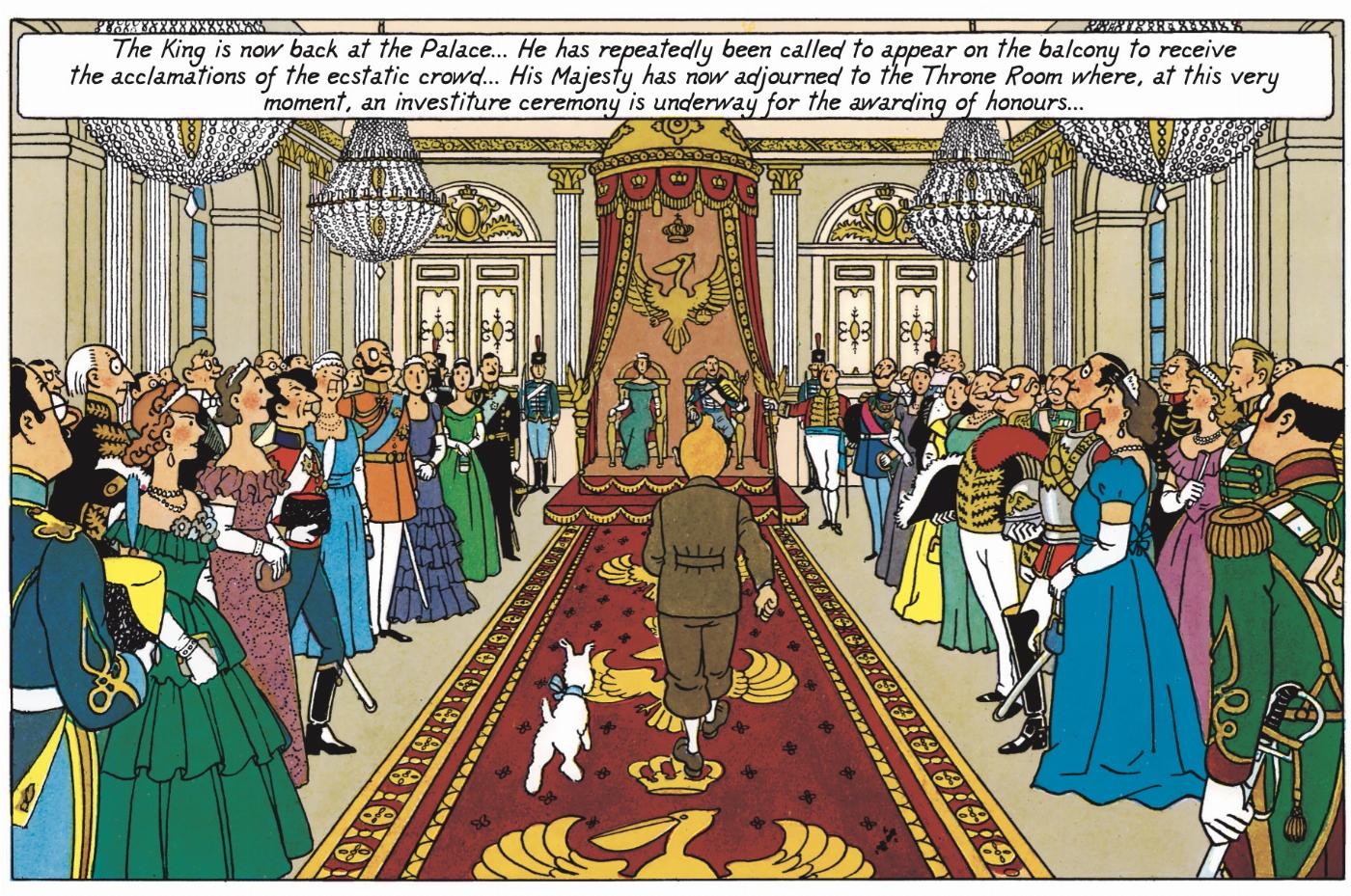
But hang on a moment – take a closer look at this crowd. Some of the faces don’t look Sylvdanian…
Because Hergé has slipped a few acquaintances into the crowd. And not just any acquaintances; yes, the cartoonist himself is hiding in the vignette, alongside several people from his circle of friends and family. Can you spot which ones?
The scene could simply be a solemn conclusion to the adventure. Hergé, however, takes the opportunity to have a bit of fun and discreetly transform the Syldavian court into a surprising gathering of close friends and family.
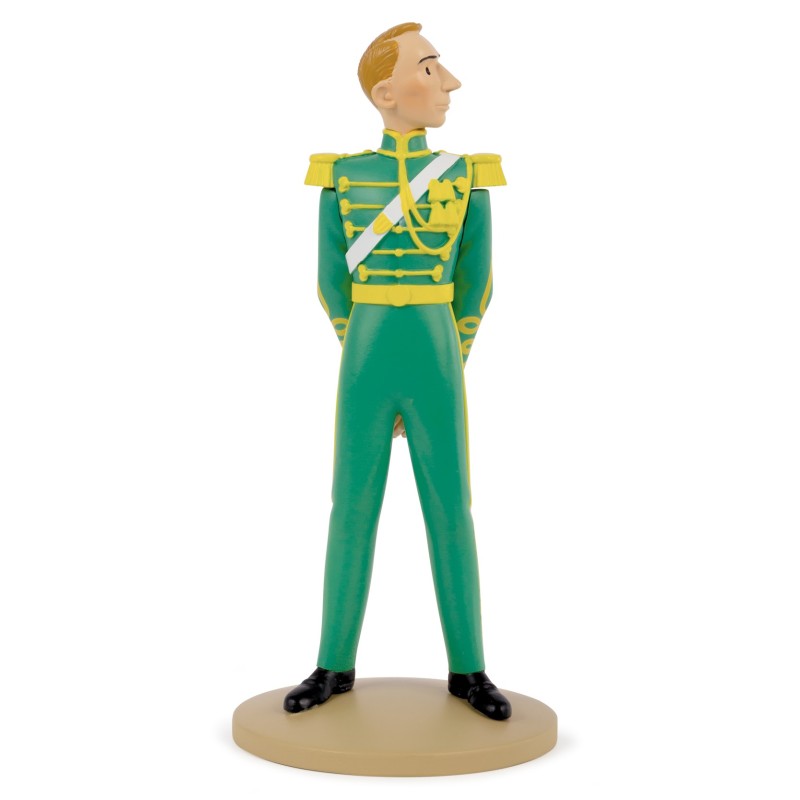
You may well have recognised him already. Look on the right-hand side of the vignette: the blond man in the green uniform, right next to Germaine – that’s him! His brother Paul Remi is standing beside him.
A few steps away stands Edgar P. Jacobs, recognisable by his black hair and, above all, his monocle. On the other side of the room, near the window, Jacques Van Melkebeke stands out with his blond hair and white bow tie. The scene features yet more familiar faces, from the painter Marcel Stobbaerts to Édouard Cnapelinckx, a friend of Hergé’s, depicted as an aristocrat on the left-hand side of the vignette.
Let’s face it, it’s a rather original way to secure an invitation to the royal palace. Yet this little gathering is not merely a joke. This isn’t the first time Hergé has borrowed faces from those around him and slipped them into his stories. In The Broken Ear, his own father-in-law had already served as the model for one of the characters. But never before had this practice taken on such a scale.
And, surprise, surprise, he doesn’t just do it once. Earlier in the story, when Tintin is arrested by the royal guards, Hergé and Edgar P. Jacobs already appear amongst the onlookers. This time, Hergé is once again wearing a green uniform and is standing on the far left of the vignette, alongside Jacobs, who is dressed in red.
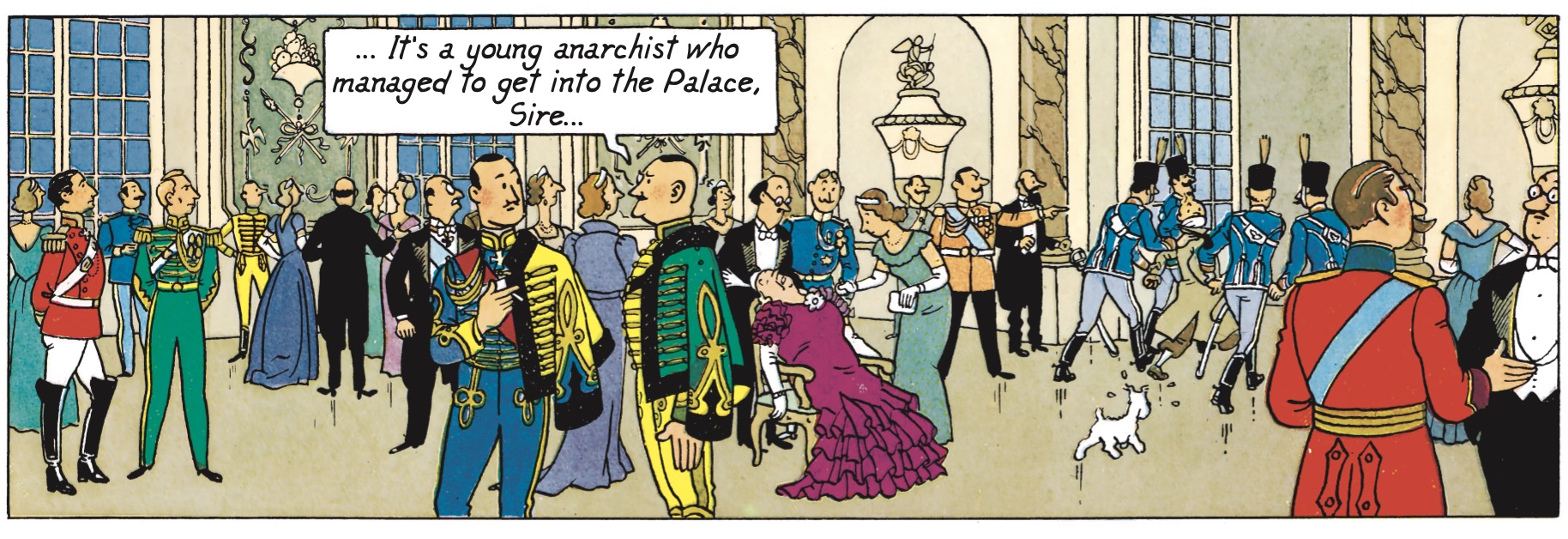
With two appearances in a single adventure, it’s fair to say that the journey to Syldavia certainly doesn’t go unnoticed.
Jacobs’s presence takes on even greater significance when one considers the production of the book. The first version was published in black and white on the eve of the Second World War. A few years later, when the older adventures were adapted to the new colour format, the task was a considerable one. The stories had to be shortened, the drawings redrawn and many of the backgrounds enhanced.
Hergé was no longer alone. From 1944 onwards, Edgar P. Jacobs played a part in this transformation. His work is particularly evident in King Ottokar’s Sceptre, the colour version of which was published in 1947. The landscapes, costumes and settings were reworked to reinforce the identity of this small imaginary kingdom. Jacobs notably contributed to ‘Balkanising’ certain elements of the adventure.
Behind these cameos lies one of the distinctive features of Hergé’s universe. The artist liked to blur the boundaries between reality and fiction. He borrowed aeroplanes, cars and buildings from the world around him, carried out meticulous research to construct his settings, and therefore has no qualms about borrowing faces either.vv
Syldavia lends itself particularly well to this, as it does not appear on any map, yet Hergé constructed it using a multitude of real-world references. Its landscapes are reminiscent of the Balkans, its history of Central Europe, whilst certain aspects of its monarchy are reminiscent of those of Belgium or the United Kingdom.
Why, then, would all its inhabitants have been imaginary? By placing his own face and those of his close friends and family in the courtyard of Muskar XII, Hergé ultimately reminds us that behind the imaginary Syldavia lies a little of his own world as well.
Texts and pictures © Hergé / Tintinimaginatio - 2026


