


 News
News Contest
 Forums
 Collectors
 Videos
 E-books
A new look-alike for the Arumbaya fetish
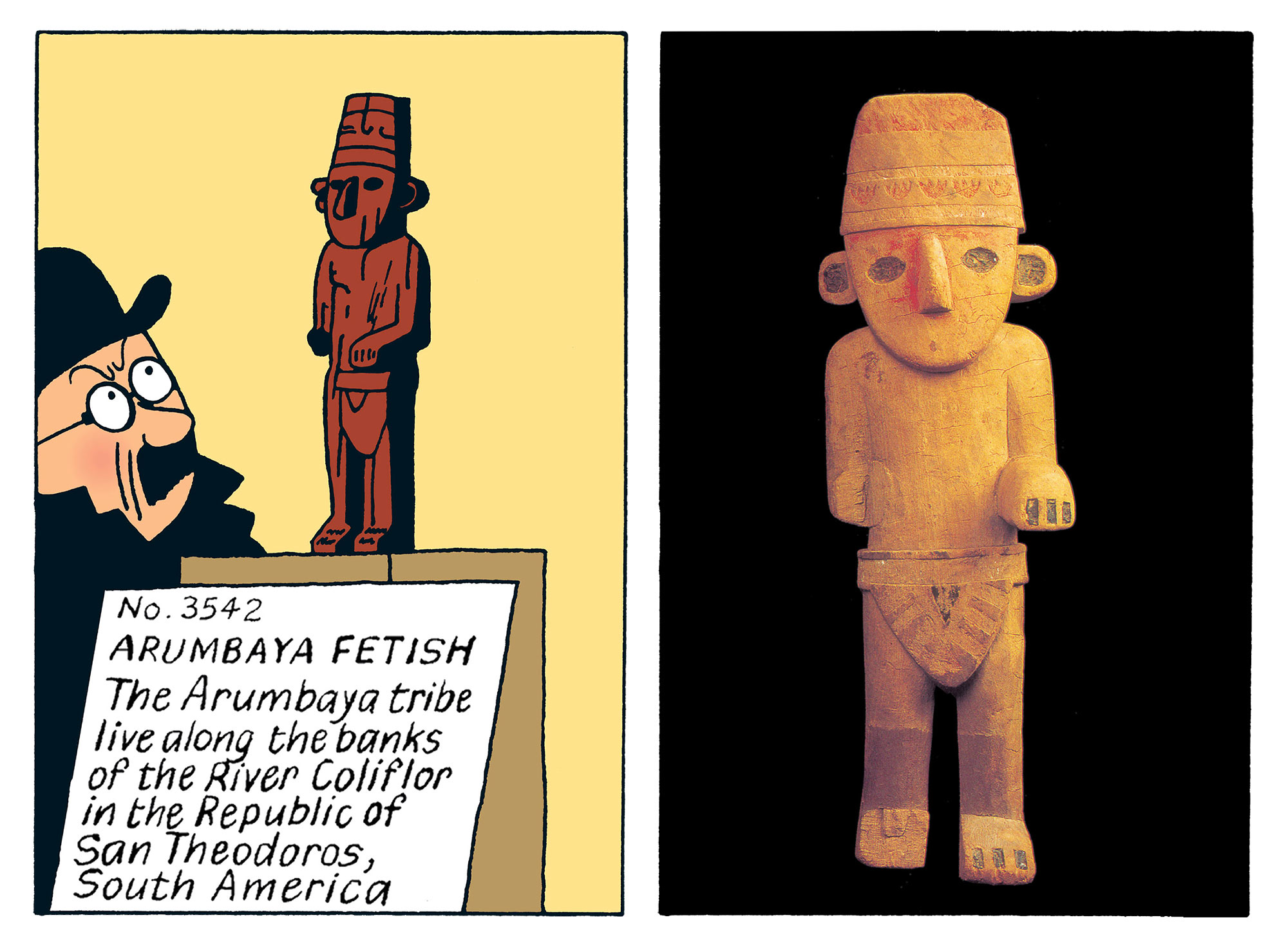
A sculpture with a flat, oval-shaped face painted red has been discovered at the Chan Chan archaeological site in northern Peru. If you are familiar with this description, you already know the mystery behind the fetish stolen in The Broken Ear, the thrilling chase that took Tintin to South America. Let's virtually embark on a journey to these regions to salute this beautiful discovery.
@ Hergé / Tintinimaginatio - 2026 © Royal Museums of Art and History
The Arumbaya fetish in The Adventures of Tintin, the object of all the envy, is in fact inspired by a pre-Columbian wooden statuette belonging to the collections of the Royal Museums of Art and History in Brussels. This statuette, intended as a funerary offering, is not actually related to an object from the Amazon region. It comes from the Trujillo region in northern Peru...
And as proof, a similar statuette was recently found in this region: "The archaeological site of Chan Chan, located a few minutes from Trujillo, is to this day the largest brick city in America. The city was founded in 850 AD and survived until 1470 AD, when it was conquered by the Inca Empire. A Peruvian treasure in which an incredible archaeological discovery was made. The Peruvian Ministry of Culture announced in a press release on Tuesday 28 June that a perfectly preserved wooden figurine had been discovered at the Chan Chan site.
The face of the sculpture is flat, oval-shaped and painted red, said archaeologist and head of the research unit Arturo Paredes Núñez. The figure wears a triangular skirt with small rectangular bands on the edge, similar to those on the hat. His legs are straight and his feet are spread out. The Ministry of Culture also stated that nectandra seeds (a tree in the Lauraceae family) were also recovered. It is believed that they were used to form a necklace.
More precisely, the figurine was found at the Huaca Takaynamo site, associated with the Chimú culture (12th and 15th centuries), in the Trujillo province of La Libertad department. Other wooden statuettes had already been found in the past at the site. This suggested to researchers that the archaeological site was used for religious or funerary purposes. "The discovery adds substantial evidence confirming the ceremonial function of the Chan Chan periphery. It enriches the knowledge around a World Heritage site", said project leader César Gálvez Mora. (GEO)

Discover the pictures of the new statuette:
- Au Pérou, on a retrouvé une nouvelle "oreille cassée" de Tintin !, par Johan Rennotte
- Une figurine en bois parfaitement conservée de la culture Chimu découverte au Pérou, par Claire Domenech


