


 Le Journal
 Concours
 Forums
 Collectionneurs
 Vidéos
 Livres (e-books)
Music boxes...
... or rather, ‘vignettes of music’! Because there's always a sound reference hidden somewhere in the Tintin books: a note here, an instrument there, when it's not Bianca Castafiore herself lyrically singing along. This month's thematic dossier provides the anthems of The Adventures of Tintin soundtrack.
Music, Maestro!
Hergé was a music lover. So it's hardly surprising that the character he created was one too, and that his adventures were set to music. Admittedly, we don't hear it that way... with our ears, but it's nevertheless there. Beautiful and well presented. Omnipresent, even. It's just that, instead of making it sound, Hergé created the illusion of it. So much so that his melodies can't be heard. They are seen. In this way, the artist engaged his readers in a synesthetic experience in which inaudible - but graphically present - sounds blend with the visuals to amplify the action.
Hergé was also a film buff. In fact, he knew full well - having experienced it himself, as a spectator - that the soundtrack is a narrative element in its own right. So he always wrote his ‘scores’ in the form of plots, with their share of bursts and modulations, so as to soundtrack the tensions and resolutions of his screenplays. Of course, his music also magnified the emotional power of his images. So it's a sensitive factor that makes us see, perceive and be moved.
Let's take a look at how Hergé masterfully ‘orchestrated’ the instrumentals that accompany the adventures of his young hero.
Highlights: the pillars of the action
For the cartoonist, music was above all a structural factor. He used it to punctuate key passages in his stories. So when he used it once or only occasionally in an adventure, it automatically accentuated and highlighted the action. This sudden eruption also created a surprise effect that coincided perfectly with the emotional state of the characters. This is the case, for example, in The Secret of the Unicorn, when a tune rings out through the partition - freshly pierced by Tintin - of one of the cellars in Marlinspike Hall. Both the young reporter and the readers immediately understand that the situation is about to change.
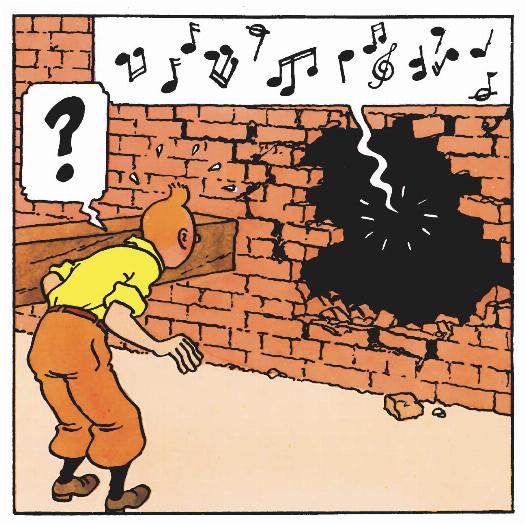
Obviously, Tintin is surprised by this unexpected melody, especially as it contrasts with the context. The melody is far from mysterious or worrying, as the situation suggests. As evidence of this, the notes that make up the melody bounce merrily inside the speech bubble that embodies it. The presence of eighth notes and triplets also reinforces the idea of a cheerful air. So there's no need to get dramatic to create mystery and strangeness.
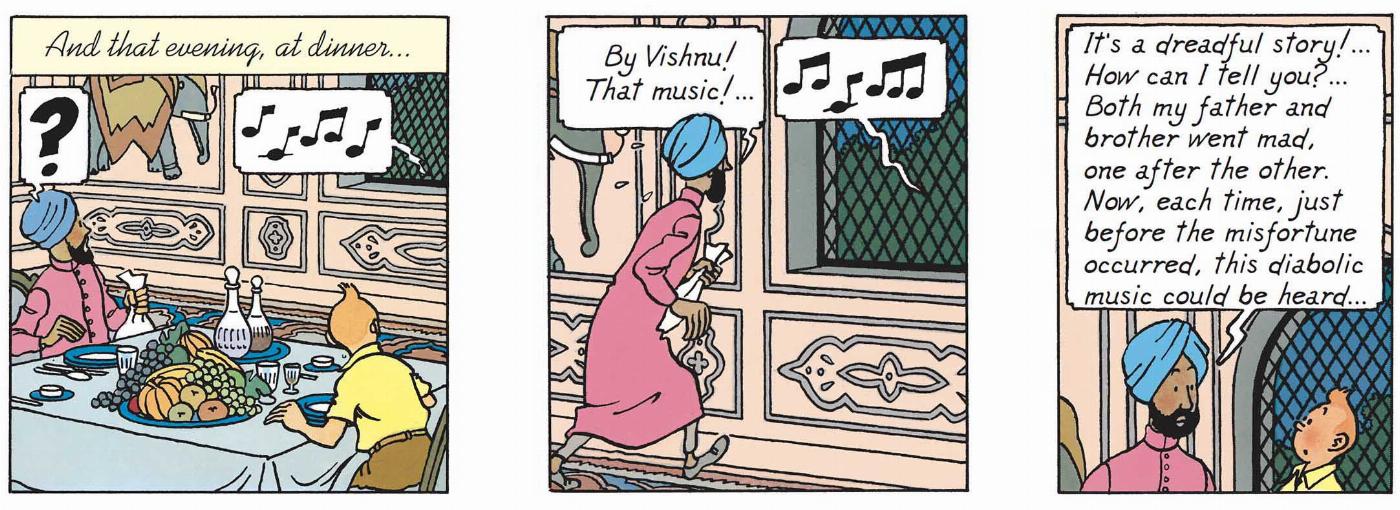
Another curiosity to be credited to the soundtrack of The Adventures of Tintin is the ‘diabolical’ music in Cigars of the Pharaoh. In his story, Hergé used this disturbing gimmick as a reminder that danger hovers - insidiously but recurrently - over the protagonists. Surprisingly, this characteristic pattern does not feature the same rhythmic figures. Unless Hergé is representing the different bars that make it up. For example, during the dinner between Tintin and the Maharaja of Gaipajama, it takes the form of a succession of eighth notes, eighth notes, sixteenth notes, eighth notes, while in the next frame it evolves into sixteenth notes, eighth notes, triplets. In both cases, however, the speech bubbles last two and a half beats.
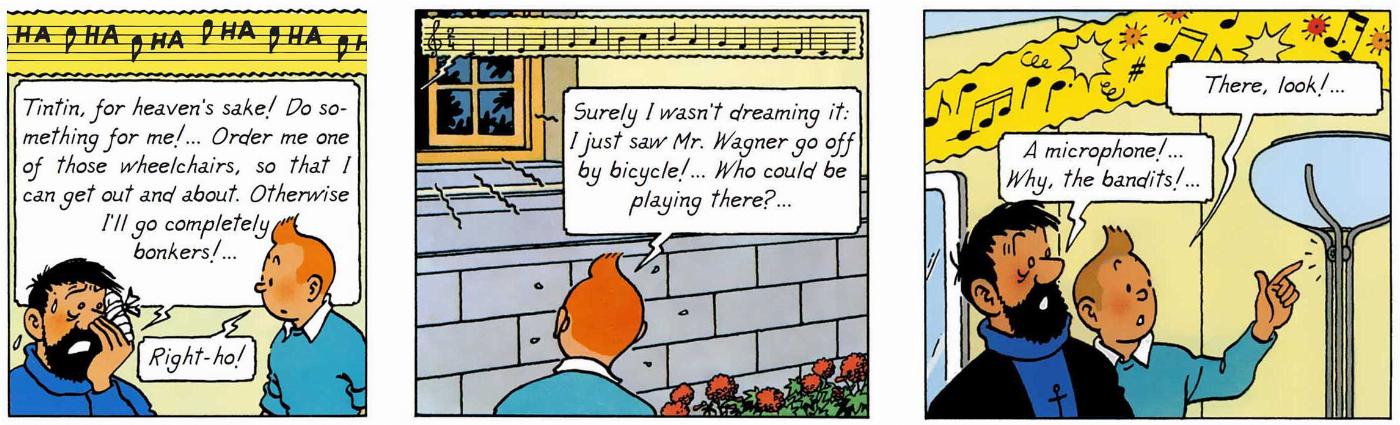
Hergé also sometimes used music as a sound mask to distract his characters and readers. This background noise is generally laid down in staves or coloured layers so as to encroach on the drawing and compete with the speech. This is the case, for example, in The Castafiore Emerald with the deafening singing of the Milanese diva and the exhausting C scale looped by her devoted accompanist, Igor Wagner. The latter also takes advantage of the system to slip away for a few hours to go and bet in the neighbouring village as if nothing had happened. In Tintin and the Picaros, Hergé used the same subterfuge, but this time he used it more to deceive the enemy (of the story) rather than the reader.
Weak moments: pauses and slowdowns
In music, as in fiction, rhythm is everything. In fact, to slow down the pace of the story a little, Hergé always interjected a few ‘breaks’ (a musical term for a break or brief interruption in the rhythmic flow of a piece) of his own. There's nothing like a musical interlude to help you catch your breath and get going again.
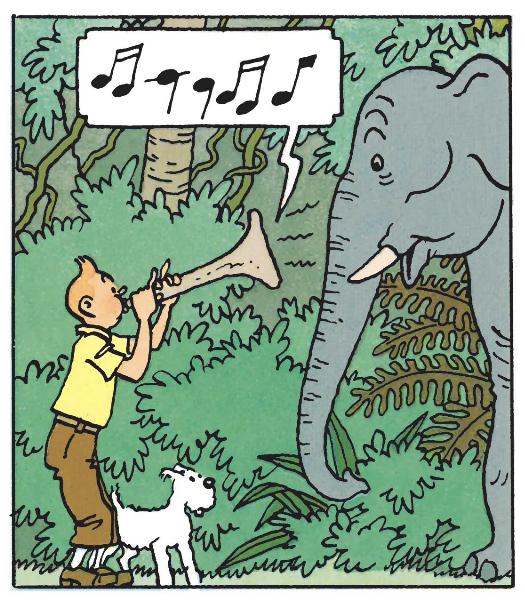
In Cigars of the Pharaoh, after a vertiginous aerial fall of several metres, Tintin allows himself a well-deserved break in the heart of the Indian forest. This salutary greening-up is an opportunity for him to try his hand at the trumpet. It's the only way he's found to converse with a peaceful herd of elephants. Why should he do this? Because music is a universal language, of course! So it can be understood by everyone, including animals. What's more, readers will discover - not without some humour - that the pachydermic dialect is in fact a simple combination of the degrees of the C major scale. So: ‘G, A, B, C means yes. C, B, A, G: no. (And that) ‘To drink’ is expressed by G, G, F, F", Tintin says.
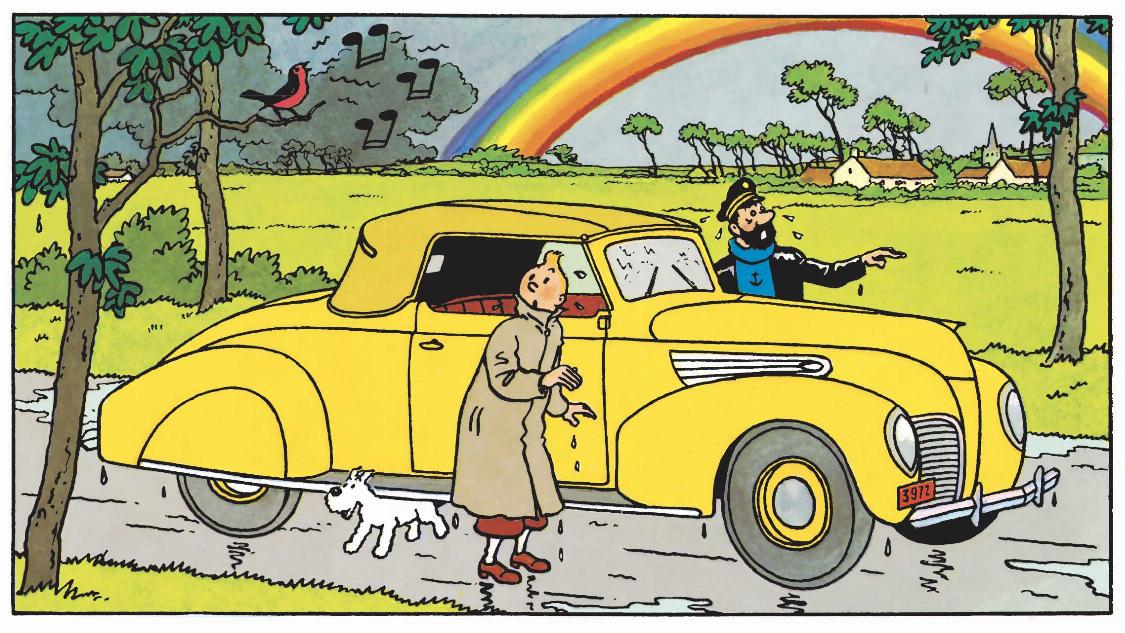
An immaterial expression by nature, Hergé's music wonderfully expresses another intangible dimension: the passing of time. In The Seven Crystal Balls, for example, this movement is reflected in a spontaneous meteorological recovery celebrated, as it should be, by a magpie... or rather, a singing peony bullfinch. An original way - obviously - of illustrating the popular adage that ‘after the rain, (always) comes the good weather’.
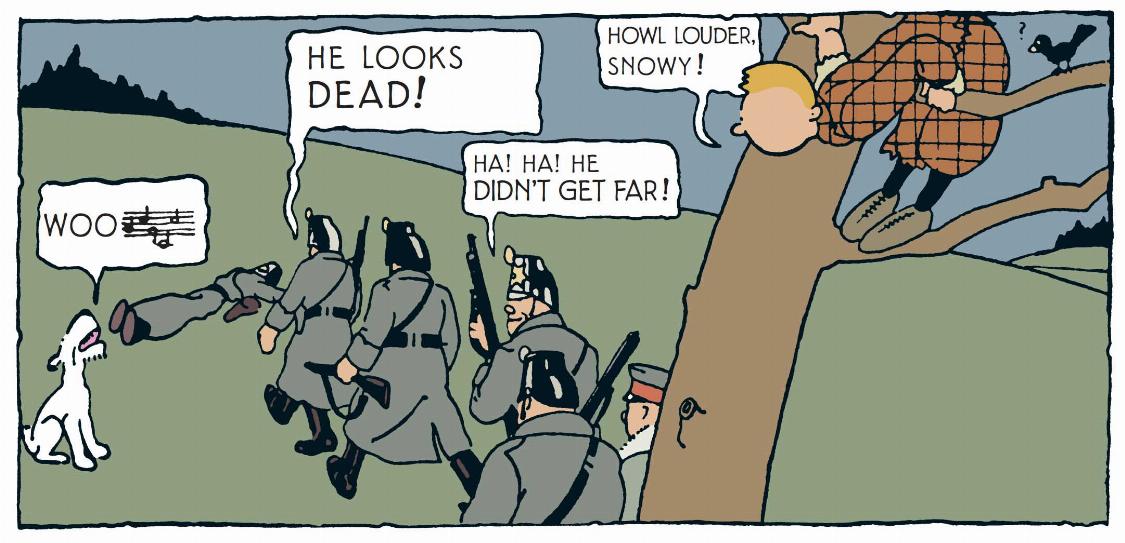
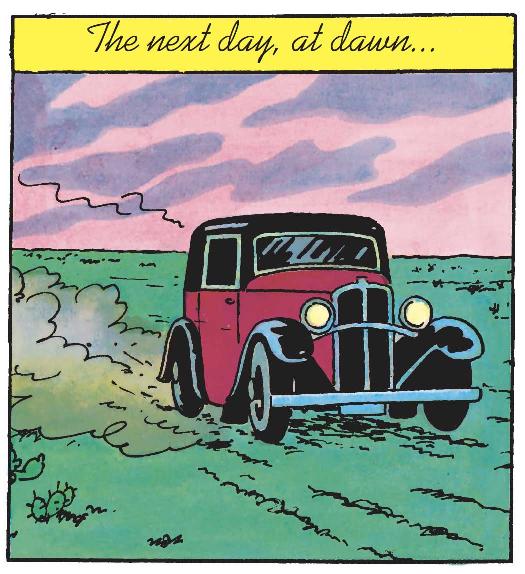
In the same spirit, in The Broken Ear, Hergé used alternating night and day scenes as a transition. It was an opportunity for him to create a composition worthy of a Western. In this case, a shot in which the hero drives off into the pampas, in a car, under a sun that is rising rather than setting. Naturally, a few notes float through the air to accentuate the picturesque character of the scene. Set to music in this way, the picture has nothing to envy of those that usually close The Adventures of Lucky Luke, the famous lone cowboy. The end is approaching, of course, but the time depicted here is not yet that of the denouement.
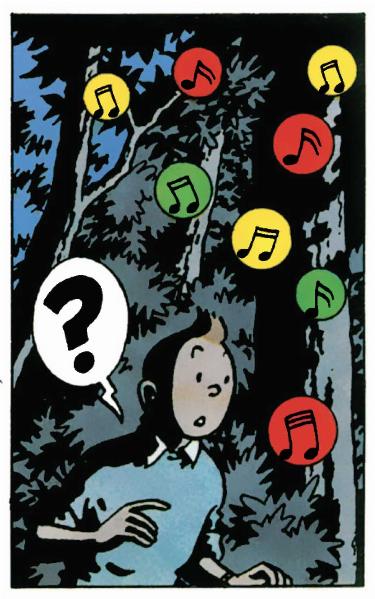
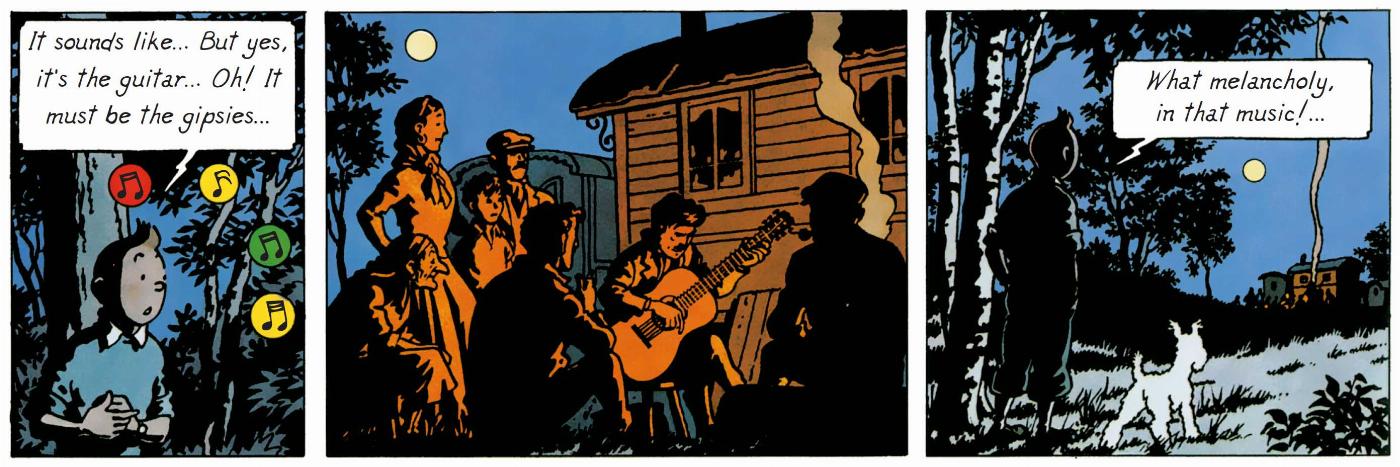
Renowned for softening the blow, Hergé used music to reinforce the hushed, intimate atmosphere of his quieter passages. This is particularly the case in The Castafiore Emerald, when Tintin and Snowy go for a walk in the woods by Marlinspike Hall, to escape the hustle and bustle of the mansion. Hergé accompanied this moment of respite with a ‘little night music’. In this case: a gypsy piece played on a single guitar. He drew coloured notes around his young hero to show readers how deeply he is touched by the harmony and accents of what he hears. Then nothing. Silence. As if the sight of this family gathered around a campfire was enough to convey the full force and intensity of the piece.
Setbacks: snags and impromptus
Hergé's music also struck a sensitive chord, giving his characters greater emotional and psychological depth. It's an original way of enriching their personalities and lending them a human nature that's as authentic as it is spontaneous.
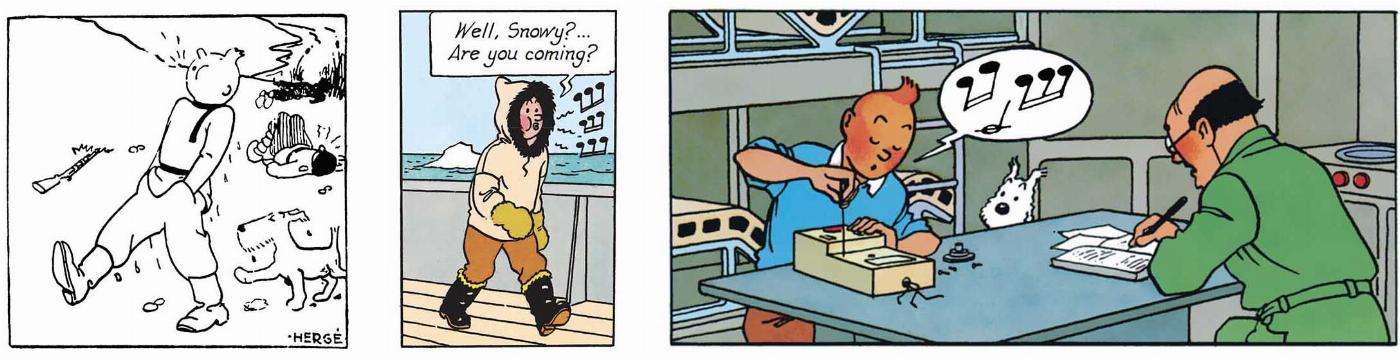
Right from the first volume of his adventures, readers discover that Tintin likes to ‘whistle while he works’, because in The Land of the Soviets he often indulges in this pleasant activity: to wait in the office of the People's Commissar (illustration plate 13,vignette C2 in the B/W edition), to show satisfaction at a rather successful change of outfit (illustration plate 16, vignette C2 in the B/W edition) and also to adopt a clear air after a misdeed (illustration plate 75, vignette2 in the B/W edition). In the other adventures, he makes this high-pitched sound to call his faithful companion to the rescue, as in The Black Island and The Shooting Star, for example, unless it's to tinker with the faulty radio in Explorers on the Moon.
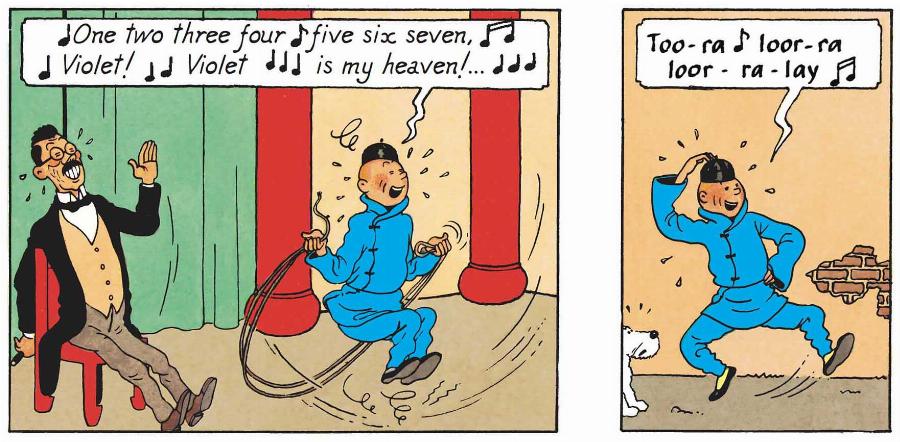
Singing, on the other hand, is generally the expression of a disturbed state. In The Blue Lotus, this is how Hergé expressed the madness of the characters who fell victim to poison darts. It's also very interesting to see how Tintin manages to get out of his predicament by faking a fit of madness. His performance is astonishingly realistic. It builds to a crescendo, as if the product is gradually taking effect. He intones light but understandable words, before eventually transforming them into an improvised scat: a succession of syllables and onomatopoeias.
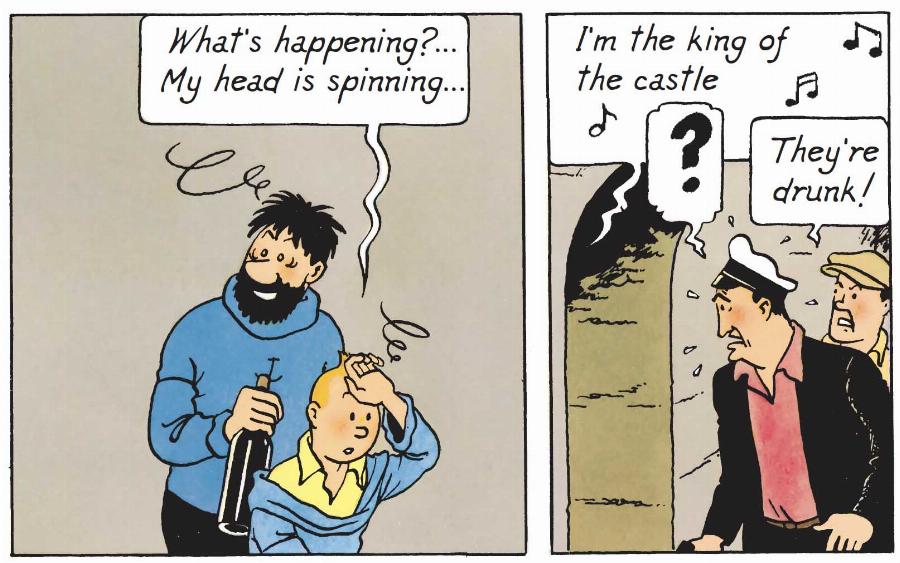
In the same way, Hergé did a great job of conveying the drunken state of his heroes. In fact, Tintin and Haddock are quick to raise their voices when they are both trapped in the cellar in The Crab with the Golden Claws. They rush to the bottles in the cellar, not to drink them but to throw them at their attackers. But that was without counting on the fact that the alcohol fumes were soon to invade this enclosed space and get up their noses.
Apart from these more or less transient ‘second states’, vocalised reactions are sometimes synonymous with pain. But only in very rare cases. No doubt because this is a cultural, poetic or even humorous manifestation of suffering. In any case, it's that voice... the path that the Asian torturer in Tintin in the Land of the Soviets uses when he falls flat on his nail-board.
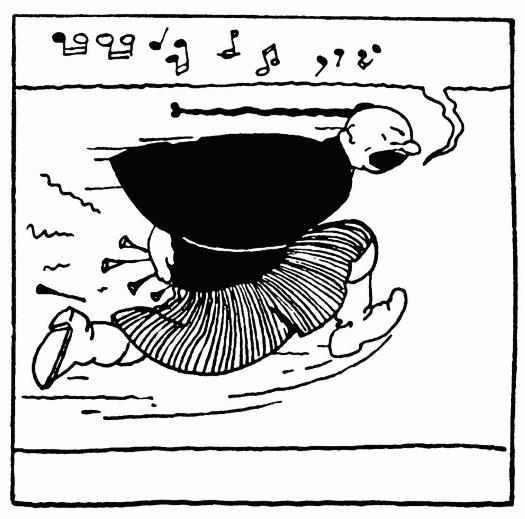
But rest assured, as soon as sensible words meet notes, it's a good sign. And that's what we'll be looking at in the next dossier.
Texts and pictures © Hergé / Tintinimaginatio - 2024


